The Chemistry, Medicine, and Alchemical Theories of the Emblems
What Maier Encoded in Fifty Allegorical Scenes
The fifty emblems of Atalanta Fugiens are not mystical free associations or arbitrary mythological illustrations. Each encodes a specific chemical or medical concept drawn from the alchemical textual tradition that De Jong has meticulously identified. To read the emblems as Maier intended, the modern reader must understand the chemical theories they encode and the source texts they reference — the Turba Philosophorum, the Rosarium Philosophorum, the Pseudo-Aristotelian Tractatulus, Senior's Tabula Chimica, and the other authorities that De Jong traces emblem by emblem.
Maier's Chemical Framework
The governing theory of the Atalanta Fugiens is the mercury-sulphur theory of metals, as transmitted through the medieval Latin alchemical corpus. All metals are composed of two principles: Mercury (the volatile, liquid, feminine principle) and Sulphur (the fixed, combustible, masculine principle). Gold is the metal in which these two principles are perfectly balanced and purified; base metals are imperfect combinations that can theoretically be perfected through the alchemist's art. This dyadic framework — not the Paracelsian Tria Prima of Mercury, Sulphur, and Salt — governs every emblem in the sequence, as Peter Forshaw has demonstrated. Atalanta is Mercury, Hippomenes is Sulphur, and their footrace is the alchemical work itself.
The medical dimension draws on the Galenic humoral system that Maier learned during his medical training at Basel. Disease is an imbalance of the four humors; cure involves restoring balance through purgation, diet, and pharmaceutical intervention. Maier's steam baths, washings, and digestive processes are simultaneously alchemical operations and medical therapies — as Walter Pagel demonstrated, the medical register is not metaphorical but foundational to Maier's understanding.
Each entry below identifies the chemical process encoded in the emblem, the source text that De Jong traces it to, the allegorical vehicle that carries the meaning, and the medical parallel where applicable.
Frontispiece
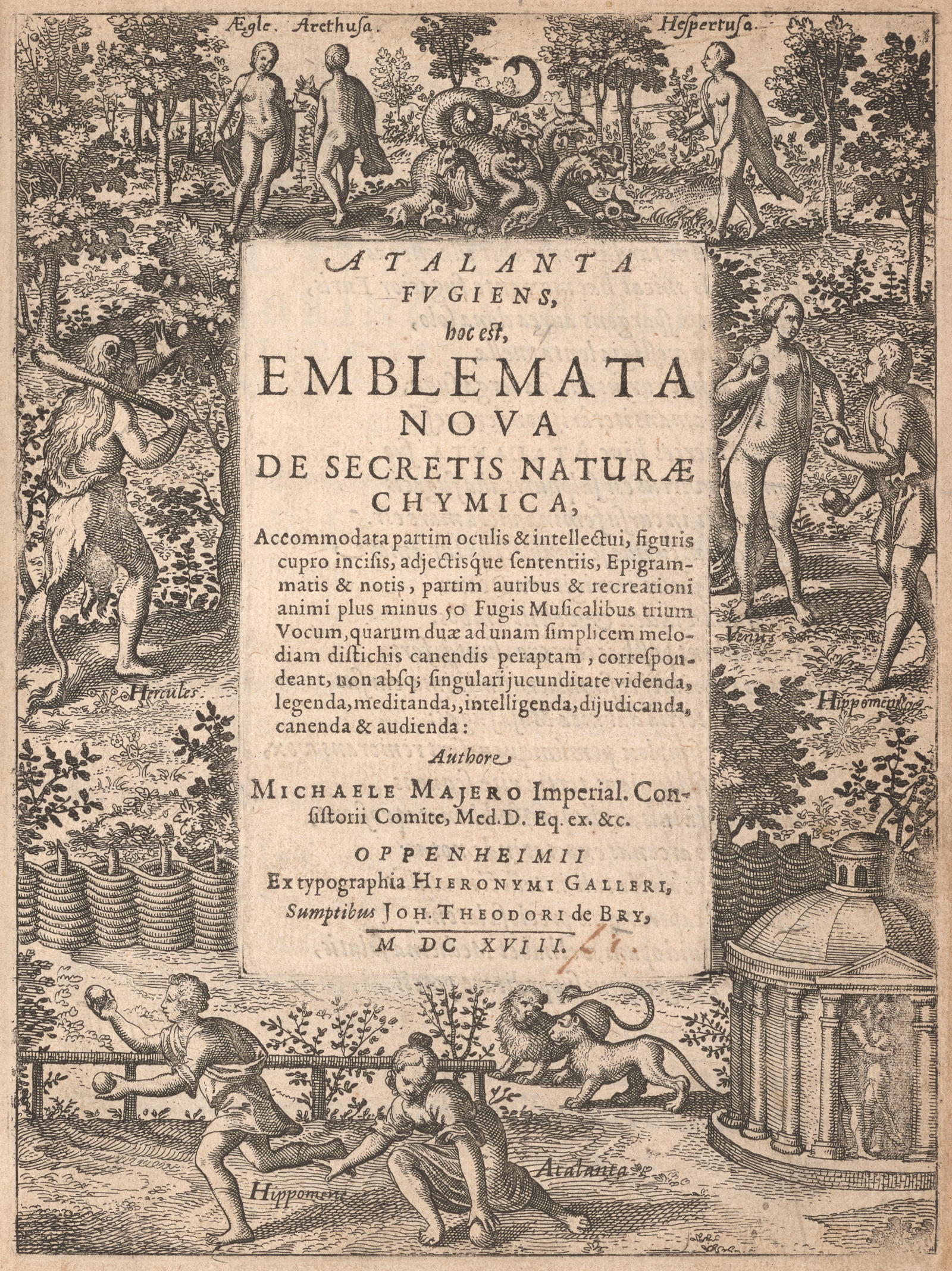
The frontispiece of Atalanta Fugiens is not merely decorative but encodes the chemical program of the entire work. The race between Atalanta and Hippomenes dramatizes the central problem of practical alchemy: how to fix volatile mercury. Atalanta represents quicksilver in its raw, fugitive state — a silvery liquid that evaporates when heated, refusing to be captured. Hippomenes represents sulphur, the fixed, fiery principle that must somehow bind the volatile substance into a stable compound. The golden apples that Venus provides are the catalytic agents of the art, the specific chemical techniques by which the practitioner slows the evaporation of mercury long enough to combine it with sulphur in the sealed vessel.
De Jong identifies Maier's source for this framing in the sulphur-mercury theory transmitted from the eighth-century Arabic alchemist Jabir ibn Hayyan through the Latin Geber. In this theory, all metals are composed of sulphur and mercury in varying proportions and purities. Gold represents the perfect equilibrium of these two principles. The alchemist's task is to reproduce this balance artificially, and the frontispiece announces that the fifty emblems to follow will teach how. The Garden of the Hesperides, depicted in the background with Hercules reaching for golden fruit guarded by a dragon, reinforces the point: the treasure (gold, the philosopher's stone) is guarded by a volatile, serpentine substance (mercury) that must be overcome through both strength and cunning.
The transformation of Atalanta and Hippomenes into lions at Cybele's temple, shown at the rear of the plate, signals the final stage: once the volatile and fixed principles unite, they become something new and powerful. Lions are traditional alchemical symbols for mature, activated chemical substances. The entire frontispiece thus maps a chemical narrative — from raw materials (fleeing mercury), through catalytic technique (the golden apples), to a stable, perfected product (the lions) — onto the beloved Ovidian myth, transforming a love story into a laboratory manual disguised as a game.
Emblem I
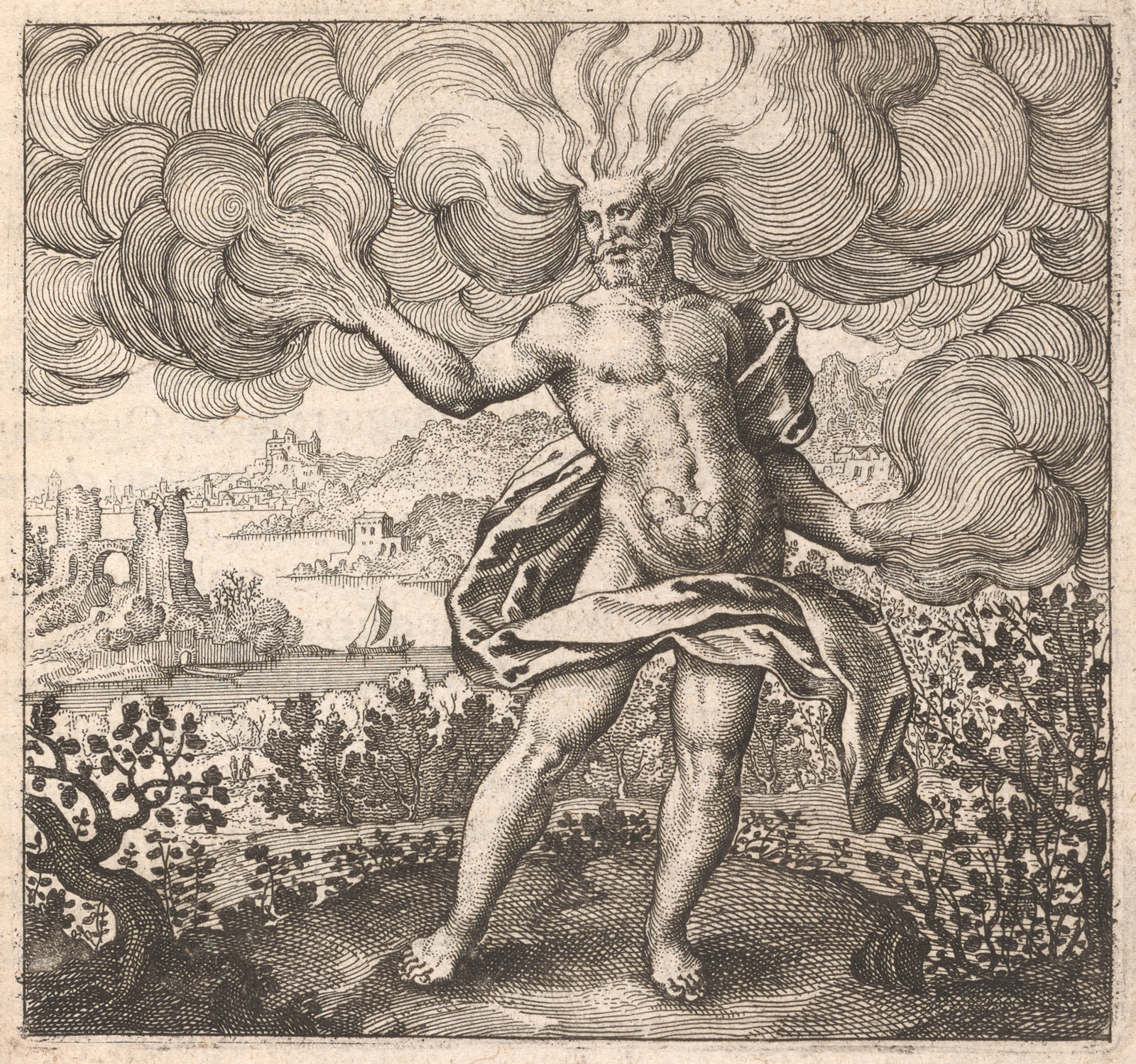
Emblem I takes its motto directly from the Tabula Smaragdina, the most ancient and authoritative text in the alchemical canon: "The wind carried him in its belly." In chemical terms, this describes the transport of sulphur within mercury vapor. When mercury ore (cinnabar, mercury sulphide) is heated, the mercury volatilizes and rises as vapor — the "wind" carrying the sulphurous seed within itself. The philosophical child gestating in the wind's belly is the potential for gold hidden within the volatile mercurial substance.
De Jong demonstrates that Maier draws on the pseudo-Lullian tradition where quicksilver (argent vive) serves as the prima materia from which all metals develop. The figure of Boreas, the North Wind, is an unusual male personification of mercury. His two sons — white-haired Calais and red-haired Zetes — encode the two terminal stages of the color process: the albedo (whitening, associated with silver and purification) and the rubedo (reddening, associated with gold and completion). That one son is winged and the other wingless introduces a contrast that recurs throughout the entire emblem sequence: the volatile substance that rises in the retort versus the fixed substance that remains at the bottom.
Maier reinforces this chemical content with references to the Argonauts and the Golden Fleece, connecting the quest for gold to the ancient tradition that Jason's expedition was itself an alchemical allegory — the fleece was supposedly a sheepskin on which the formula for transmutation had been inscribed. The pedagogical strategy is characteristic: by embedding the chemistry of mercury sublimation within a mythological adventure, Maier transforms a technical procedure into a memorable narrative that can be sung (the accompanying fugue), viewed (the engraving), and contemplated (the discourse).
Emblem II
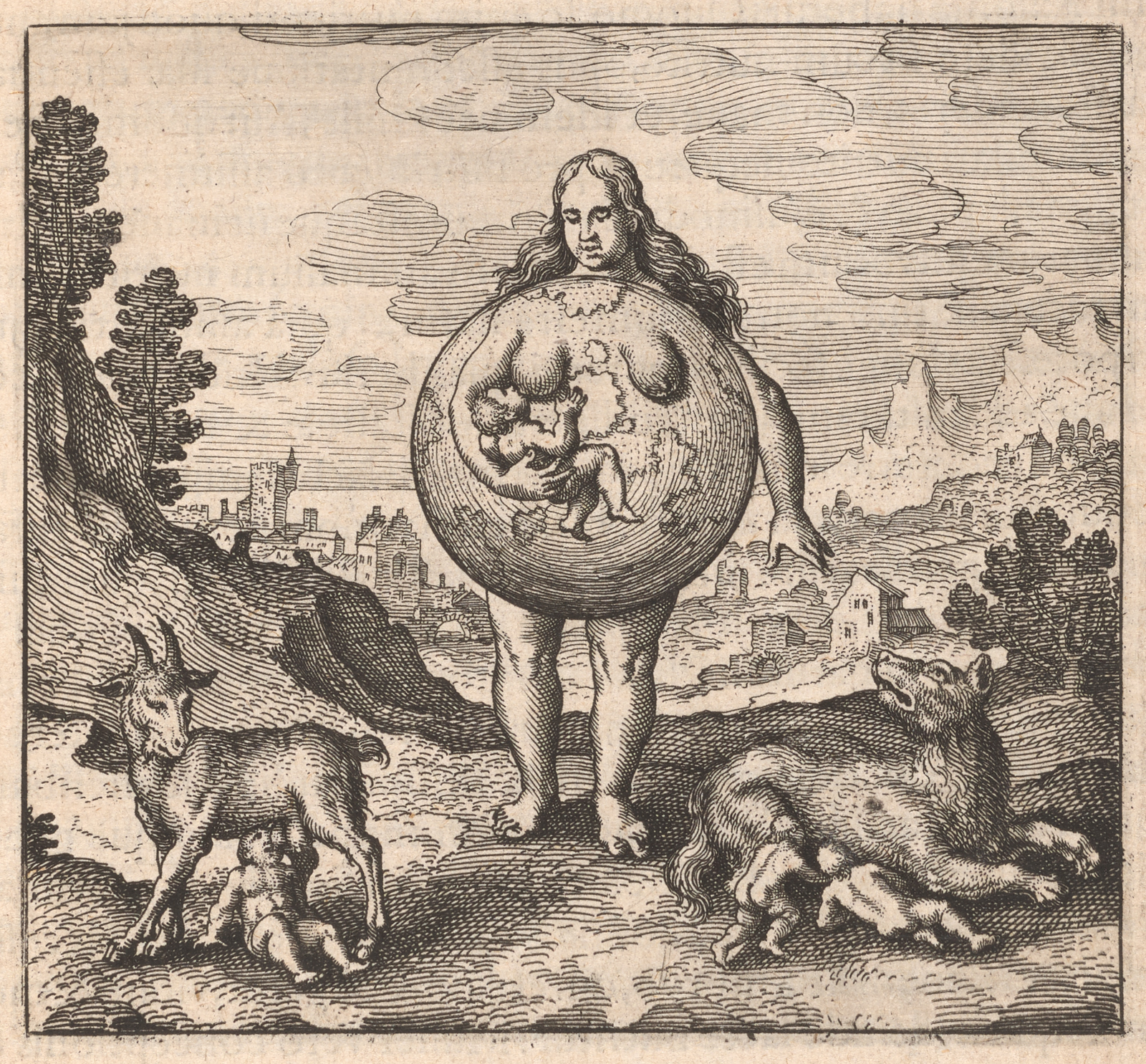
Emblem II continues directly from the Tabula Smaragdina: "Its nurse is the Earth." Where the first emblem described the volatile phase — mercury vapor carrying the sulphurous seed aloft — this emblem addresses the complementary process of fixation and nourishment. In a laboratory context, the philosophical child that was born in the air (vapor) must now condense and solidify. The earth "nurses" the substance by coagulating it, providing the matrix in which volatile spirits become fixed and stable.
De Jong shows that Maier uses this emblem to articulate a fundamental alchemical principle: the process in the retort is identical to the process in nature. Just as metals ripen slowly in the earth's interior over thousands of years — lead gradually maturing into gold through the action of subterranean heat — so the alchemist replicates this process in miniature within the sealed vessel. The retort functions as an artificial womb, the furnace provides the equivalent of solar warmth, and the earth element within the vessel coagulates, fastens, and colors the developing substance, turning it into "sap and blood."
The medical analogy is explicit in Maier's discourse: just as a mother's milk is the most beneficial nourishment because it transmits the mother's own substance and strength to the child, so the philosophical earth transmits its mineral essence to the developing stone. Physicians of Maier's era understood nourishment as assimilation — food changes into the substance of the one who is nourished. This Galenic principle maps directly onto the alchemical operation: the earth does not merely contain the philosophical child but actively transforms it, just as the body converts food into living tissue.
Emblem III
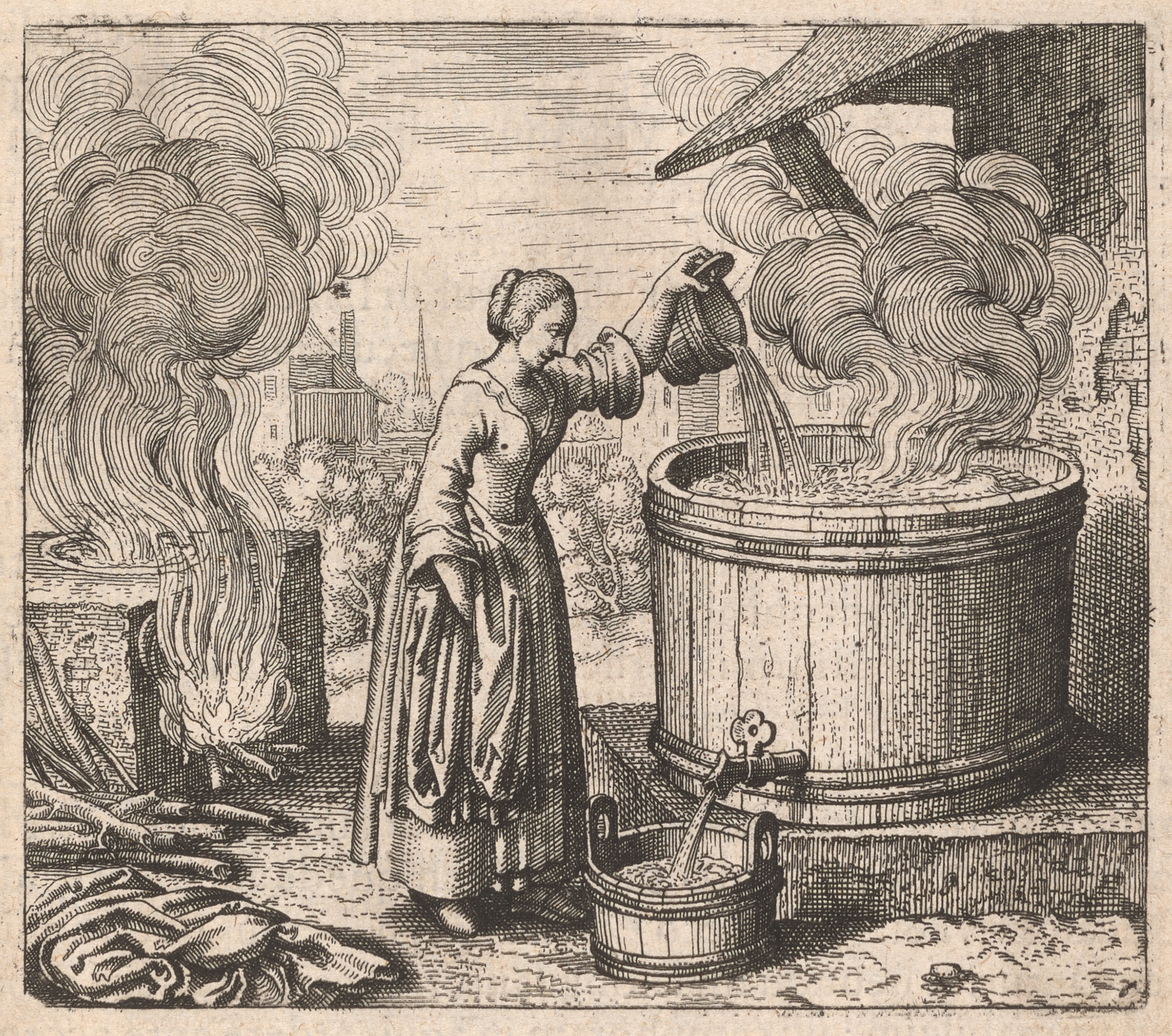
"Go to the woman who washes the sheets and do as she does." This motto, drawn from the Tractatus Opus Mulierum et Ludus Puerorum and the Turba Philosophorum, translates an entire complex of laboratory operations into a single domestic image. The washerwoman bleaching dirty linen represents the albedo — the whitening stage in which impure, blackened matter is purified. In practical terms, this encompasses calcination (heating to ash), dissolution (breaking down with water or acid), distillation, precipitation, and coagulation. De Jong emphasizes that Maier treats all of these as variations on a single theme: removing impurities from the base material to reveal its hidden purity.
The chemistry encoded here derives from ancient dyeing and metallurgical practice. Before a fabric could accept a dye, it had to be thoroughly bleached. Similarly, before a base metal could be transmuted toward gold, it had to be purified to whiteness — the stage of white lead or silver. The Pseudo-Aristotelian source and the Rosarium Philosophorum both describe this as washing with "philosophical water," which is not ordinary water but a specially prepared solvent (likely an acid or mercury solution) that penetrates the inner parts of the substance and dissolves its black, impure components.
De Jong identifies a critical medical dimension: the washing away of blackness extends to the treatment of Saturnian melancholy, the excess of black bile (atra bilis) that afflicts both metals and men. Lead belongs to the planet Saturn, which symbolizes coldness, inertia, and depression. The laundress's work thus prefigures Emblem XXVIII, where King Duenech is purified in a steam bath to cure his melancholic illness. The chemical, medical, and spiritual registers converge: purifying a metal alloy, curing a melancholic patient, and cleansing a soul stained by sin are presented as the same fundamental operation performed on different substrates.
Emblem IV
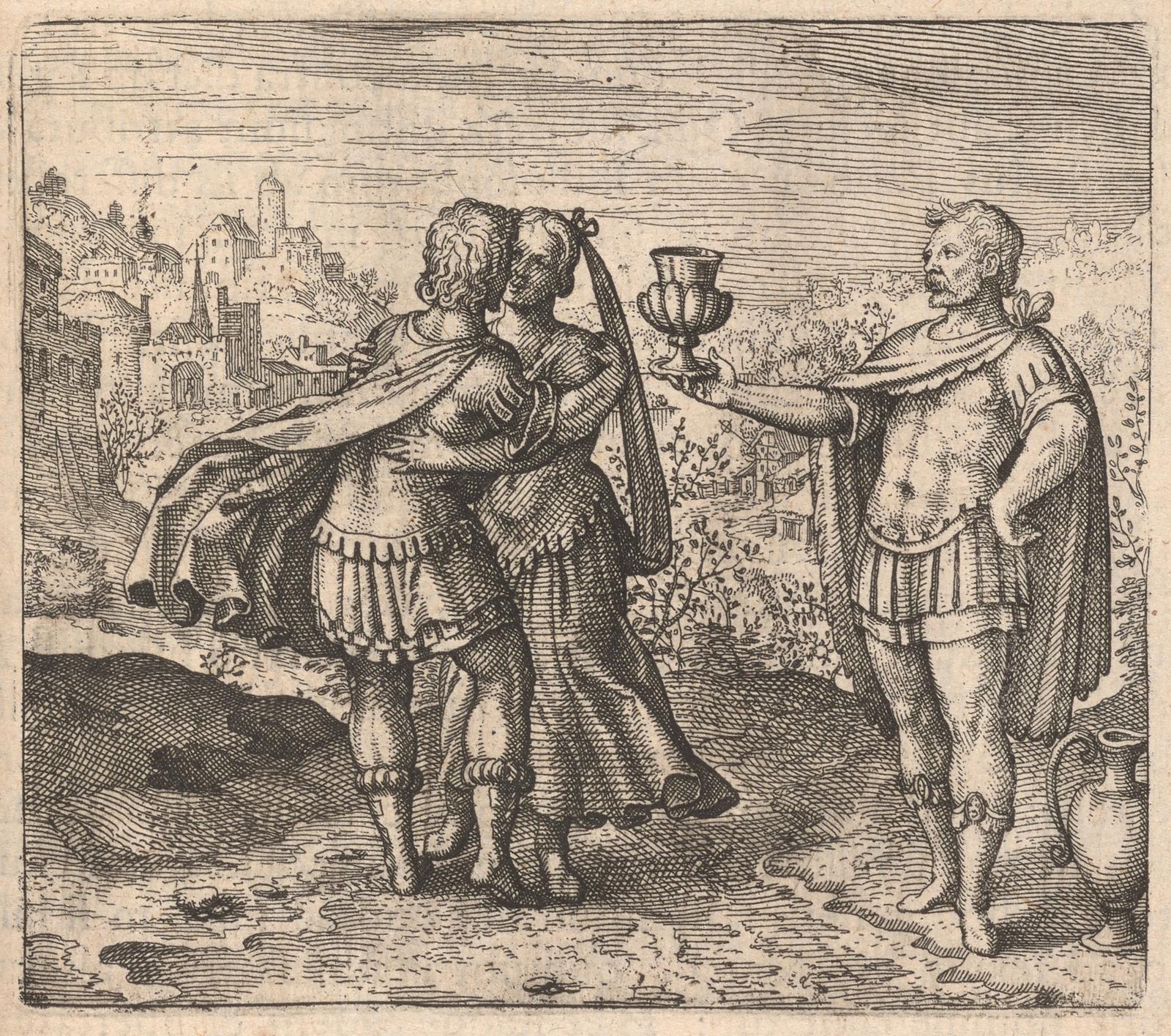
"Join brother and sister and give them the cup of love." This emblem dramatizes the coniunctio oppositorum — the union of chemical opposites that is the central operation of the Great Work. The brother, described as hot, dry, and choleric, represents sulphur and the element fire. The sister, cold, moist, and phlegmatic, represents mercury and the element water. Their marriage is not merely symbolic; it describes the actual combination of two reactive substances in a sealed vessel, where they must dissolve into one another to form a new compound.
The source is the Pseudo-Aristotelian Tractatulus de Practica Lapidis Philosophici, which describes the first stage in preparing the philosopher's stone: the dissolutio lapidis, the dissolution of matter into its primary components. The love potion is the solvent that enables this dissolution. As the source text specifies, one must "pour the honey-sweet liquid over them, till they are satisfied and disintegrate into extremely small pieces." De Jong connects this language to the atomistic theory of Leucippus and Democritus, suggesting that the alchemists conceived of dissolution as the splitting of combined atoms — a remarkably prescient intuition about the particulate nature of matter.
The Empedoclean framework is explicit: the opposing forces of love and hate between the elements drive all change in the universe. The love potion converts hate (the natural repulsion between fire and water) into love (their chemical combination). In Paracelsian medicine, this principle governed therapeutics: a physician balanced contrary humors by introducing their opposites in measured proportion, just as the alchemist balanced sulphur and mercury. The incestuous marriage — shocking to literal-minded readers — simply expresses the fact that the two substances being combined originate from the same primary matter and are therefore "related."
Emblem V
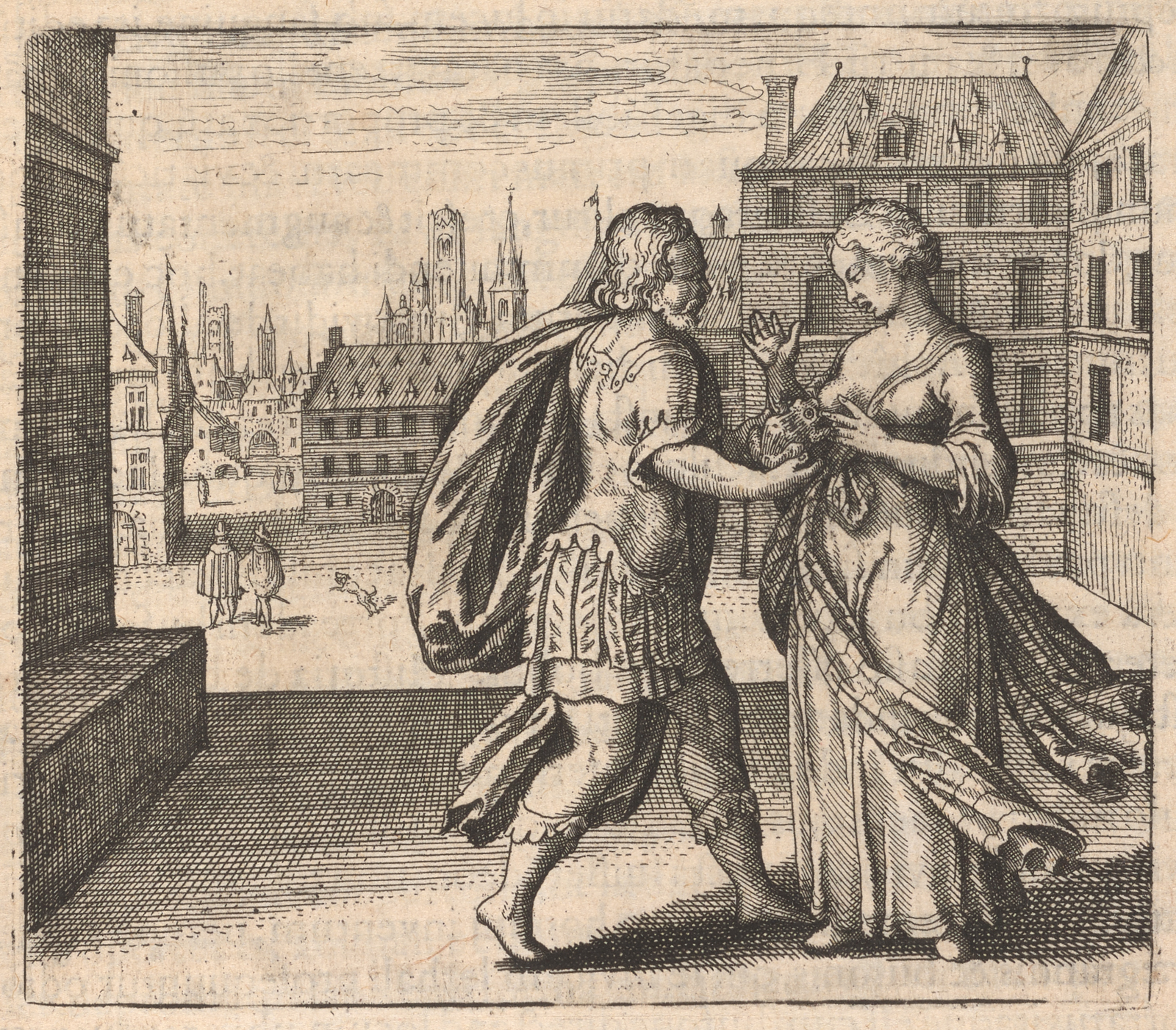
The grotesque image of a woman suckling a toad encodes a precise chemical operation: the addition of water to extremely dry earth. In the staged preparation of the philosopher's stone described in the Pseudo-Aristotelian source, the third stage requires making the purified, desiccated earth pliable by gradually adding moisture. The toad represents the element earth — cold, heavy, slow-moving, with its head turned toward the ground. The woman represents the element water. As the toad drinks the woman's milk (absorbs the water), it grows and solidifies, while the woman dies (the water is entirely consumed). This reciprocal process, coagulatio unius naturae non fit absque dissolutione alterius (the coagulation of one nature does not occur without the dissolution of another), is a fundamental axiom of practical alchemy.
De Jong traces the deeper significance through Maier's own heraldic device: a toad chained to an eagle by a golden chain. The toad (earth, base matter) is linked to the eagle (air, volatile spirit) by the catena aurea — Homer's golden chain by which Jupiter holds the entire universe together. This chain represents the circular course of the elements: earth transforms into water, water into air, air into fire, and fire returns to purified earth. The Lullian tradition that Maier cites describes this as a circular process willed by the Creator, connecting microcosm to macrocosm.
The medical content is equally specific. The motto instructs that a "noble medicine" should be made from the toad, "which drives the poison out of the human heart." This refers to the preparation of aurum potabile (drinkable gold) or the philosopher's stone as universal medicine. The toad stone (bufonite) was believed to be a powerful antidote to animal poisons. Maier transforms this pharmaceutical lore into an allegory of the entire alchemical project: the humble, despised earth contains within itself the potential for the highest medicine, just as lead contains the hidden nature of gold.
Emblem VI
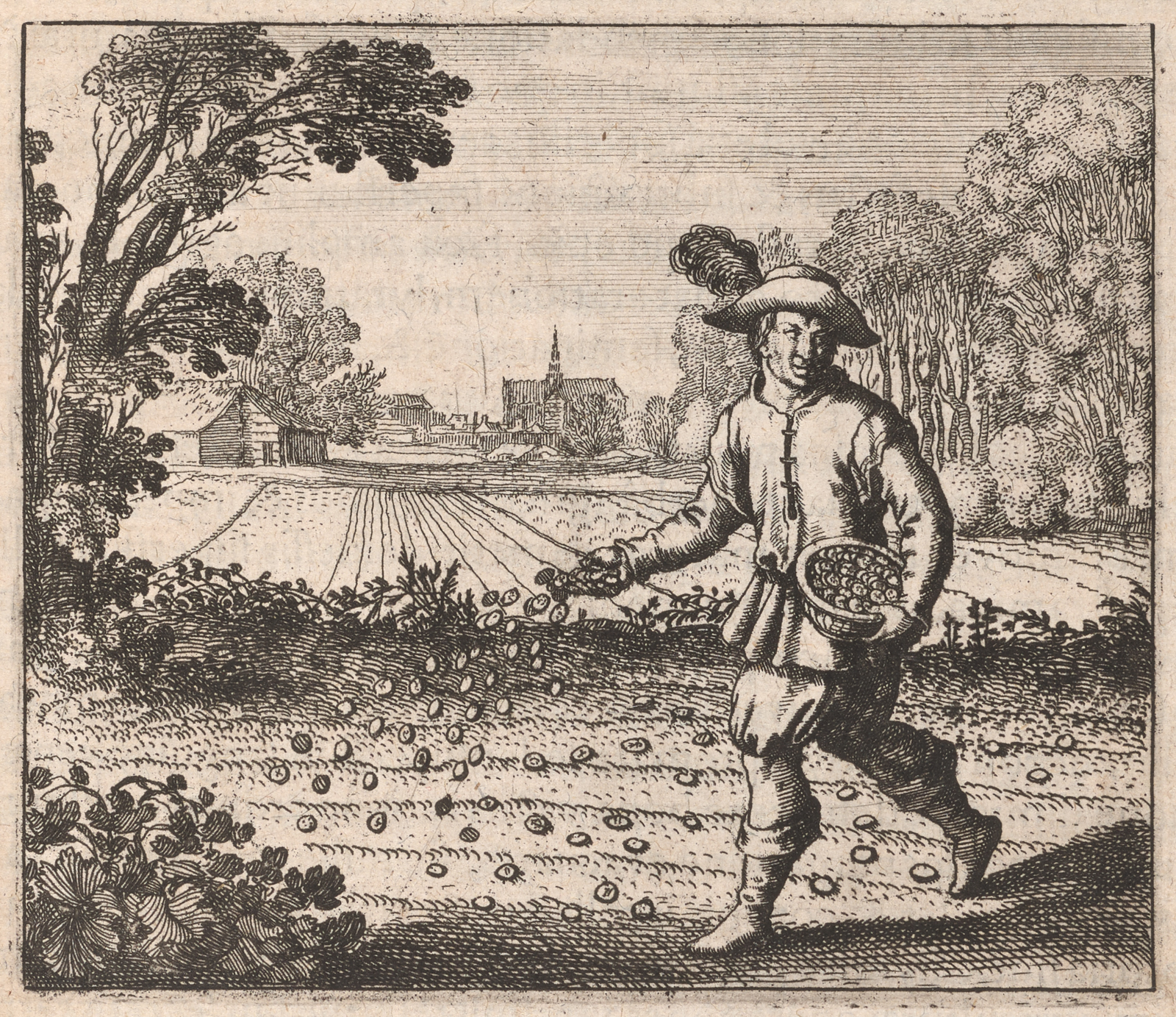
"Sow your gold in the white foliated earth" draws an extended parallel between agriculture and metallurgy. The farmer sows seed in ploughed, fertilized soil and waits for sun and rain to produce a harvest. The alchemist sows gold (or a gold-bearing tincture) in purified, whitened earth (the matter that has passed through the albedo stage) and applies regulated heat and moisture to produce an increase. De Jong notes that in Maier's engraving, the seeds the farmer scatters are deliberately shaped like coins bearing the alchemical sign for gold — a circle with a dot in the center — making the parallel visually explicit.
The sources for this emblem include Pseudo-Aristotle, the Clangor Buccinae, and the Rosarium Philosophorum. The chemical operation described is the introduction of a coloring vapor into purified white matter. This originates in ancient dyeing and metalworking practice: metals that needed to change color were exposed to metallic vapors that precipitated on their surfaces. Over time, alchemists reinterpreted surface coloring as thorough internal transformation. The "white foliated earth" is matter that has been reduced to thin, leaf-like flakes through repeated washing and calcination — maximizing its surface area so that the gold-bearing vapor can penetrate fully.
The Rosarium Philosophorum extends the meaning into spiritual territory: the soul, descending from the clouds into the purified hermaphrodite lying on a tomb, represents the reintroduction of the volatile principle into the fixed. Death and resurrection serve as symbols of the transmutation process — the grain of wheat that must die in the earth before it bears fruit, as Christ himself taught. De Jong demonstrates that Maier deliberately interweaves chemical, agricultural, and Christological imagery, presenting the ripening of gold in the earth's interior, the germination of wheat, and Christ's salvific death as parallel expressions of a single natural law.
Emblem VII
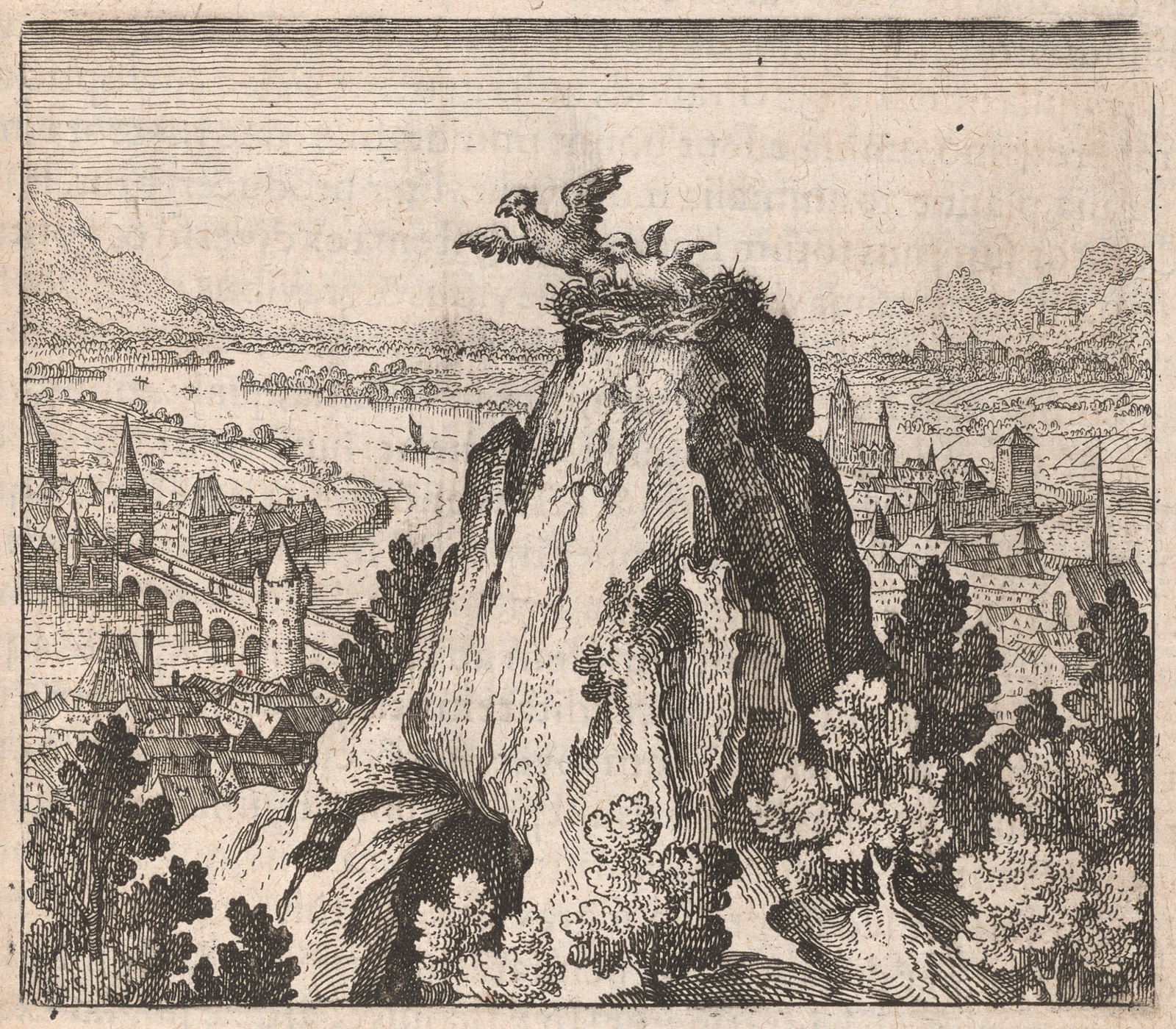
A young bird flies from its nest and falls back again. This emblem illustrates the struggle between volatile and fixed components during distillation. When a compound is heated in a retort, lighter elements (fire and air) rise as vapor while heavier elements (earth and water) remain at the bottom. The winged bird represents the volatile fraction attempting to escape; the wingless bird represents the fixed fraction that holds it back. In practical terms, this describes the repeated sublimation and condensation of mercury: the substance rises, condenses on cooler surfaces, and falls back into the vessel.
The primary source is Senior's Tabula Chimica, a Latin translation of the tenth-century Arabic alchemist Mohammed ibn Umail, supplemented by Lambsprinck's De Lapide Philosophico. Both texts describe two birds — one winged, one wingless — connected head to tail, forming a ring. This ouroboric image represents the goal of the operation: to bind the volatile and fixed principles so tightly that they cannot be separated. The alchemist's task, as Maier's discourse explains through Hippocratic analogy, is to achieve a composition as stable as gold or diamond, in which the element earth binds all other elements permanently.
De Jong identifies three grades of elemental composition: substances like camphor, where fire and air predominate and the matter evaporates completely; substances like gold and glass, where elements remain bound even in intense fire; and ordinary combustible matter, where elements separate into ash and vapor. The alchemist must produce the second type — a composition so firm that neither component can escape. The medical parallel is the Hippocratic understanding that disease arises from imbalanced humors: just as the body requires equilibrium between its fluids, so the philosopher's stone requires perfect balance between volatile and fixed.
Emblem VIII
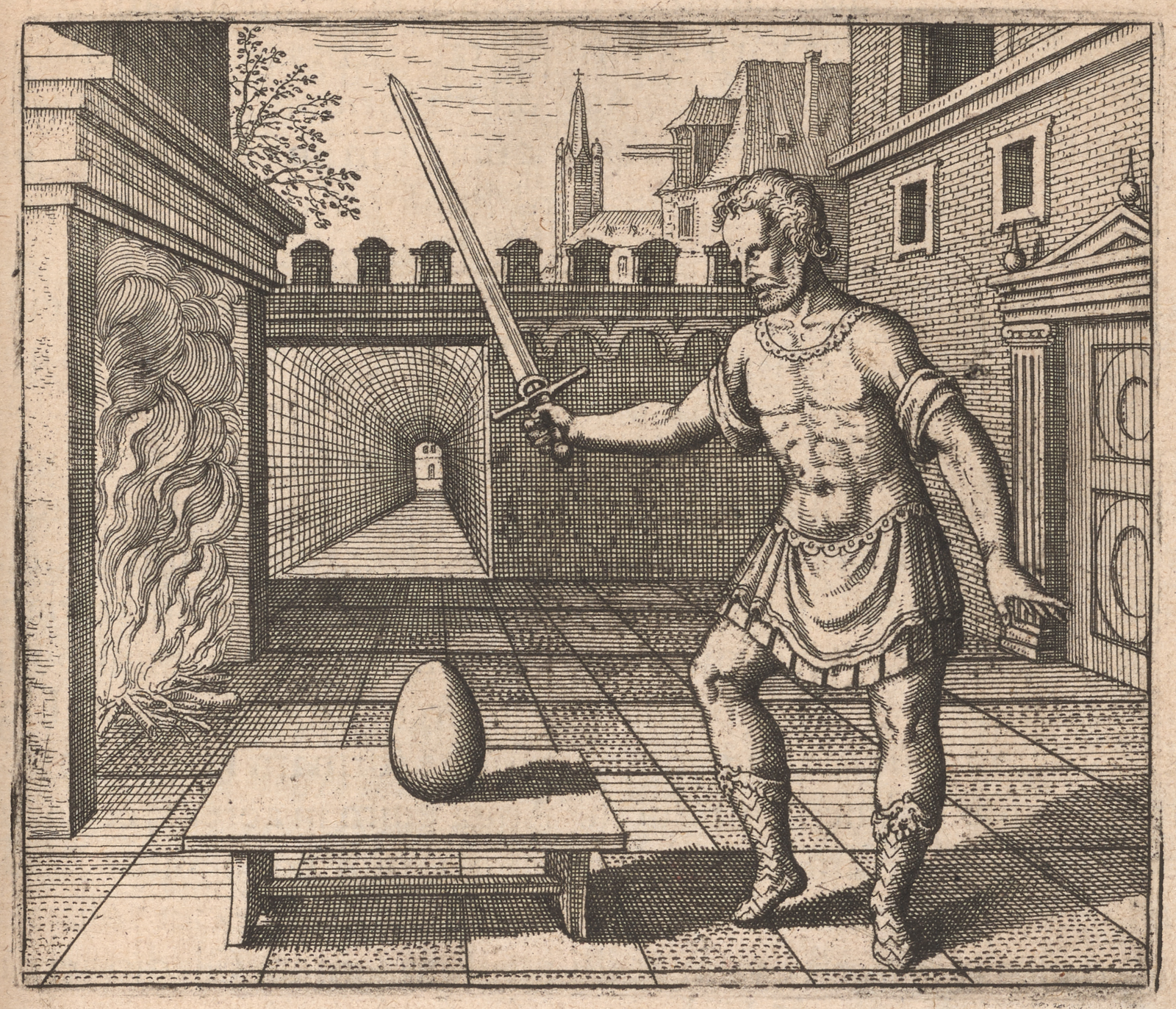
"Take the egg and pierce it with a fiery sword." The philosophical egg is the sealed retort containing the prima materia, and the fiery sword is carefully regulated heat. De Jong traces this image to the Turba Philosophorum, where the philosopher Pandolphis explains the egg as a model of the universe: the hard shell is earth, the albumen is water, the inner membrane is air (separating earth from water), the yolk is fire, and the membrane around the yolk is the finer air separating fire from water. The solar point at the center of the yolk is the bird — the living product that will emerge from the completed process.
The chemical operation is straightforward: the sealed vessel must be heated at precisely the right temperature — not so hot as to destroy the contents, but hot enough to initiate the internal transformation. Maier cites Morsoleus from the Turba: the first moisture should be expelled by burning in a gentle fire, just as a hen hatches an egg. When the fire is intensified, the vessel must be well closed to prevent the volatile spirits from escaping. The Lullian tradition calls this the fiery sword or sharp lance, because fire pierces bodies and makes them porous, allowing water to penetrate and dissolve them.
The egg also carries cosmological significance inherited from Babylonian and Egyptian creation myths. The god Khnum formed the universe from an egg emerging from his mouth and shaped men as a potter shapes clay on a wheel (anticipating Emblem XV). In the Christian reading that De Jong documents, the egg-vessel is simultaneously the womb of the Virgin Mary, in which the Filius Macrocosmi (Christ) gestates. Maier's emblem in the Symbola Aureae Mensae depicts Mary nursing the Christ child with the motto: "The Stone should be fed, just as a child, with milk of a Virgin." The chemical vessel, the cosmic egg, and the sacred womb are all the same thing seen from different registers.
Emblem IX
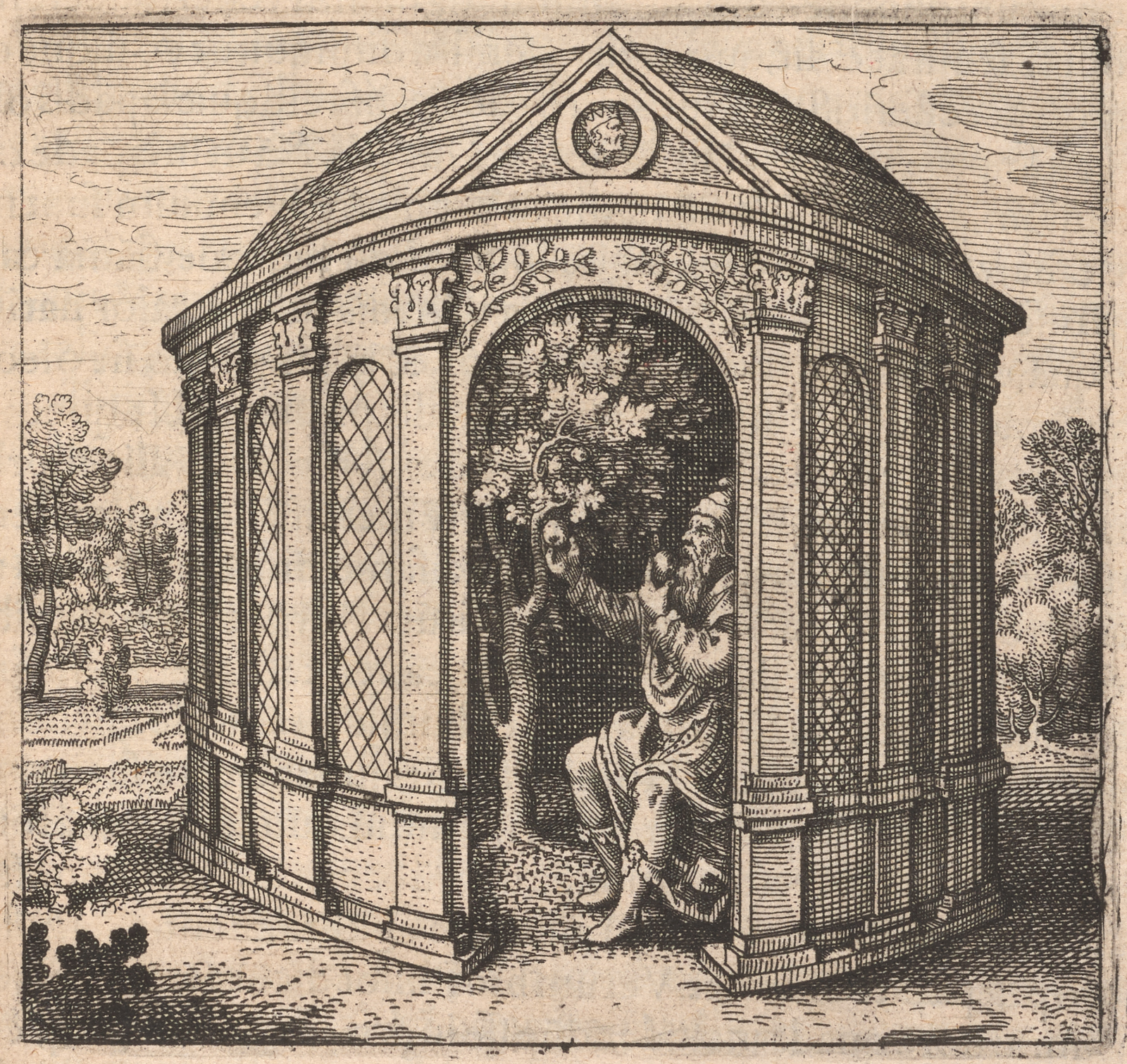
The old man locked in a glass house with a tree, eating its fruit until he becomes young again, encodes the distillation of mercury from cinnabar ore. De Jong makes a remarkable identification: Maier's illustration closely resembles a picture from Agricola's De Re Metallica (1556) showing a round, vaulted distilling room used for mercury extraction. In Agricola's image, a furnace heats mercury ore, causing mercury vapors to rise and condense on the foliage of a tree placed inside the room. Maier has transformed this industrial metallurgical scene into an allegorical narrative drawn from the Turba Philosophorum, where Balgus describes the procedure as an old man rejuvenating himself by eating the tree's fruit.
The chemical reality is the union of sulphur and mercury: the old man represents sulphur (the fixed principle, white with age) and the tree represents mercury (the volatile principle, bearing condensed droplets like fruit). The glass house that must be "wet with dew" is the retort filled with mercury vapors that precipitate like dew on the tree's branches. The old man's rejuvenation — turning from white to red — represents the color change from albedo to rubedo that signals the successful completion of the transmutation. As the alchemists state: "The Stone is an old man on account of its whiteness, a young man on account of its redness."
De Jong connects the tree of Emblem IX to the broader arboreal symbolism running through Atalanta Fugiens: the tree bearing gold apples in the Garden of Wisdom (Emblem IX epigram), the Tree of Life in Emblem XXVI, and the locked rose-garden of Emblem XXVII. In Maier's Symbola Aureae Mensae, he depicts trees bearing fruit shaped as suns and moons, watered by Saturn — the humble first stage from which perfection eventually arises. The rejuvenation of the old man parallels the purification of humanity through Christ's sacrifice: the old Adam becomes the new Adam, the red color of the philosopher's stone corresponds to the rose-red color of salvific blood.
Emblem X
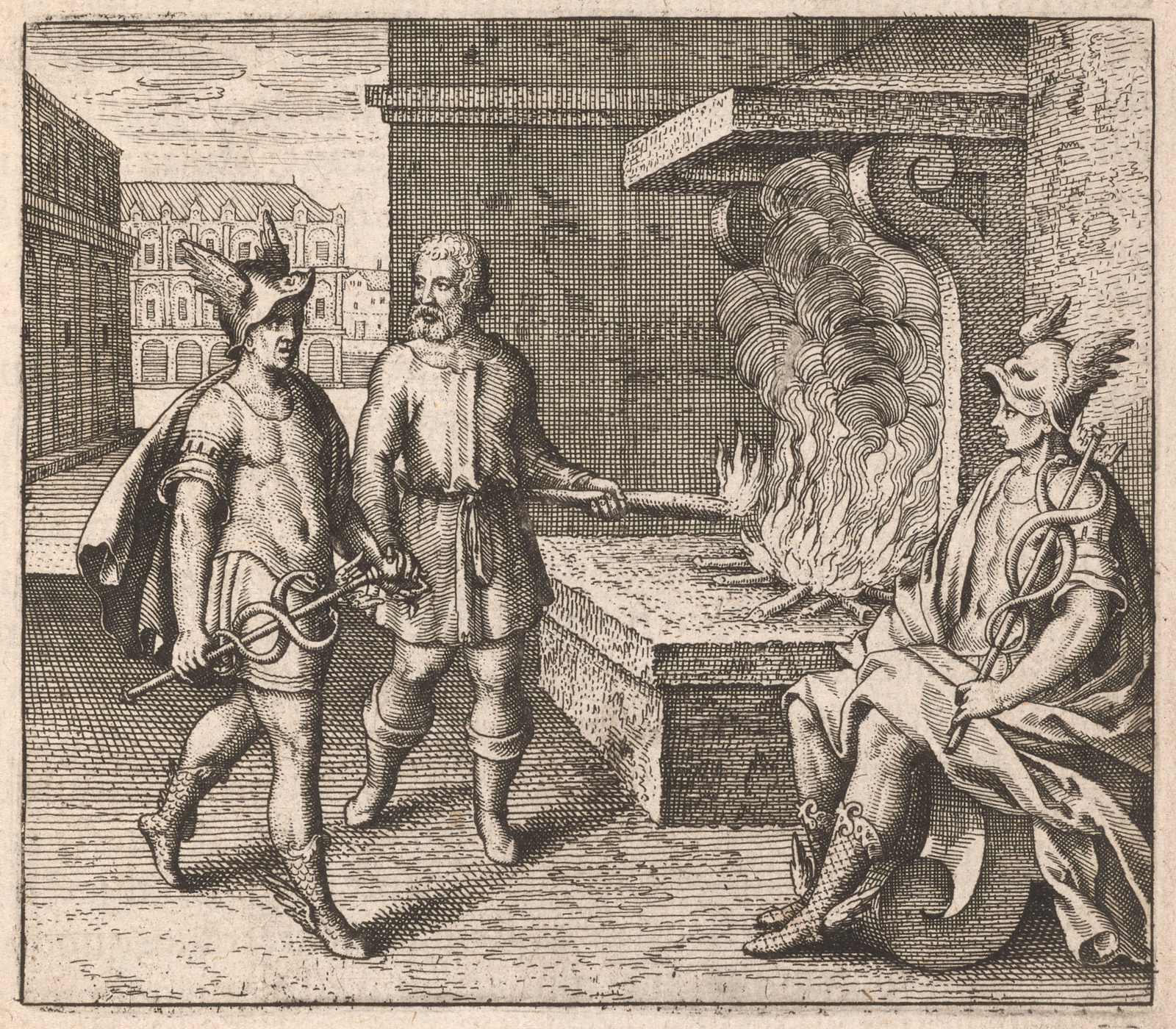
"Give fire to fire, Mercury to Mercury, and that is enough for you." This motto, from the Aurora Consurgens, articulates the sulphur-mercury theory as a practical laboratory instruction. There are two fires: the inner fire inherent in the philosophical subject (the latent heat within the matter itself) and the outer fire applied by the furnace. There are likewise two mercuries: the philosophical Mercury locked within the ore and the external mercury used as a solvent. The alchemist must match inner to outer — adding fire to fire and mercury to mercury — so that the hidden qualities of the substance are drawn out by their external counterparts.
De Jong explains the medical reasoning behind this principle through Maier's own examples: a man who has burnt his hand is drawn toward the same heat, because the external warmth draws out the internal burning. Frozen limbs are treated with cold water, not hot, because a sudden transition to the opposite condition is dangerous, while a gradual approach through similar qualities produces healing. This Galenic therapeutic principle — similia similibus curantur in one application, contraria contrariis in another — is directly applied to the chemical work. The external fire must be tempered to match the degree of internal heat in the substance, increasing gradually as the work proceeds, just as the sun's warmth increases from Aries to Leo.
The Aurora Consurgens describes three stages of mercury's action: first, mercury burns and decomposes bodies; second, through putrefaction, the soul is withdrawn; third, the quintessence is extracted. Mercury is thus described as threefold, and its role shifts from destructive solvent to purifying agent to perfecting medium. Albertus Magnus, in the Liber Octo Capitulorum, elevates mercury to near-sacramental status: it is the eternal water, the water of life, the source from which whoever drinks will not die — language that deliberately echoes Christ as the living water.
Emblem XI
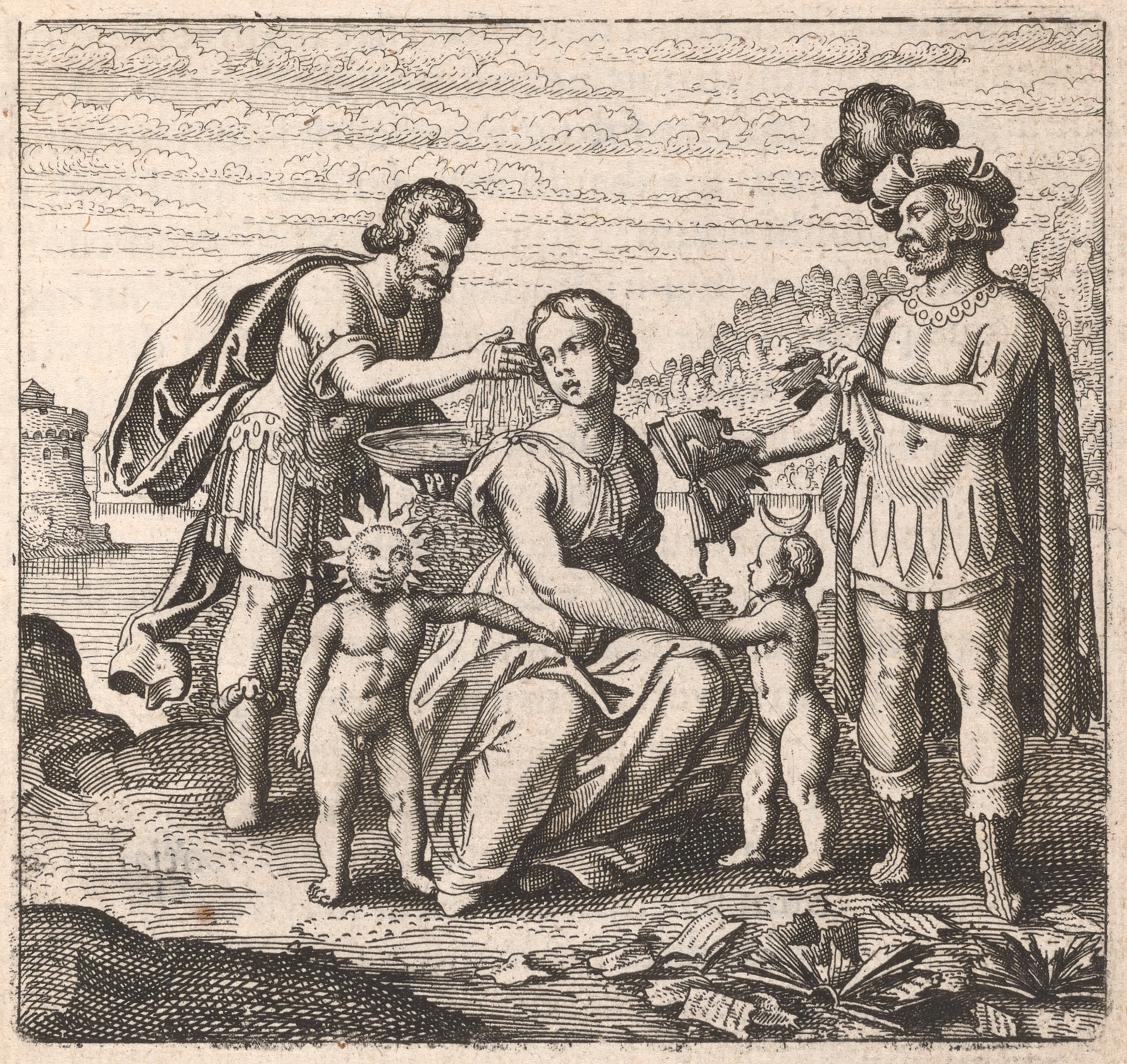
"Make Latona white and tear up the books." The name Latona (the goddess, mother of Apollo and Diana) puns on laton or latten, an impure alloy of copper and zinc resembling pale gold. The chemical instruction is to purify this alloy — to wash the impure metal until it becomes genuinely white (silver-like), at which point the practitioner should trust direct experience over contradictory texts. The Rosarium Philosophorum, Maier's primary source, quotes Hermes: join the dry with the moist, the black earth with its water, and boil until it becomes white. The purified white earth is then called "air" — it has been refined from its gross, earthy state into something subtler.
De Jong documents the deep connection between this emblem and the color theory underlying all alchemical practice. Colors differ according to their proportion of light: black contains the minimum of light, white the maximum. The hierarchy of elements — earth, water, air, fire — runs parallel to the progression from black to white. Fire is not red but white in its pure state; earth is opaque and dark. To make Latona white is therefore to elevate the substance from the earthly to the fiery, from darkness to light. Maier has Solomon explain this to King Hiram and the Queen of Sheba in his Septimana Philosophica, linking alchemical purification to the Sapientia Dei.
The emblem also carries baptismal significance. The Clangor Buccinae, one of the motto's sources, connects the whitening of Latona directly to Emblem XIII's imagery of Naaman washing in the Jordan: the curing of leprosy, the purification of metals, and the cleansing of sins through baptism are presented as the same operation. The picture of Emblem XI, showing a standing figure washing or sprinkling a seated figure while touching its forehead, closely resembles a miniature from the Aurora Consurgens manuscript depicting the washing of Laton with azoch and fire — a visual quotation linking Maier's work to the Thomistic mystical-alchemical tradition.
Emblem XII
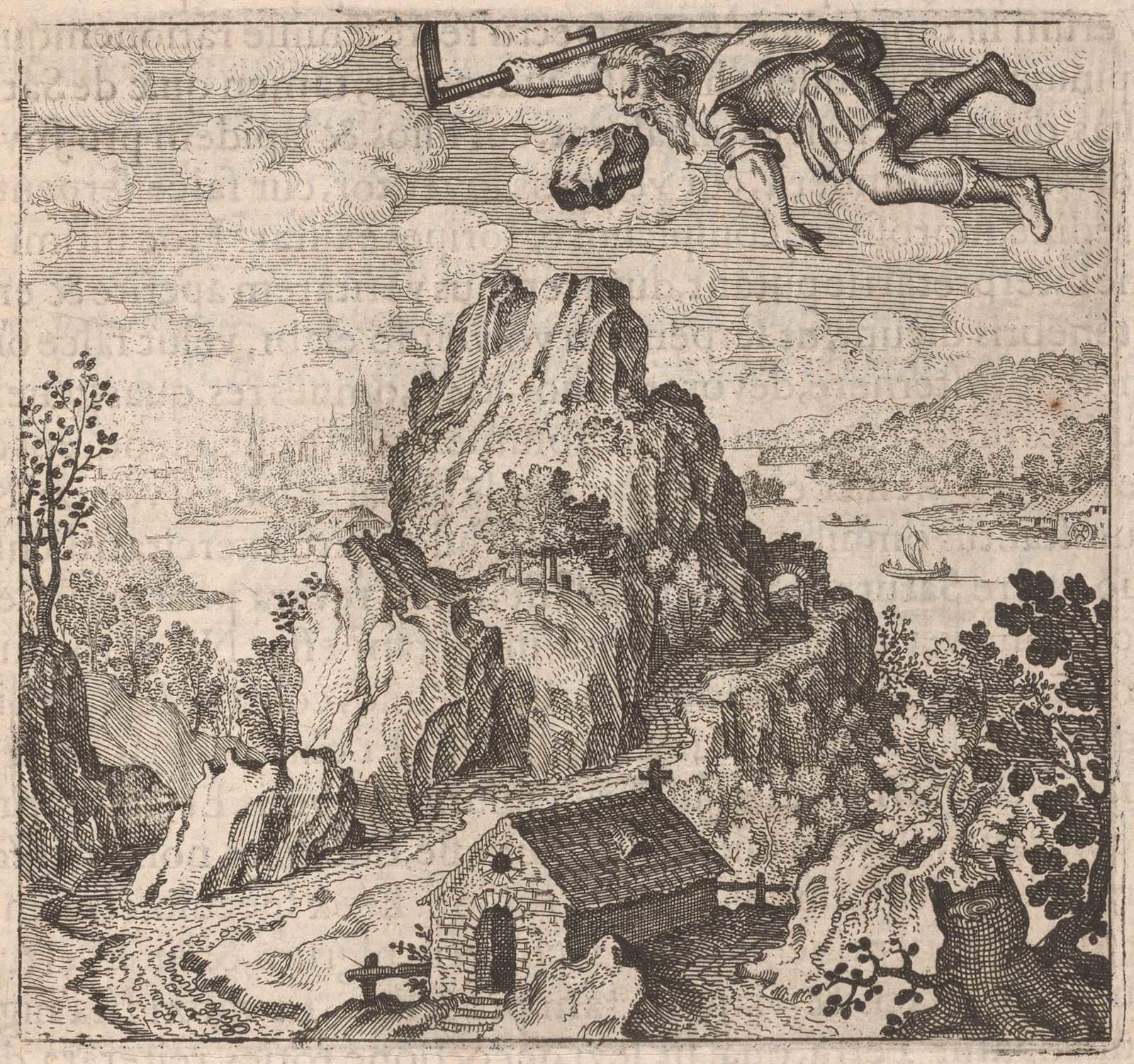
Saturn devouring his children and vomiting the stone placed on the Helicon encodes the initial stage of the alchemical process. In chemical terms, Saturn is lead — the humblest, heaviest, and most impure of the seven planetary metals. His act of devouring represents the universal solvent (mercury or acid) dissolving all metals back into undifferentiated prima materia. The stone he vomits is the philosopher's stone itself, which emerges from this dissolution. That it is placed on Mount Helicon, seat of the Muses, signifies that the product of this humble beginning ascends to the highest perfection.
De Jong identifies the alchemical maxim at work: Saturn (lead) is always the first to appear and is proof of the beginning of the truth. The masters of chemistry explain that Saturn's devouring represents the fact that all metals must pass through the lead stage — the dark, heavy, saturnine nigredo — before they can be refined. The scythe Saturn carries represents the cutting apart of composite matter, and his blackness represents the color of putrefaction. His son Jupiter (tin) eventually dethrones him, representing the next stage: the whitened lead that has begun to shed its impurities.
Maier draws on Ovid's Metamorphoses and on the Rosarium Philosophorum, but De Jong demonstrates that the deeper resonance is with the Kronos myth as cosmogonic allegory. Saturn devouring and regurgitating represents the cyclic destruction and renewal of matter — the same solve-et-coagula rhythm that governs the entire fifty-emblem sequence. The stone placed on Helicon is "chemical," as the epigram insists, but it is also the rejected cornerstone of Scripture, and the alchemical process of extracting perfection from lead mirrors the spiritual process of finding the divine light hidden within gross matter.
Emblem XIII
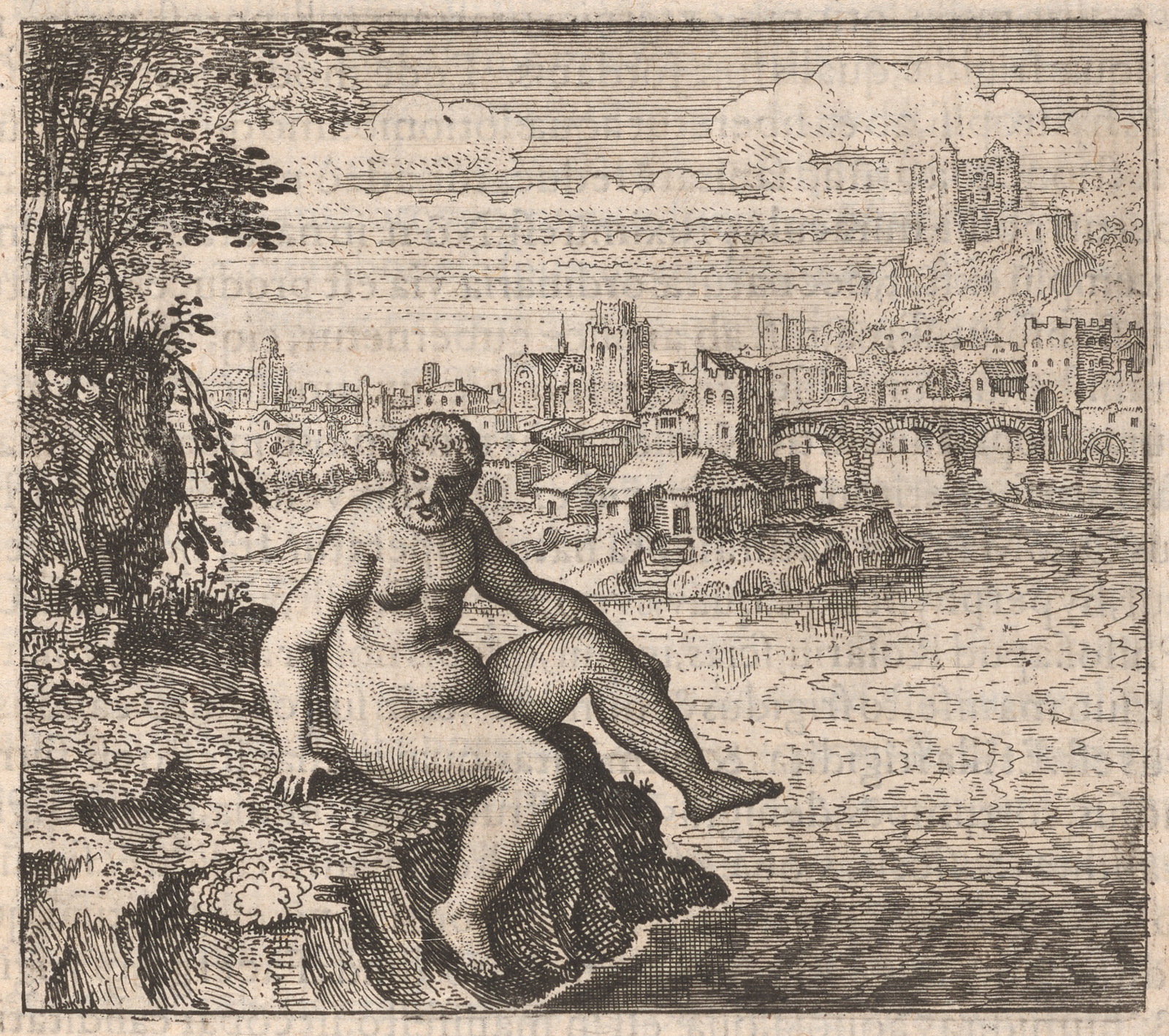
The philosophical ore is "dropsical" — swollen with excess moisture that must be removed through repeated washing, just as the biblical Naaman cured his leprosy by washing seven times in the Jordan. The chemical operation is desiccation: driving off superfluous water from the philosophical substance through carefully controlled heating. The "seven washings" represent seven cycles of distillation, each one removing more of the corrupting moisture until the matter is purified.
De Jong shows that Maier's extended discourse on dropsy is not merely analogical but reflects genuine iatrochemical thinking. Maier describes actual therapeutic approaches to dropsy in detail: patients buried in hot sand or cattle manure, locked in hot furnaces to sweat, or sent to thermal baths at Carlsbad and Wiesbaden. The active factor in all cases is warmth expelling redundant fluid through the pores. He warns of the danger of working with both purgatives and sudorifics — "as dangerous as sailing between Scylla and Charybdis" — because purgatives dissolve solidified substances while sudorifics excrete the finer parts, leaving the coarser impurities behind. This medical sophistication reflects Maier's training as a physician at the University of Padua.
The sources — the Clangor Buccinae and the Aurora Consurgens — explicitly merge chemical and sacramental language. The Aurora quotes Isaiah ("Wash yourselves and be clean") and 2 Kings (Naaman's sevenfold washing) in the same breath as the alchemical instruction to "distil seven times." The Jordan rises in the Lebanon, whose name means "whiteness" — the river of baptism is also the river of purification. Maier grants Paracelsus particular respect in this emblem's discourse for his success in curing dropsy where others failed, though he qualifies the praise: Paracelsus's books would be excellent "if only they were purged of all crafty explanations, just as good fertile fields are purged of thistles."
Emblem XIV
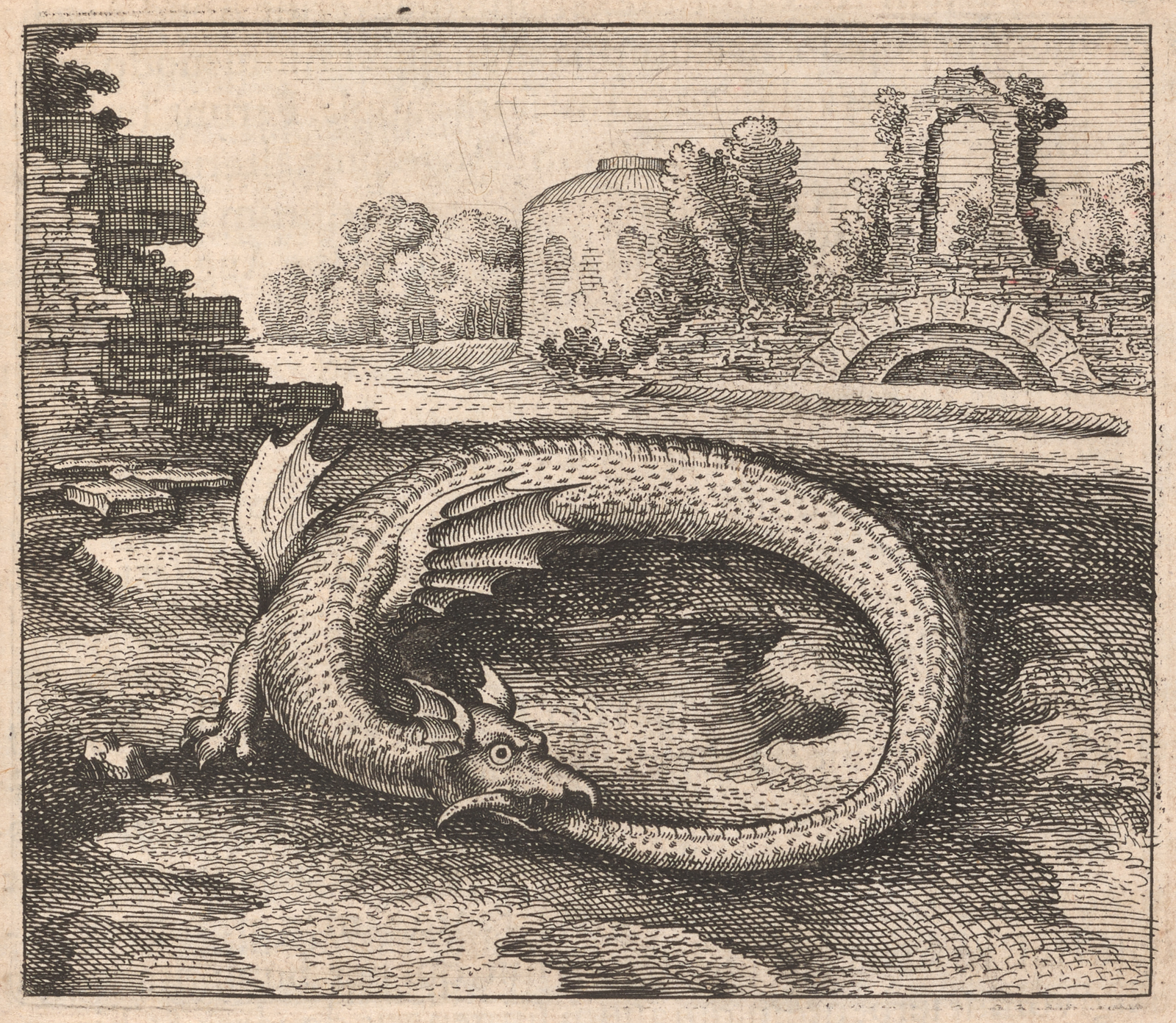
The ouroboros — the dragon devouring its own tail — is one of the oldest symbols in alchemy, appearing in the Papyrus Leidensis and the Chrysopoeia of Cleopatra from around 300 CE. In chemical terms, the dragon is mercury after distillation: the black residue (nigredo) remaining at the bottom of the cucurbit after the water has been driven off. The Clangor Buccinae is precise: "The dragon is the matter remaining at the bottom after distillation of the water; that water is called the dragon's tail; its blackness is the dragon; the dragon is watered by its own water and coagulated, and thus the dragon devours its tail."
This describes a specific laboratory operation: the distillate (volatile mercury, the "tail") is poured back onto the black residue (the "dragon's body") and the mixture is heated again, causing coagulation. The volatile part is reabsorbed by the fixed part. Through seven repetitions of this cycle, the perishable becomes imperishable. De Jong connects this to the astronomical meaning that Maier acknowledges: the dragon devouring its tail also represents the year returning upon itself, and the alchemical work should proceed in harmony with the solar cycle, beginning when the sun enters Capricorn and ending when it reaches Leo.
Lambsprinck's version captures the medical dimension: "This is truly a great wonder, that the highest medicine is found in the poisonous Dragon." Mercury, properly prepared — sublimated, dissolved in its own water, and coagulated again — becomes the supreme alexipharmacum, the antidote against all poisons. The dragon that kills becomes the dragon that heals, embodying the Paracelsian principle that the dose makes the poison. De Jong traces this ambivalence back to Gnostic cosmology: in the Pistis Sophia, the ouroboros appears both as the dragon of outer darkness encircling the world and as the sun-disk ascending to the seven powers — destroyer and illuminator in one.
Emblem XV
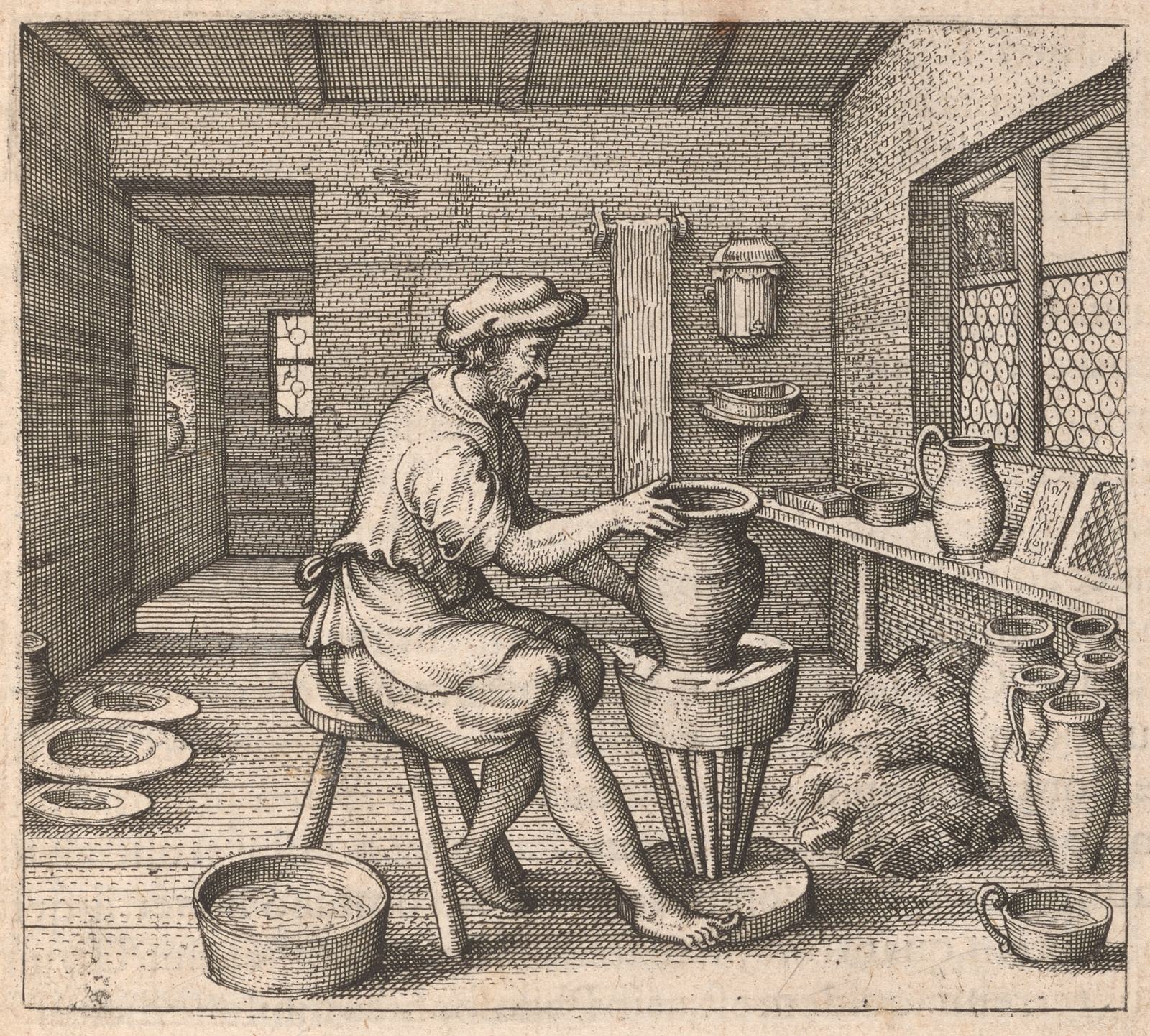
"Let the work of the potter teach you." The potter mixing clay with water, shaping it on the wheel, drying it in air, and hardening it in fire enacts all four elemental stages of the alchemical process. The source is the Scala Philosophorum, which states explicitly: "Dissolving and coagulating are the foundations of this art. For he who does not dissolve nor coagulate, often errs." The potter's art is the alchemist's art in miniature: finding the correct proportion of dry (sulphur) to moist (mercury) so that the resulting mixture is neither as thin as vapor nor as dense as crude earth, but a workable intermediate state.
De Jong reveals how Maier uses this humble analogy to express the sulphur-mercury theory in its fullest cosmological dimension. The potter is God the Creator, whose wheel is the firmament. He kneads humanity from clay and water, and each person's individuality is defined by the influence of the planets — a conception shared by Persian, Arabic, and Western European culture. The philosophical stone, like the potter's vessel, begins as a mixture of earth and water, is refined through air, and is perfected through fire. But the alchemist's vessel is nobler in its matter and more natural in its form than the potter's crude earthenware.
Maier's discourse contains a cautionary tale about a man who placed bricks and white pebbles in chests, hoping to transmute them into gold and silver through diabolical conjurations. He spent enormous sums and died of shame when the experiment failed. The lesson: there is no room for magic in this divine work. The alchemist must follow nature's laws, not attempt the impossible. Gold ripens from sulphur and mercury in the earth's cavities over millennia; the art merely accelerates what nature already does.
Emblem XVI
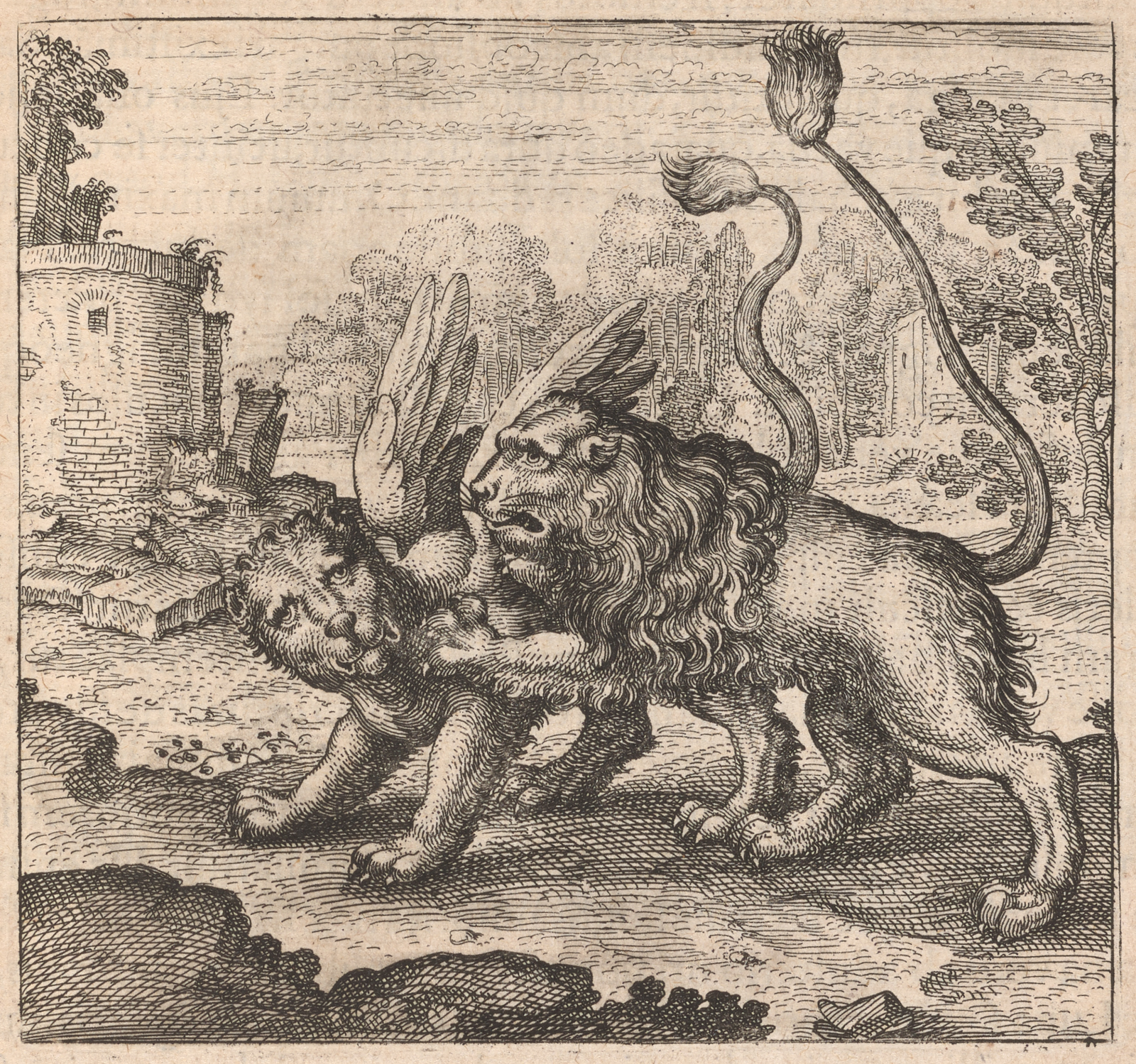
The winged lioness and wingless lion restate the volatile-fixed dichotomy of Emblem VII in a more powerful register. Lions were associated with mature, activated chemical substances — far beyond the nestling birds of the earlier emblem. The wingless lion (sulphur, the fixed masculine principle, Sol) holds the winged lioness (mercury, the volatile feminine principle, Luna) with his paws, preventing her from flying away. This represents the process by which the volatile mercury is gradually fixed through repeated heating, until it can endure fire without evaporating.
De Jong traces the source to Senior's Tabula Chimica, where the winged denotes female (mercury, Moon) and the wingless denotes male (sulphur, Sun). The two contrasts are aspects of a single Unity — the same substance manifesting as volatile and fixed. Lambsprinck's parallel emblems describe the two birds becoming one big ostrich-like creature that walks on earth though it has wings. In laboratory terms, the successfully fixed mercury retains its subtle properties but no longer volatilizes: it has acquired the stability of a solid while preserving the penetrative power of a spirit.
The lion imagery connects to the frontispiece, where Atalanta and Hippomenes are transformed into lions by Cybele. The fugitive mercury, once captured and fixed, becomes something formidable — the "lion's heart" that Basil Valentine will describe in Emblem XXIV. The lion's bones are so hard they strike fire when clashed together, just as steel strikes sparks from flint. This hardness is the quality the alchemist seeks: a substance so thoroughly consolidated that its elements can never again be separated.
Emblem XVII
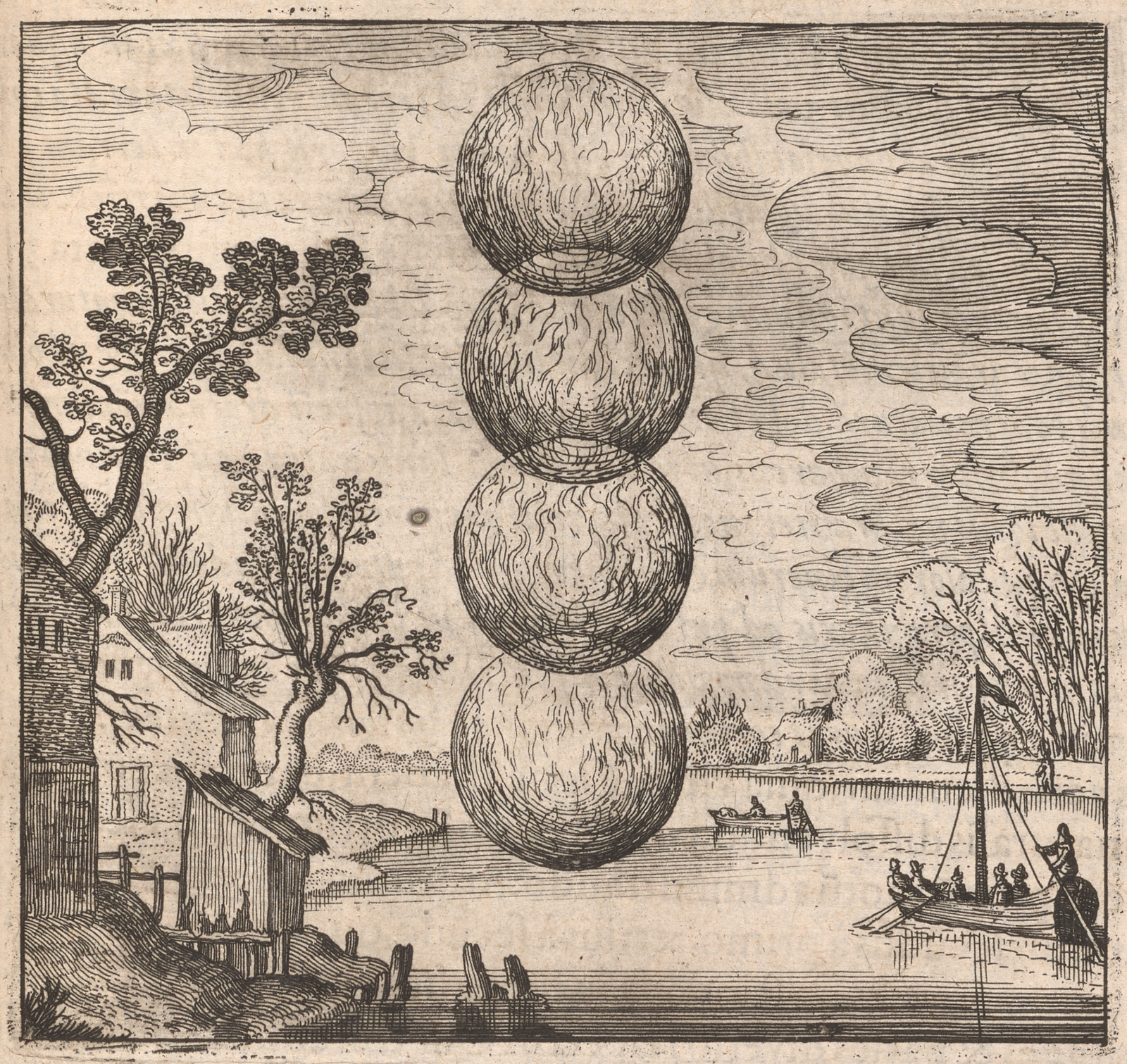
"A fourfold fire-ball controls this work." Maier teaches that there are four distinct types of fire required in the alchemical process, corresponding to the four elements and four stages of heating. The first fire is gentle, like springtime warmth, suitable for the initial dissolution. The second is moderate, like summer, for the phase of purification. The third is intense, for the driving off of volatile impurities. The fourth is the sustained, extreme fire needed for the final fixation and hardening of the stone.
De Jong connects this emblem to the broader theme of graduated heat management that runs through the Atalanta Fugiens. The discourse draws a parallel between the alchemist's furnace and the sun's passage through the zodiac: just as solar warmth increases from Aries to Leo, the philosophical fire must increase in measured degrees. Too much heat too soon destroys the work; too little fails to drive the transformation. This graduated approach echoes both agricultural practice (different crops require different seasons) and medical therapeutics (Galenic medicine prescribed treatments matched in intensity to the severity of the disease).
The picture of Emblem XVII is notably paradoxical: a chain of four fire-balls hangs in the air over a commonplace river landscape, creating what De Jong calls an aesthetic contrast between Nature and Supernature. Maier's point is that the four fires are not ordinary flames but philosophical concepts — the inner fire of the substance, the fire of dissolution, the fire of purification, and the fire of fixation — each corresponding to an elemental transformation. The fourfold fire-ball is the controlling mechanism of the entire Work, governing the pace and sequence of all operations.
Emblem XVIII
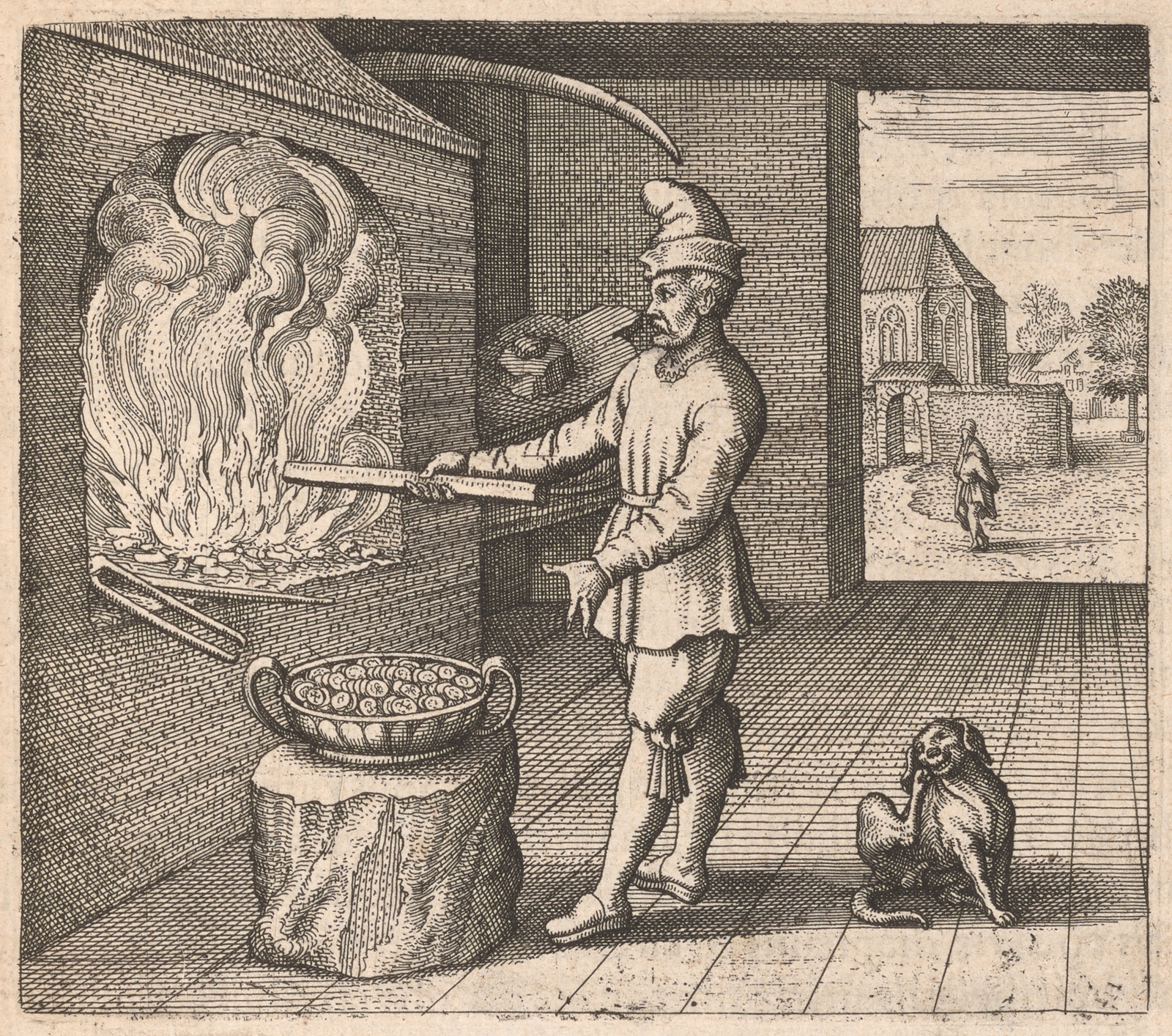
"Fire likes making things fiery, but not, like gold, making gold." This emblem draws a crucial distinction between the transformative power of fire and the generative power of gold. Fire can heat, calcine, and purify, but it cannot by itself produce gold. Only gold (or the philosophical seed derived from gold) can generate more gold, just as only wheat can produce wheat and only a hen can produce a chick. The principle is that like generates like: the seed must be of the same nature as the desired product.
De Jong identifies this as a corrective against a common error among would-be alchemists who believed that fire alone could transmute base metals. Maier insists that fire is the instrument, not the agent, of transmutation. The true agent is the philosophical mercury prepared from gold itself — the "seed" extracted from the most perfect metal, which, when sown in properly prepared "white foliated earth" (as in Emblem VI), can reproduce its own perfection in the base metal substrate.
The medical analogy follows naturally from Paracelsian iatrochemistry: a physician does not cure a disease by applying arbitrary force but by introducing the specific remedy that matches the specific illness. Heat may assist the remedy's action, but heat without the right medicine accomplishes nothing. Similarly, the alchemist's furnace provides the conditions for transformation, but the transformation itself requires the correct starting material — a substance containing the hidden potential for gold, properly extracted and applied.
Emblem XIX
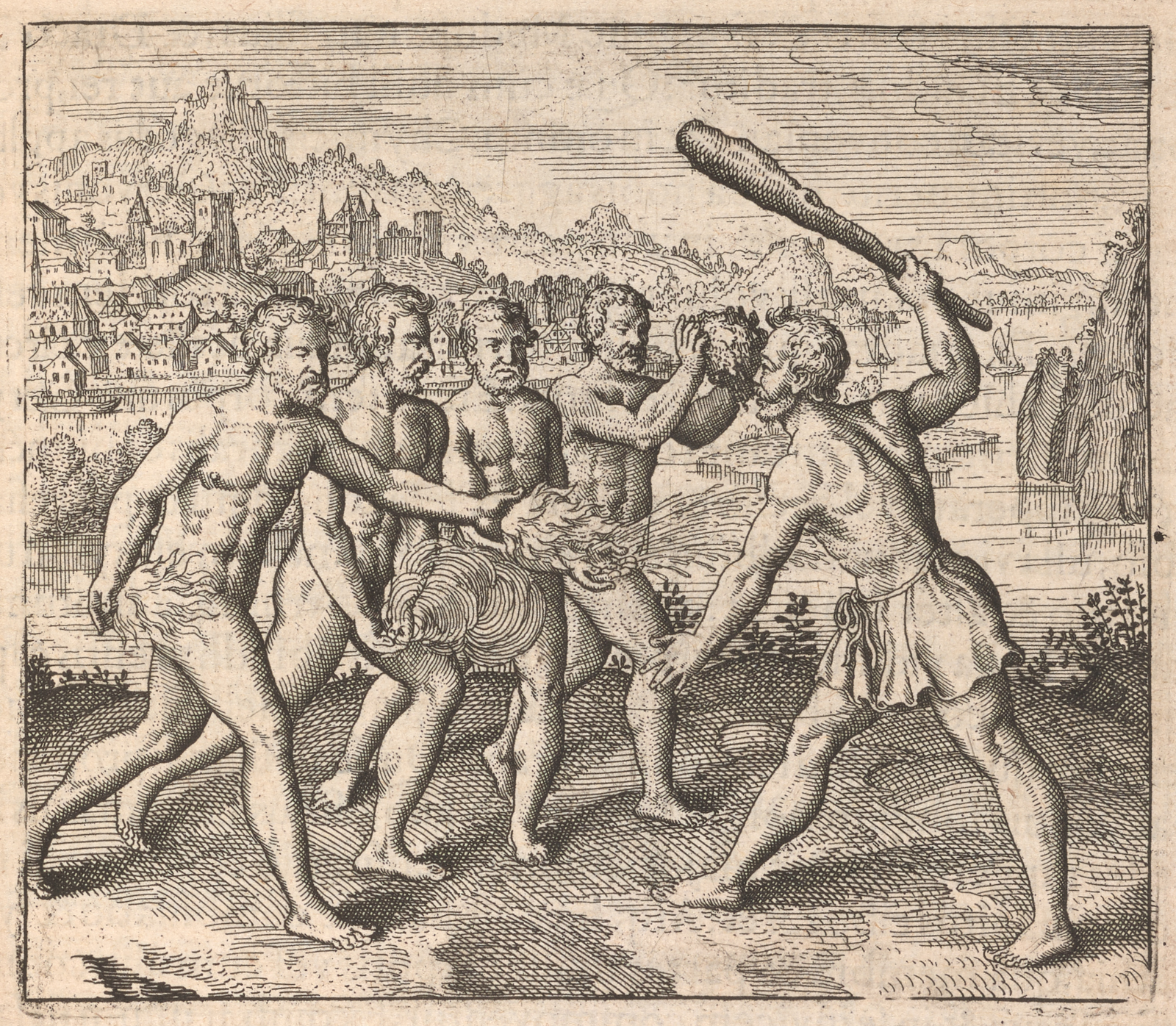
"If you kill one of the four, everybody will be dead immediately." Four brothers stand in a row, each holding one of the four elements: earth, water, air, and fire. If any one dies, all die, because the four elements are so interdependent that destroying any single one triggers a chain reaction that annihilates the rest. The allegory of Geryon, the three-bodied king of Spain whose cattle Hercules stole, reinforces the point: the components of the philosophical substance are so intimately connected that they cannot be isolated without destroying the whole.
De Jong draws on the Opus Mulierum (quoting Arnoldus) for the chemical explanation: air feeds fire as water feeds earth; fire lives on air, air on water, water on earth. If you bind earth and water together, so that air can be fixed in water, and you have "killed" the water properly, then you have killed all the elements and they are all dead — reduced to prima materia. This reduction to primary matter is the necessary first step before reconstitution into the philosopher's stone. The four brothers killed by mutual wounds are the four elements returning to the undifferentiated chaos from which they originated.
Maier adds a remarkable instruction: "Kill the living one, but do it in such a way that you can revive him again, otherwise his death has not been of any use." The death of the elements must be reversible. When the king rises from death, darkness and the waters flee from him, the dragon that guarded the abysses flees from the sunbeams. This resurrection motif — drawn from the Belinus metaphor in the Rosarium, where the Son of the Sun describes his own death, dismemberment, and glorious return — makes the killing and reviving of elements a rehearsal for both the completion of the stone and the redemption of the soul.
Emblem XX
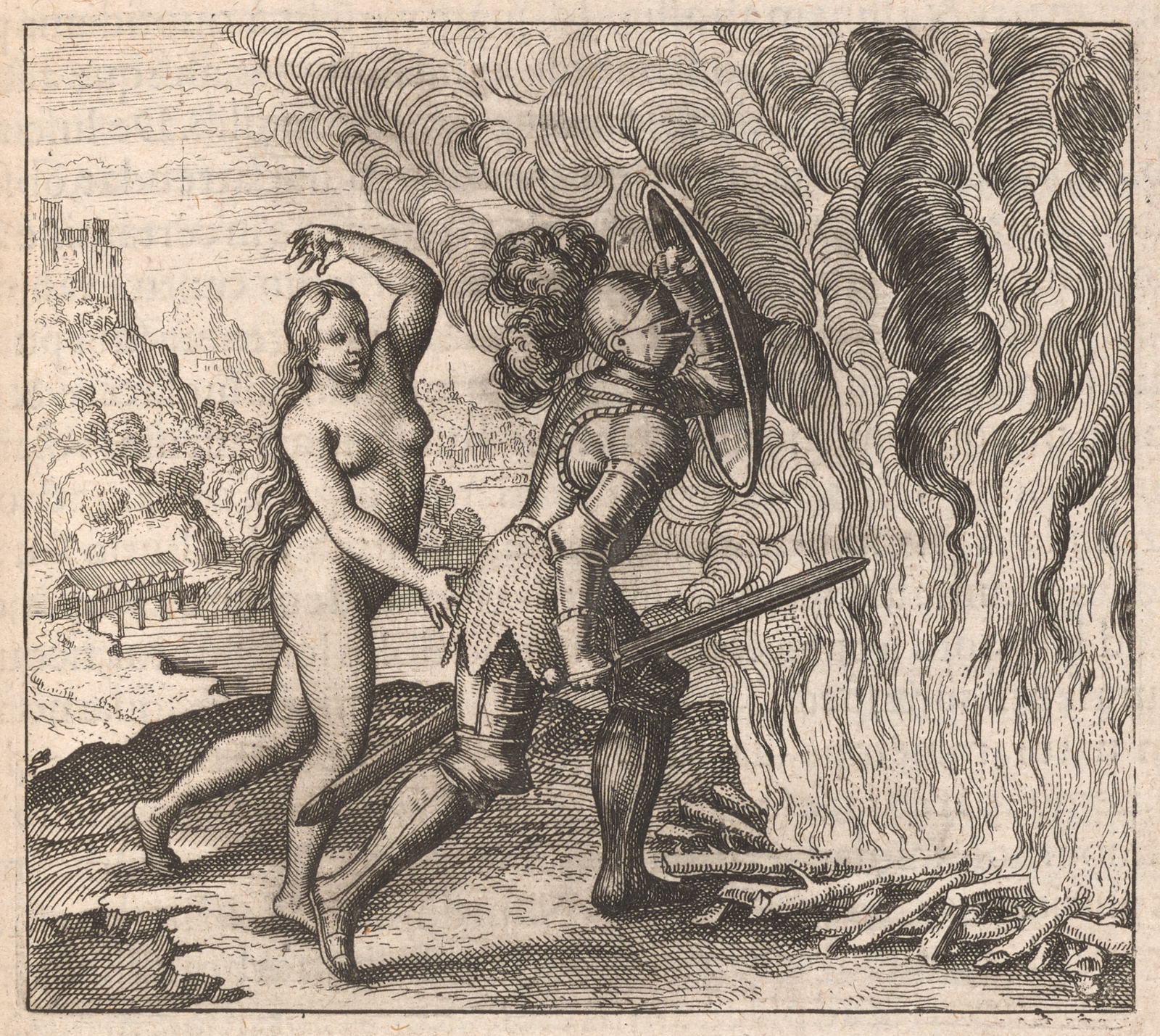
"Nature teaches Nature, Nature conquers Nature, Nature rules Nature." This triple pronouncement, originating in the Greek alchemist Pseudo-Democritus's Physica et Mystica and transmitted through the Turba Philosophorum, describes how one chemical substance protects another from destruction by fire. The picture shows an armored knight defending a vulnerable maiden from a fire-breathing dragon. In laboratory terms, this means using a refractory additive to prevent the substance being refined from being consumed by excessive heat.
De Jong documents Maier's specific examples with precision. Iron protects gold and silver when these precious metals are found in ore bound with cadmium, arsenic, or antimony (all destructive to gold and silver in the smelting process). Iron, thrown into the fire with the ore, preferentially absorbs the destructive compounds, allowing the gold and silver to survive. Similarly, when iron is being hardened into steel, white beach pebbles prevent the iron from burning. The philosophers call their protective agent "eudica" (glass gall), following Morienus, who specifies that it must be sought in the glass vessel and that it helps bodies retain their volatile spirits despite the heat of the fire.
The maiden saved by the knight is Beya or Blanca — the personification of volatile mercury from the Visio Arislei, the allegorical dream-vision appended to the Turba. She represents the white, volatile principle that must be taught to endure fire. Her red-armored rescuer is Pyrrhus, the red-haired son of Achilles — the fixed, sulphurous principle that confers fire-resistance. The union of the two produces a substance nobler than either parent, demonstrating Nature's law that perfection arises gradually from the interaction of imperfect components.
Emblem XXI
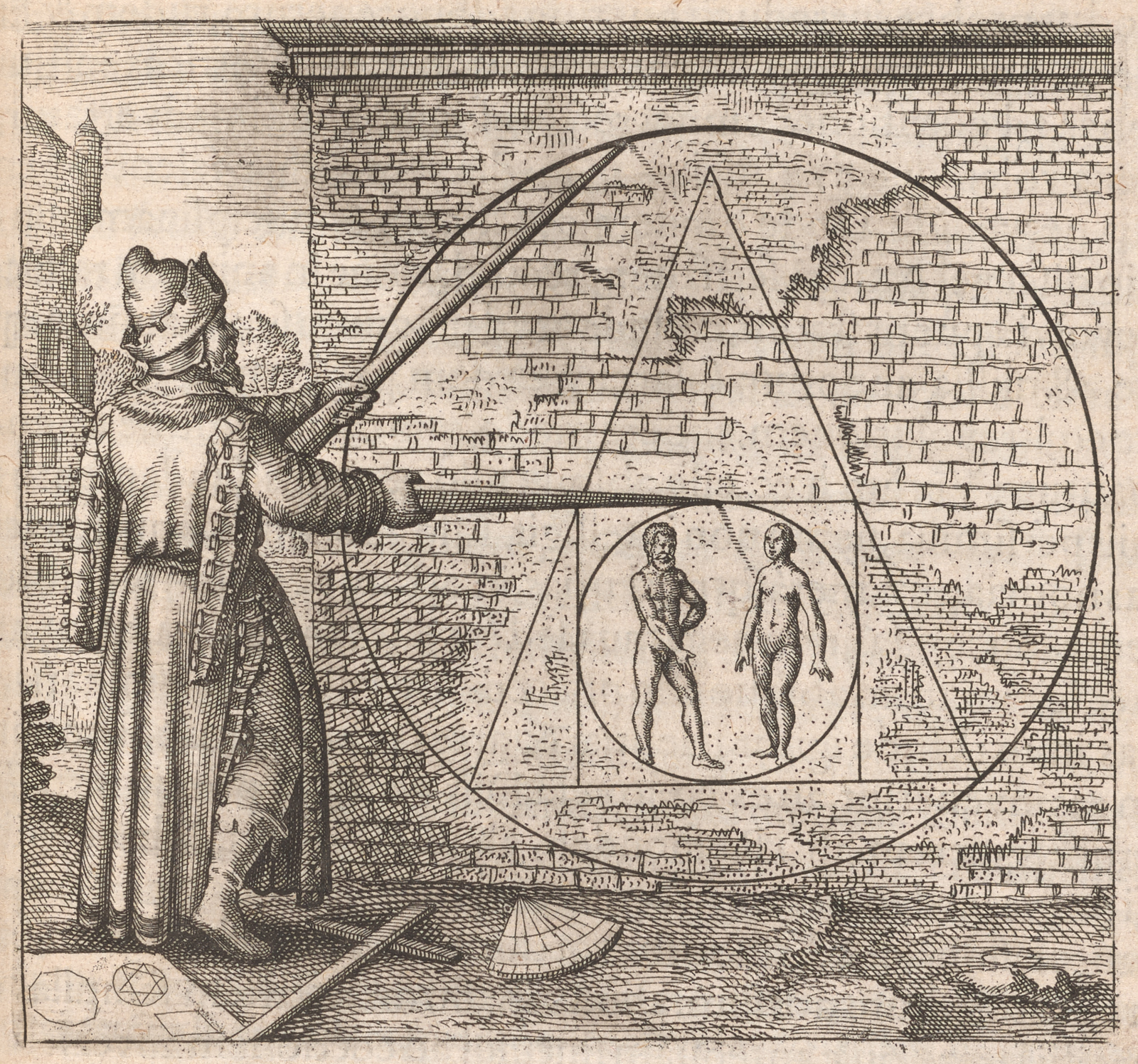
"Make a circle out of a man and a woman, out of this a square, out of this a triangle, make a circle and you will have the Philosopher's Stone." This is the most compressed and schematic emblem in the series, encoding the entire alchemical process in a geometric formula. The man and woman are sulphur and mercury, the fundamental contrasts. Their circle is the materia prima, the undifferentiated primary matter to which all compounds must be reduced. The square represents the four elements (earth, water, air, fire) separated from this primary matter. The triangle represents the tria prima — body, soul, and spirit (or salt, sulphur, and mercury in the Paracelsian framework) — visible as three colors: black (Saturn/body/earth), white (Luna/spirit/water), and yellow (Sol/soul/air). The final circle is the perfected stone, the unchangeable redness of the tinctura rubea.
De Jong's commentary on this emblem is among his most extensive. He traces the source to the Rosarium Philosophorum and demonstrates its connection to the Tractatus Vere Aureus ascribed to Hermes Trismegistus. The commentary on the latter text explains the simple circle as Mercury in its primary state (beginning, middle, and end of the work), the double circle as the active and passive principles (sulphur and mercury), the triangle as the threefold relationship of body-soul-spirit, and the square as the four elements that must be divided, rectified, and reunited. The small circle at the center of the square is the "mediator that makes peace between enemies" — the quintessence that reconciles the warring elements.
Maier connects this geometric program to Pythagorean number theory and the medieval quadrivium. The inscription over Plato's Academy — "Let no one ignorant of geometry enter here" — applies equally to the alchemist's laboratory. The discourse concludes with the return to the monad, drawing on John Dee's Monas Hieroglyphica and the Hermetic Poimandres: the soul ascends through the seven planetary spheres back to the divine Unity. Chemical perfection (the red stone), cosmological perfection (the return of all things to their source), and spiritual perfection (the soul's reunion with God) are expressed as a single geometric transformation from circle to square to triangle and back to circle.
Emblem XXII
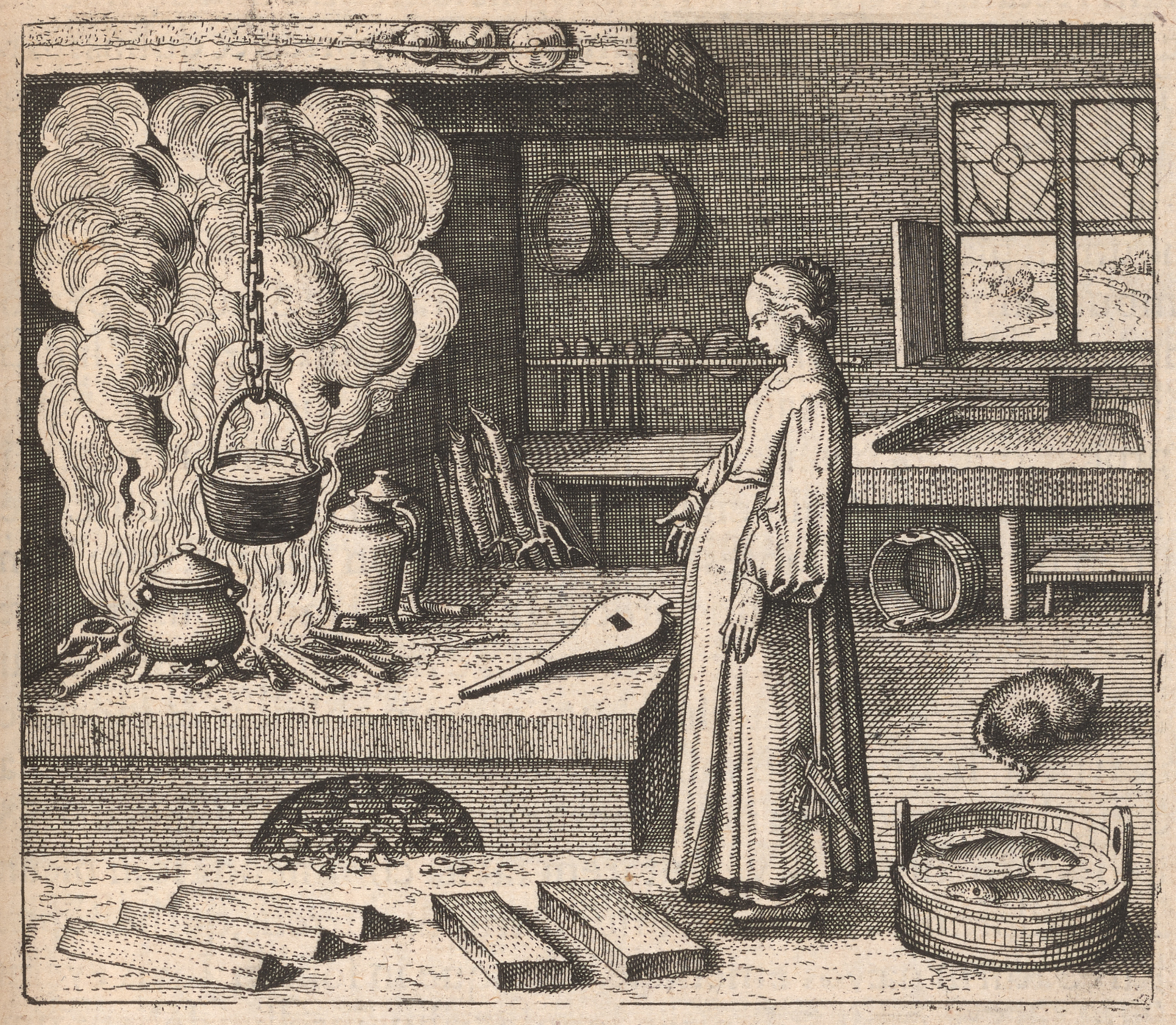
"When you have obtained the white lead, then do woman's work, that is to say: cook." Having achieved the albedo — the purification of lead into white lead or tin (Jupiter succeeding Saturn) — the alchemist must now slowly cook the substance to drive off remaining moisture and bring it toward the reddening stage. Maier takes his motto from the Turba Philosophorum, where Socrates declares: "Now I have shown the systematic arrangement of the white lead, and when that is known, nothing else follows but women's work and child's play."
The chemical operation is the careful boiling down of the philosophical subject in a sealed double vessel ("vas supra vas"). Maier compares this to the method of cooking fish between two well-closed pans: the fish is placed in the upper pan, water in the lower; the rising steam gently cooks the fish without burning it. This is precisely the procedure for the philosopher's stone: softening what is hard, dissolving what is compact, and making tenuous what is solid, using vapor rather than direct flame. The substance must lose its surplus moisture without being calcined into worthless ash.
De Jong notes that Maier specifically chooses the trout for his fish analogy because Paracelsus reported that gold could be found in trout — these fish naturally swallow gold flakes washed down from mountain streams. The woman in the picture is pregnant, representing the albedo containing the rubedo within herself, as the Margarita Pretiosa Novella states: "The Stone is called a pregnant woman, because whiteness has within itself redness, which is extracted at the end of cooking." The chemical, culinary, and gestational metaphors converge: cooking, gestation, and the slow maturation of the stone are all forms of the same patient, heat-driven transformation.
Emblem XXIII
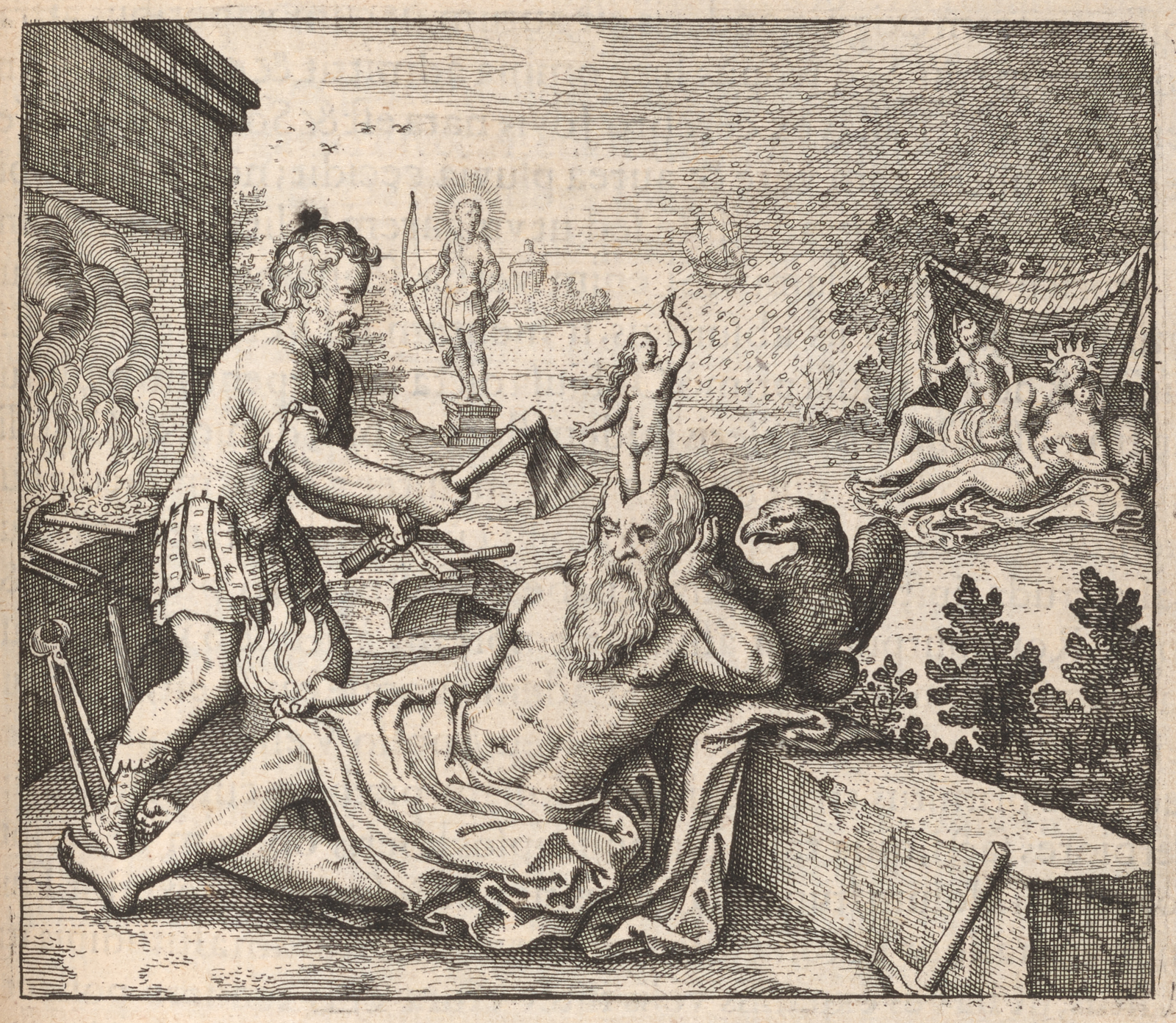
"It rains gold when Pallas is born at Rhodes and while Sol cohabits with Venus." This emblem combines two mythological scenes to describe the moment when the vivifying power of gold descends into the prepared matter. Sol (gold, the sun) united with Venus (copper, the attractive principle) represents the chemical wedding of the solar and venusian metals. The gold rain that falls during this union is the precipitation of gold-bearing tincture into the vessel — what modern chemistry might describe as the reduction of gold ions from solution onto a copper substrate.
De Jong identifies Maier's source in Strabo's Geographica and in the Arcana Arcanissima, where the Isle of Rhodes serves as an extended alchemical allegory. Rhodes was first called Ophiusa ("island of snakes") for its abundance of serpents — corresponding to the initial stage when the raw matter resembles mercury (the alchemical serpent). After preparation and cooking, the matter takes on the purple color of a rose, and Rhodes means "island of roses." The Colossus of Rhodes, the enormous Sun-statue, represents Sol's dominion over the perfected substance.
The birth of Athena from Jupiter's head, depicted in the foreground, connects this emblem to Emblem VIII: Vulcan assists the birth with his axe just as the fiery sword pierces the philosophical egg. Athena is Wisdom (Sapientia), born from the head (the seat of intellect), and her birth produces the gold rain — wisdom and material perfection arriving simultaneously. De Jong adds a historical dimension: the alchemist Bernhardus Trevisanus claimed to have discovered the secret of the philosopher's stone at Rhodes in 1472, and George Ripley reportedly sent large quantities of transmuted gold to the Knights of St. John defending Rhodes against the Turks, connecting alchemical aspiration to Rosicrucian ideals of service to humanity.
Emblem XXIV
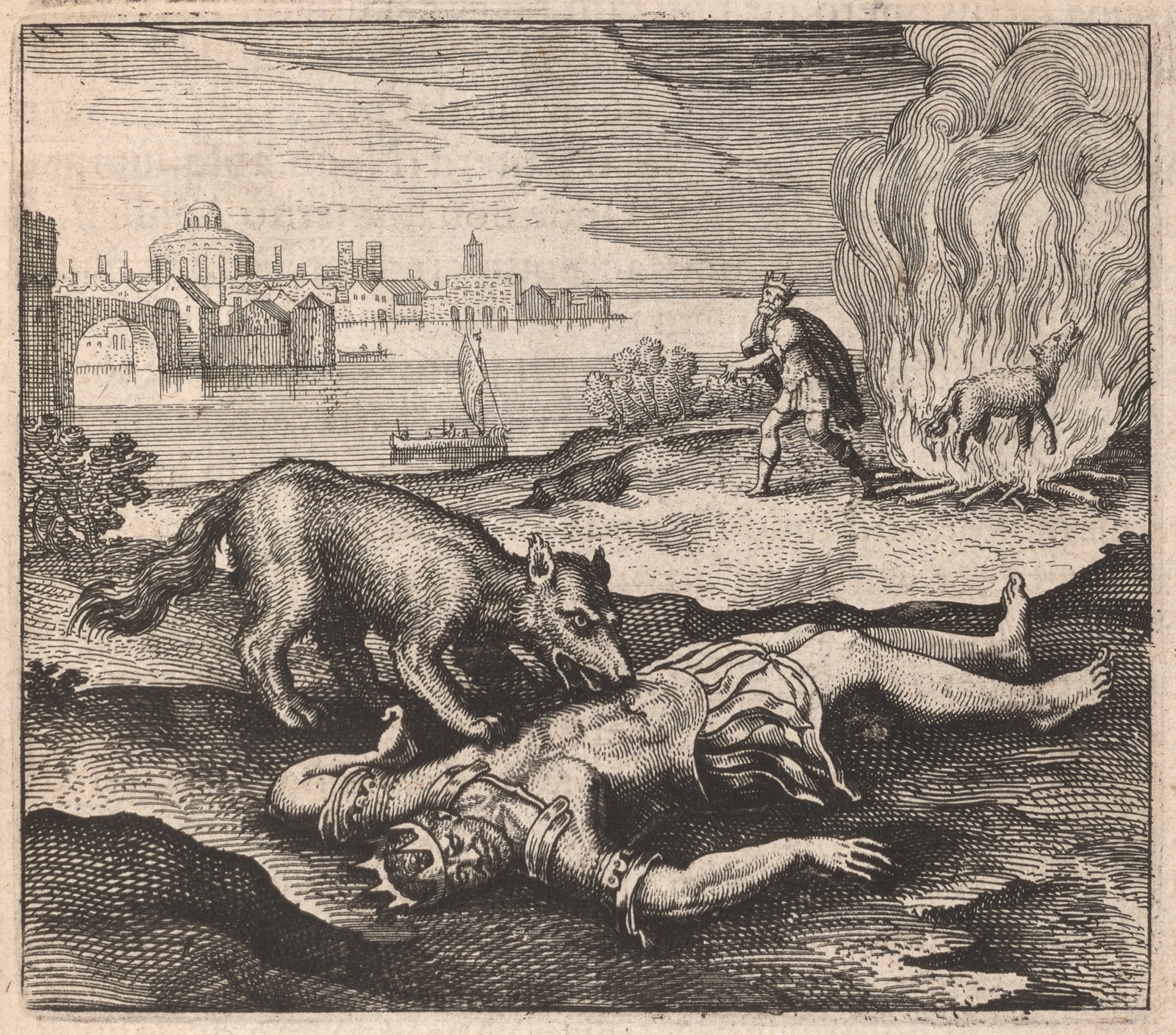
"The wolf devoured the king, and after the wolf had been burnt, it returned the king to life." This is one of the most chemically explicit emblems in the entire sequence. The wolf is antimony — the grey, voracious, martial substance known for its ability to "devour" gold by forming an alloy with it when melted together. Antimony was called the "grey wolf" because of its color, its association with Mars (bellicose, devouring), and its parentage from Saturn (lead ore and antimony occur together). The king is gold. When gold ore contaminated with base metals is fused with antimony, the antimony absorbs the impurities, leaving the gold purified. When the antimony-gold mixture is then strongly heated, the antimony burns away (the wolf is consumed by fire), and the purified gold emerges — the king returns to life with a "lion's heart."
Maier takes this emblem directly from the first of Basil Valentine's Twelve Keys, which he valued so highly that he personally supervised its first publication as part of his Tripus Aureus. Basil Valentine's text is remarkably detailed: the wolf must come from cold regions (antimony ores are found in mountain deposits), and the process must be repeated three times before the Lion (purified gold) has fully conquered the wolf. The resulting substance becomes the tincture that cures all diseases — whoever drinks from the "gold fountain" feels a renewal of being, a deliverance from evil, good circulation of blood, and perfect health.
De Jong situates this emblem within the four-part King cycle (Emblems XXIV, XXVIII, XXXI, XLVIII), which dramatizes the sickness, death, and resurrection of the solar principle. The king's journey from humble, unrecognized exile to glorious restoration mirrors both the transmutation of lead into gold and the Christian narrative of death and resurrection. The Gratianus quotation from the Rosarium captures the pattern: "In alchemy there is a noble body, which moves from master to master, in the beginning of which is misery and bitterness, but which brings joy in the end."
Emblem XXV
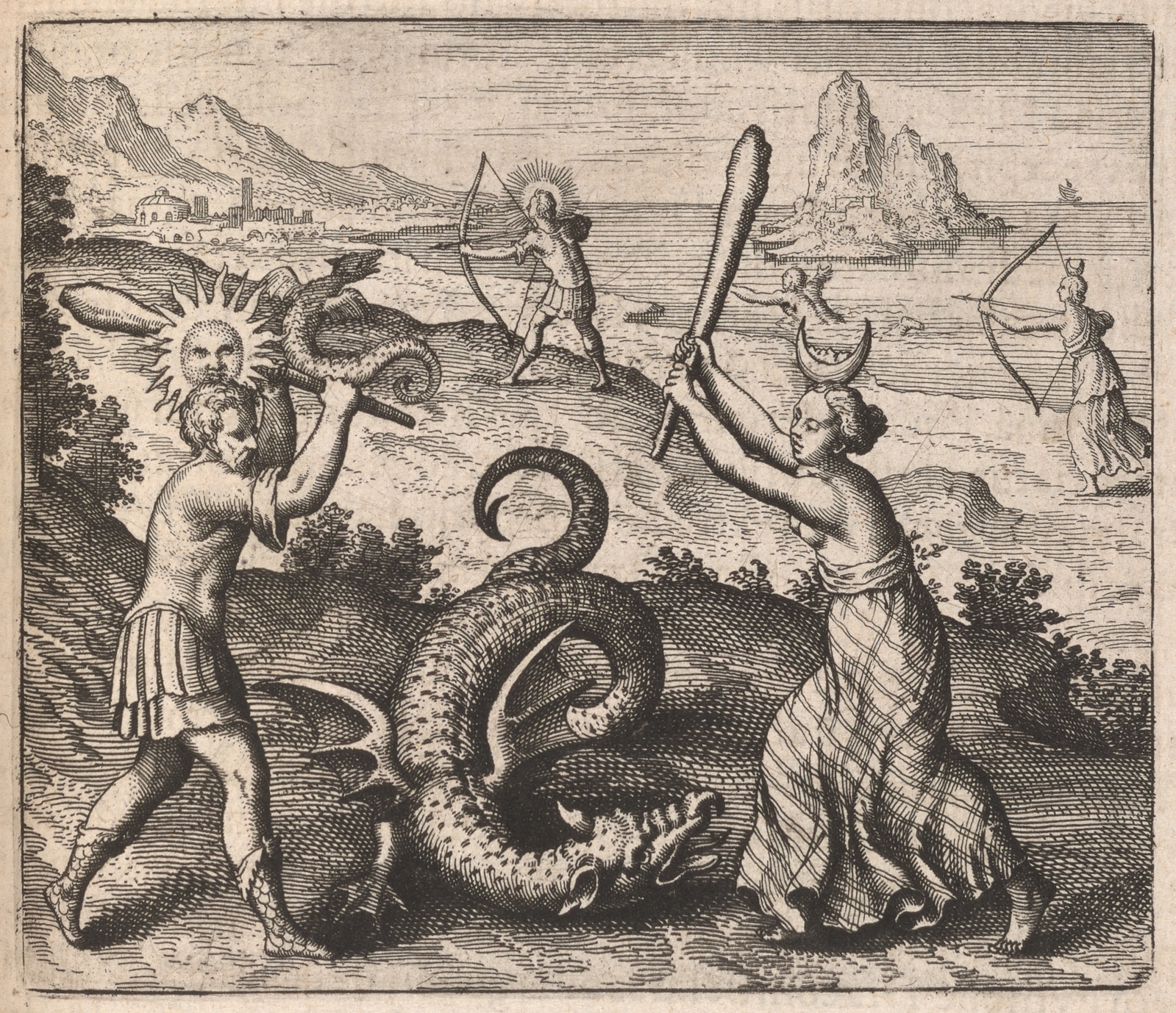
"The Dragon does not die, if it is not killed by its brother and sister, that is to say by Sol and Luna." The dragon here is philosophical mercury — the volatile, corrosive solvent extracted from metallic bodies through distillation. It possesses body, soul, and spirit (the three principles contained within it), and it cannot be neutralized by any single agent. Only the combined action of Sol (gold, sulphur, the hot-dry principle) and Luna (silver, the cold-moist principle) can fix and "kill" this volatile substance, converting it from the destructive aqua permanens into the stable, beneficent philosopher's stone.
De Jong traces the motto to the Rosarium Philosophorum, which quotes Hermes: the dragon is mercury drawn from the bodies, containing body, soul, and spirit within it. After the putrefaction and separation of elements, it becomes the "eternal water" of the philosophers, also called aqua foetida (stinking water, the subject of Emblem XXXVII). This water is simultaneously the most dangerous solvent and the most precious raw material — the chaos from which the perfected stone must be reconstituted. Jason's conquest of the Golden Fleece-guarding dragon serves as the mythological frame: the hero-physician uses Sol and Luna (the images Medea gave him) to overcome the serpentine guardian and obtain the treasure.
The struggle between dragon and the solar-lunar pair also encodes the cosmological drama of light overcoming darkness. The dragon of chaos, which De Jong connects to the Pistis Sophia's ouroboros of outer darkness encircling the world, must be slain by the combined luminaries before the treasure (gold, wisdom, salvation) can be obtained. The elephant-and-dragon combat that Maier describes in his Tractatus de Septem Montibus illustrates the same principle: the heavy, fixed substance (elephant/earth) crushes the volatile serpent (dragon/mercury) by falling on it, but both perish in the encounter — mutual destruction being the necessary prelude to the emergence of something entirely new.
Emblem XXVI
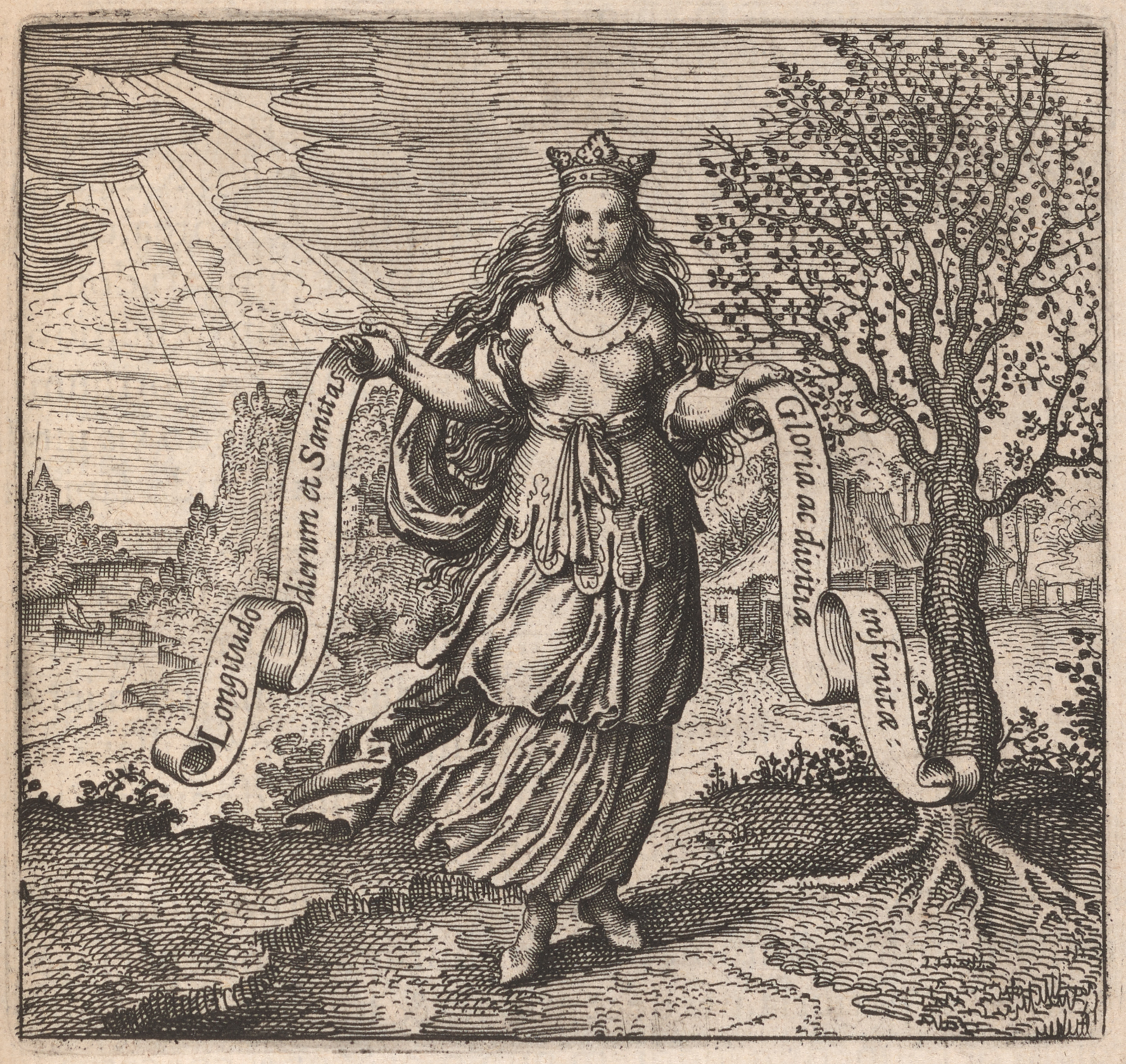
Emblem XXVI stands at the exact center of the fifty-emblem sequence, and Maier uses this pivotal position to announce the governing principle of the entire work: that true chemistry is identical with divine wisdom. The motto declares that the fruit of human wisdom is the Tree of Life, drawing directly from Proverbs III:18. In chemical terms, the emblem encodes the idea that the Philosopher's Stone is not merely a laboratory product but the culmination of a knowledge tradition stretching from Solomon through the Hermetic sages. The "Tree of Life" bearing Sun and Moon as fruit represents the perfected union of sulphur and mercury, the two principles whose reconciliation produces the tincture.
De Jong identifies the Rosarium Philosophorum as the direct source for both the motto of Emblem XXVI and the following Emblem XXVII, noting that the Old Testament quotations from Proverbs were not chosen arbitrarily by Maier but were borrowed in sequence from the Rosarium. Behind the Rosarium stands the Aurora Consurgens, whose first five chapters are devoted to Sapientia and whose seven parables map the alchemical process through successive stages of purification. Maier thus draws on a chain of transmission: the biblical Wisdom literature was read alchemically by the Aurora Consurgens, compiled by the Rosarium, and finally dramatized as an emblem by Maier.
The pedagogical strategy here is remarkable. By placing Lady Sapientia at the midpoint of the book and surrounding her with detailed scriptural marginalia found nowhere else in the Atalanta Fugiens, Maier transforms the chemical goal of transmutation into a quest for salvific knowledge. The crowned woman holding banderoles inscribed with "length of days and health" and "honour and infinite riches" is simultaneously an allegory for the Stone's therapeutic and transmutative powers and a personification of the Rosicrucian ideal of wisdom as the path to lasting happiness. The reader who decodes her is told that chemistry is not craft but contemplation.
Emblem XXVII
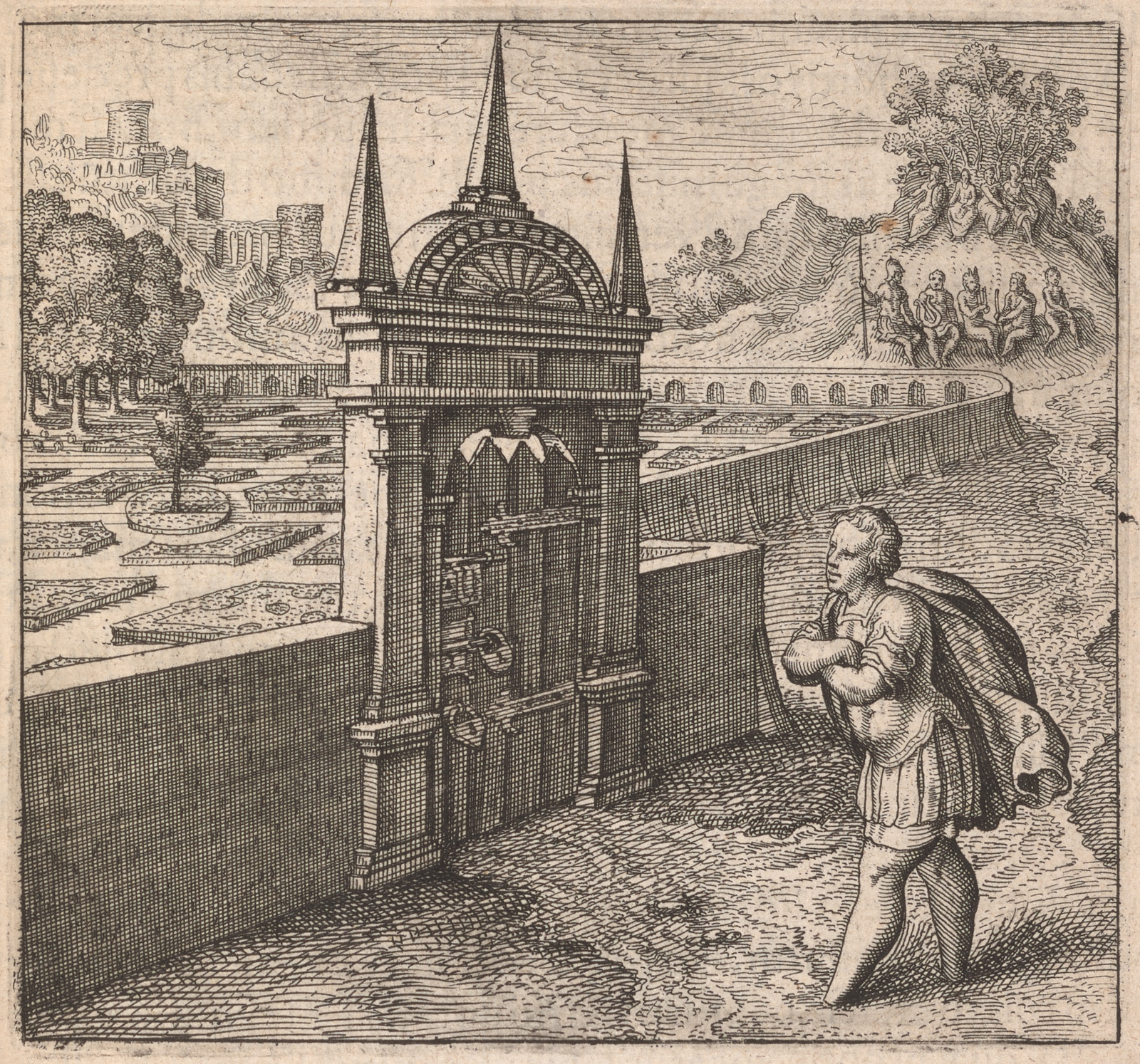
Emblem XXVII extends the Sapientia sequence by declaring that entry into the Philosophical Rose-garden requires a key, without which one walks as a man without feet. The chemical reality encoded here is dissolution: perfection cannot be reached without a prior breaking-down of the matter. The "key" is the agent of dissolution, a substance of little apparent value that nonetheless opens the seven metal gates. De Jong identifies this as a reference to the prima materia in its most humble guise, the despised starting material that practitioners overlooked precisely because of its commonness.
The motto is taken directly from the Rosarium Philosophorum, which speaks of entering the rose-garden to collect white and red roses, the symbols for the albedo and rubedo stages of the work. Behind the Rosarium, De Jong traces the imagery to the Aurora Consurgens, whose parables describe the putrefactio through visions of diluvial waters, death, and bronze gates. Maier also draws on Jodocus Greverus, whose visionary account of the tiring journey to reach the Garden of the Hesperides breathes the same spirit of trial and initiation.
Maier transforms this chemical instruction into a mythological puzzle by introducing Erichthonius, born footless from Vulcan's seed that fell on the earth when Athena refused him. The allegory teaches that fire (Vulcan) without wisdom (Athena) produces only monstrous, deformed results. The reader learns that chemical work requires both experientia and ratio, both practical skill and theoretical understanding. The discourse then shifts to the rose-garden itself, where Venus and Adonis appear, connecting forward to Emblem XLI. When common sulphur touches roses they become white; when the spirit of vitriol or aqua fortis touches them, they become red again. This is a precise chemical observation dressed in the language of myth: sulphur bleaches, strong acids restore color.
Emblem XXVIII
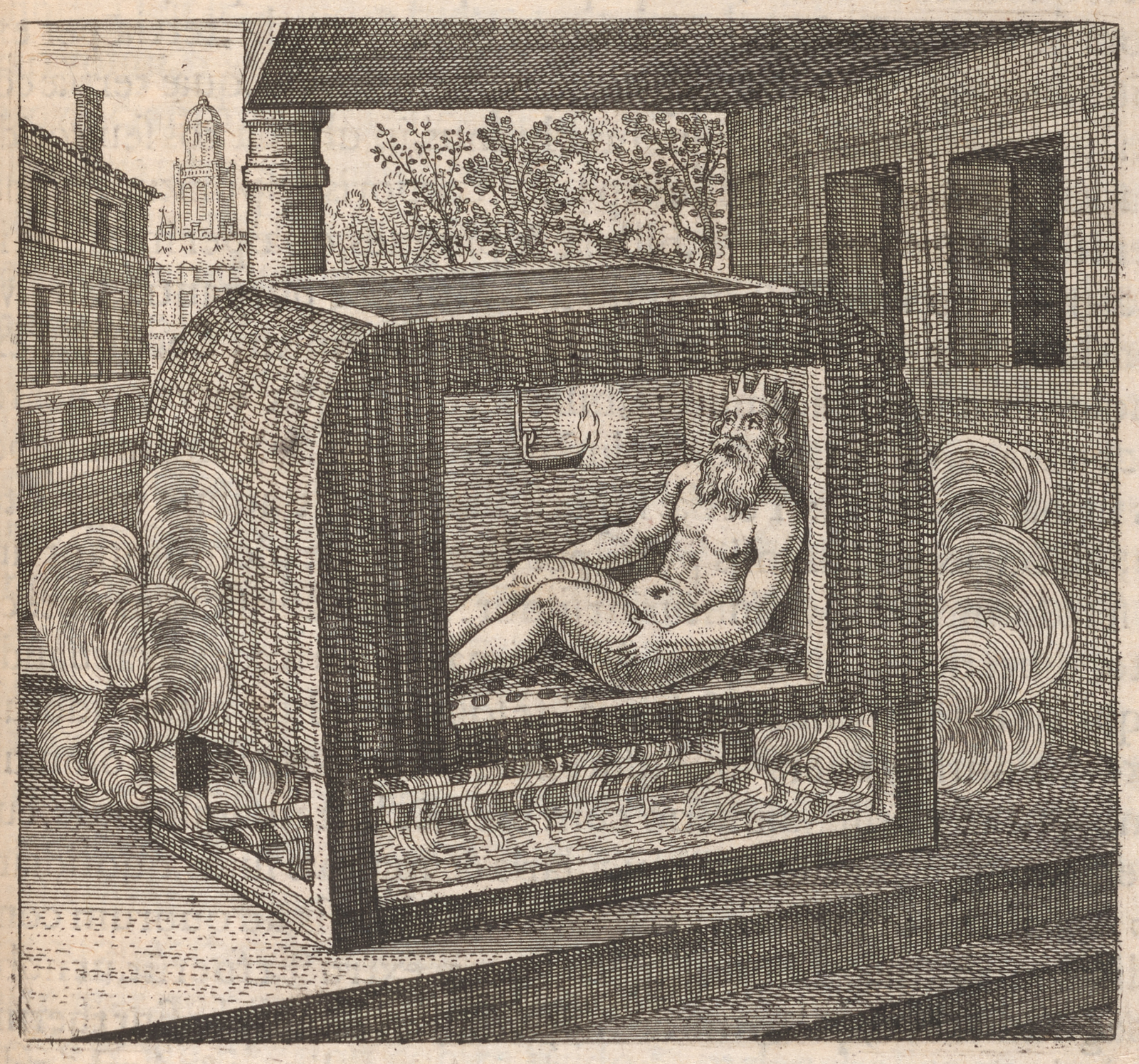
Emblem XXVIII presents the most explicitly medical allegory in the Atalanta Fugiens: King Duenech, suffering from Saturnian melancholy and black bile, is cured by the physician Pharut through a series of steam baths. Maier's discourse systematically compares the three cooking processes of the human body (in stomach, liver, and veins) with three analogous processes in metallurgy, establishing that purification of metals and purification of humors follow identical logic. The three excretory products, from coarse intestinal discharge to fine sweat, correspond to increasingly subtle stages of chemical separation.
De Jong traces the source to the Processus Chemici in the Theatrum Chemicum, specifically the allegory of the monarch Duenech. The name itself derives from the Arabic word dueneg, meaning vitriol. The "Green Lion" with whose weapons Duenech shines is green vitriol, the strongly caustic dissolving agent. The Rosarium Philosophorum states explicitly that the true matter is obtained only in the green lion, also called Adrop, Azoth, or the green Duenech. Dissolving gold in green vitriol is the chemical operation hidden behind the allegorical cure. The Merlini Allegory and the Lambsprinck emblems provide parallel king-in-bed imagery, connecting this emblem to a wider network of transmutation narratives.
Maier's pedagogical method here is to make the reader simultaneously a physician and an alchemist. The steam bath that drives black bile to the surface of the skin, restoring healthy red blood, is identical in structure to the furnace operation that drives impurities from base metal. The discourse instructs the reader to choose the right king's child even when he appears in a lead-colored, melancholy manifestation, for when well washed his royal figure will appear. This medical-chemical parallel, where diagnosis and assay are the same act, is Maier's most sustained demonstration that iatrochemistry and chrysopoeia share a single theoretical foundation.
Emblem XXIX
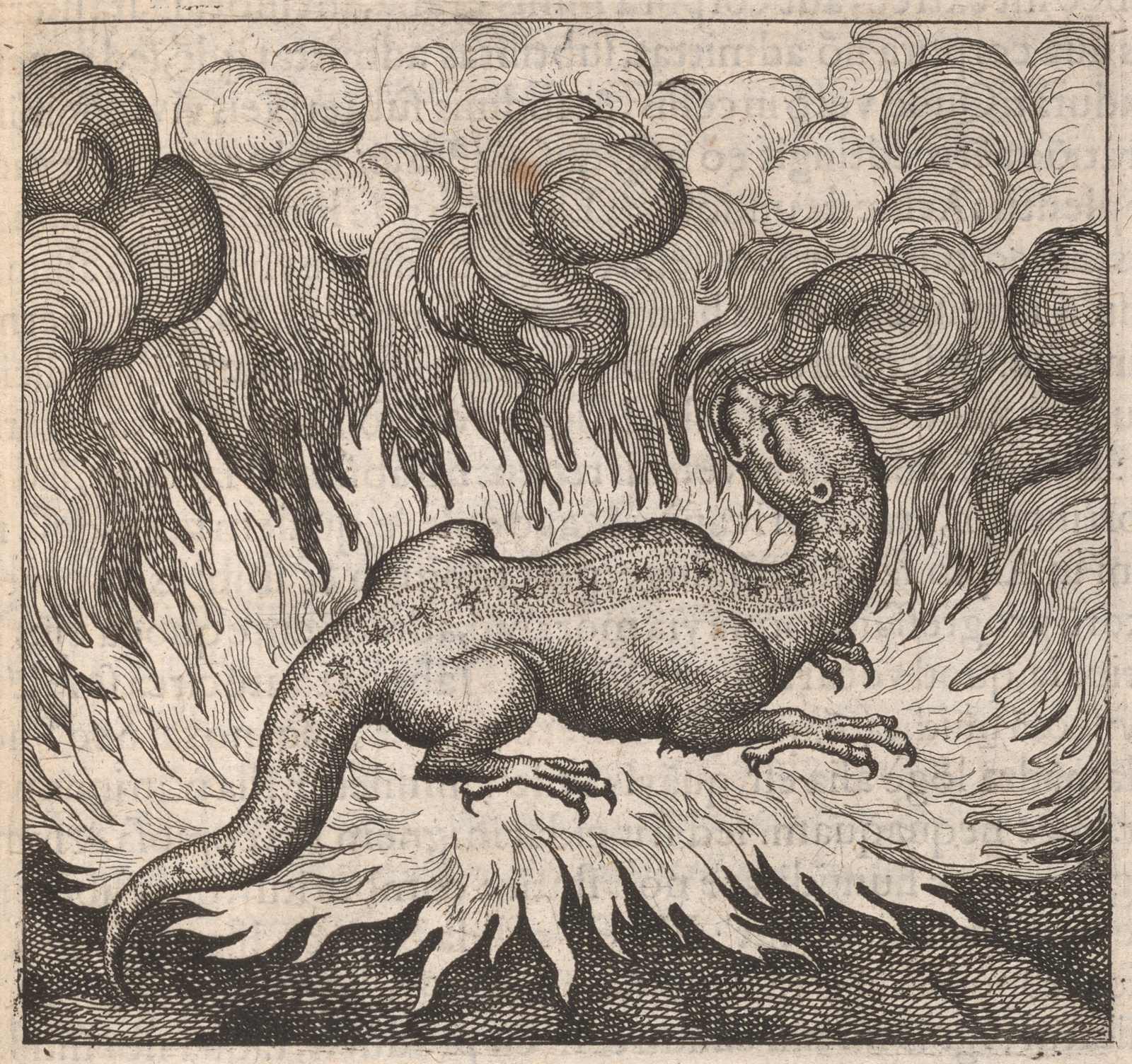
The Salamander that lives in fire encodes the final stage of the alchemical process: the achievement of perfect fixation. In chemical terms, the Stone has been hardened to such extreme solidity that fire can no longer destroy it. Maier distinguishes the common salamander, which survives fire through an excess of moisture that extinguishes the flames, from the Philosophical Salamander, which is born in fire and is itself hot and dry. The distinction is between a substance that merely resists heat (like an asbestos-like coating) and one that has been fundamentally transformed into the nature of fire itself.
De Jong identifies Avicenna's Tractatulus de Alchimia as the source, where the philosophers call their stone the Salamander because it is fed exclusively by fire and perfected by it. The key chemical concept is equilibrium: Avicenna describes one substance balanced in composition, equally warm and cold, equally dry and wet, such that when fire tries to convert its water into air, the earth prevents this, and when fire tries to turn the earth to ite ashes, the water opposes it. The four elements hold each other in check, producing indestructibility. Lambsprinck's parallel emblem confirms the identification: the Salamander represents the reiteration, gradation, and augmentation of the Tincture.
The pedagogical dimension lies in Maier's reframing of Avicenna's elemental theory as natural history. The discourse opens with a first-person account of seeing salamanders in the Alps after thunderstorms, where a farmer called them "Molch." This grounding in personal observation before pivoting to philosophical interpretation is characteristic of Maier's method. The reader moves from empirical natural history to elemental theory to alchemical practice, learning that fixation is not an arbitrary operation but the achievement of the same balanced composition that nature occasionally produces in living creatures.
Emblem XXX
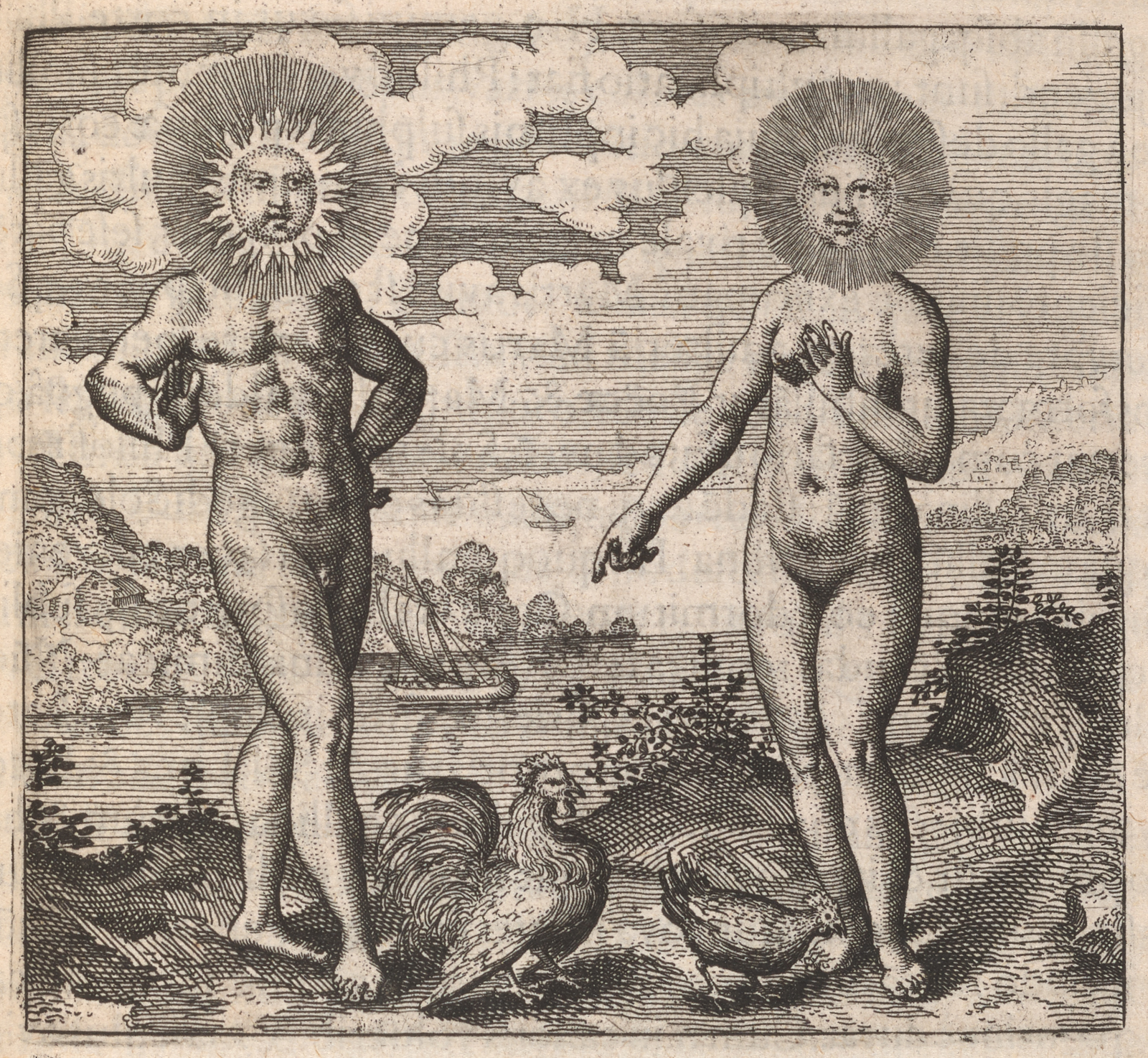
Emblem XXX presents the conjunction of Sol and Luna under the domestic allegory of cock and hen. The chemical content is the union of sulphur (hot, dry, combustible) with mercury (cold, moist, volatile) to produce a balanced compound. Maier's discourse details the complete sequence of laboratory operations that this union requires: solutio, coagulatio, sublimatio, ascensio, descensio, distillatio, calcinatio, and fixatio. Remarkably, he then declares that all these operations can be comprised in one word: cooking, just as chickens running in all directions come together under one mother hen.
The source is Senior Zadith's Tabula Chimica, specifically the Epistola Solis ad Lunam, in which the Moon addresses the Sun: "You need me like the cock the hen, and I need your action, O Sun." The Rosarium Philosophorum provides the visual source, with its famous woodcut of the crowned man and woman united in the sea, personifying Sol and Luna with their respective celestial signs. De Jong notes that Maier knew both the Rosarium and its underlying source in Senior, demonstrating his characteristic method of tracing alchemical traditions to their roots.
The allegory transforms conjugal partnership into a chemical lesson about complementarity. The cock is dedicated to the Sun, rises with it, and repeatedly turns its eyes to heaven. The hen broods with care, regulates warmth, and breaks hard grains for its young. Together they model the precise temperature control and patient attention that the alchemist must exercise. The lasting marriage between Sol and Luna, after which there will be only one bed and one body, describes the moment when the sulphur-mercury opposition resolves into the unified Stone.
Emblem XXXI
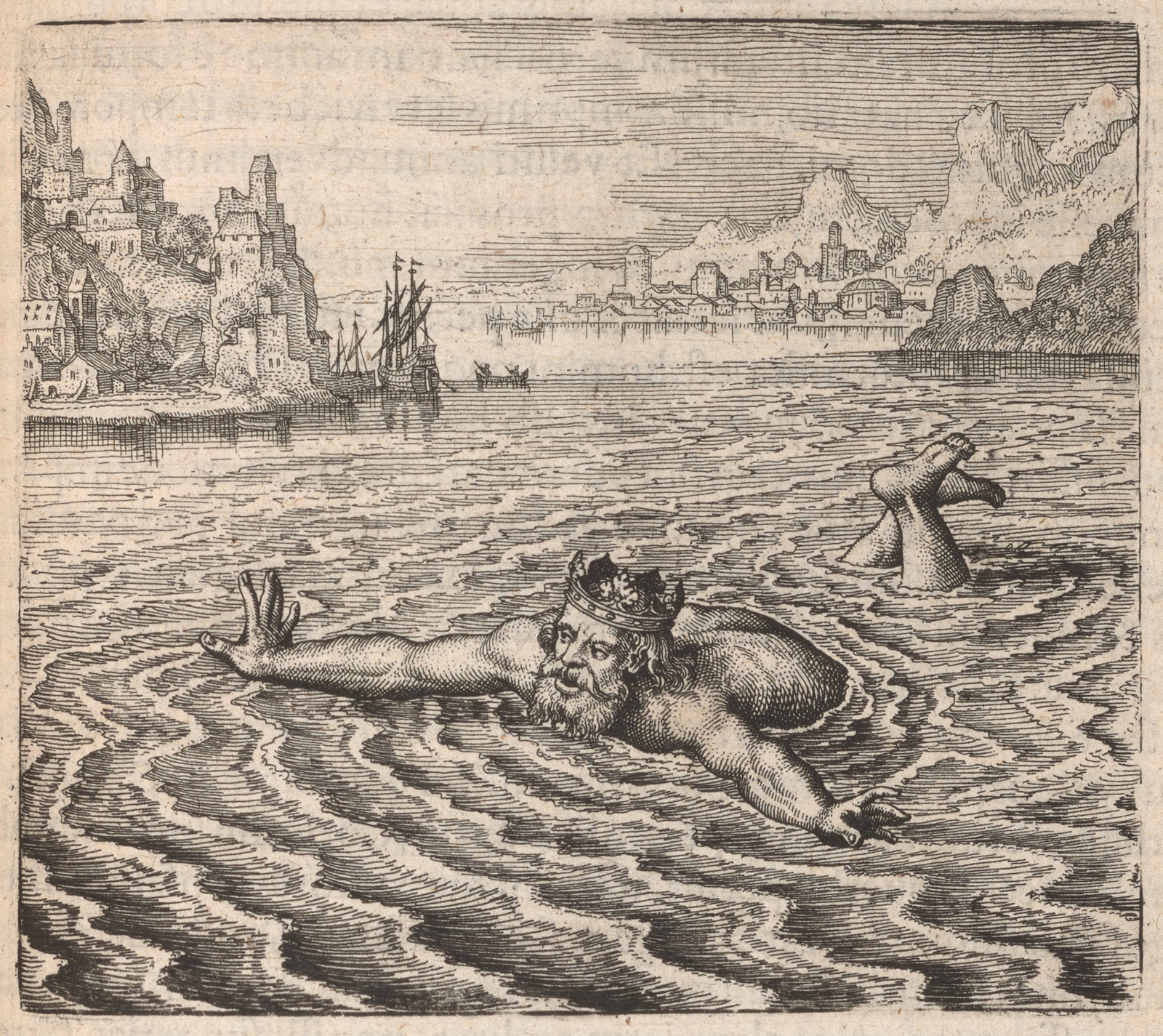
The king swimming in the sea and crying for rescue encodes the dissolution of gold in the mercury substance. The sea is identified as the Red Sea, situated beneath the Tropic of Cancer, containing magnets that pull iron-laden ships downward. This is Maier's allegory for the dissolving power of the mercurial water, which breaks down the metallic body and submerges it in the prima materia. The king's crown, sparkling with gems, represents the essential form of gold that must be preserved even as the metal body dissolves.
De Jong traces the image to the Rosarium Philosophorum, where Hermes is quoted saying that the stone calls out for help. In Maier's Symbola Aureae Mensae, the true antimony of the philosophers is described as hidden in the deep sea, living and calling from the depths. The connection to Psalm 69, where the psalmist cries out from deep waters, establishes the polyvalent meaning that De Jong identifies as characteristic of Maier's method: the king is simultaneously gold in solution, the soul calling for redemption, and a prefiguration of Christ.
The medical dimension emerges in the cure prescribed after rescue: sudorifics to expel swallowed water, heat to counter cold, moderate baths for stiffened limbs, and a sensible diet for hunger. This therapeutic regimen mirrors the sequence of operations needed to recover the dissolved gold and reconstitute it in purified form. Maier transforms what is essentially a recipe for precipitating gold from solution into a drama of kingship, peril, and restoration, making the reader invest emotionally in what is fundamentally a problem of chemical recovery.
Emblem XXXII
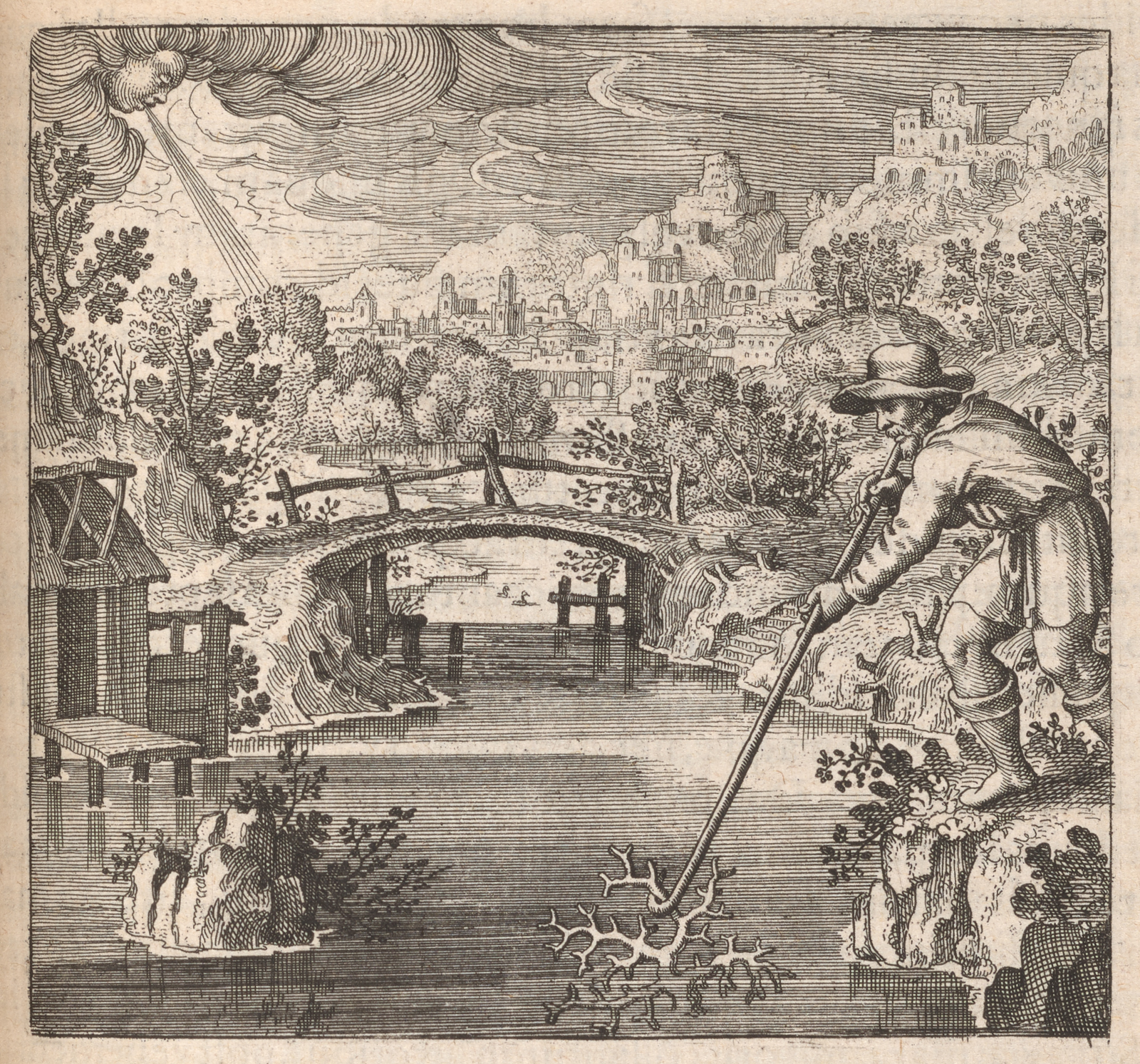
Coral growing soft underwater and hardening in air provides Maier with a natural-historical analogy for the Stone's transformation from volatile liquid to fixed solid. The chemical process described is precise: coral is soft and pliable in its native element but becomes hard and fragile when exposed to cold, dry air from the north wind, which draws out superfluous moisture. The earth-body that remains is hardened by the properties of coldness and dryness. This maps directly onto the coagulation stage of the alchemical work, where the volatile mercury water must be dried and fixed.
The source is the Allegoriae super Turbam in the Artis Auriferae, which provides a detailed recipe using coral as a metaphor: the substance is ground, soaked in sea-water for twenty-one days, placed in a bath until its dyeing spirit appears, washed and sublimated seven times until it becomes the whitest salt, then reunited with its tincturing spirit and placed in a humid location until the red color appears. De Jong notes the explicit parallels to other emblems: the bath of Duenech in Emblem XXVIII, the seven washings of Naaman in Emblem XIII, and the whitening of Latona in Emblem XI.
Maier's genius here is to find in marine biology an exact structural parallel to his chemical process. The coral tincture of antiquity provides both the color symbolism (the progression to red) and the practical insight that separation of superfluous liquid is the key difficulty. The philosophical coral is simultaneously vegetable, animal, and mineral, containing curative powers surpassing all herbs because the heavenly Sun gave more to this son and substitute than to all others. The natural history lesson becomes a chemical instruction manual wrapped in wonder at nature's ingenuity.
Emblem XXXIII
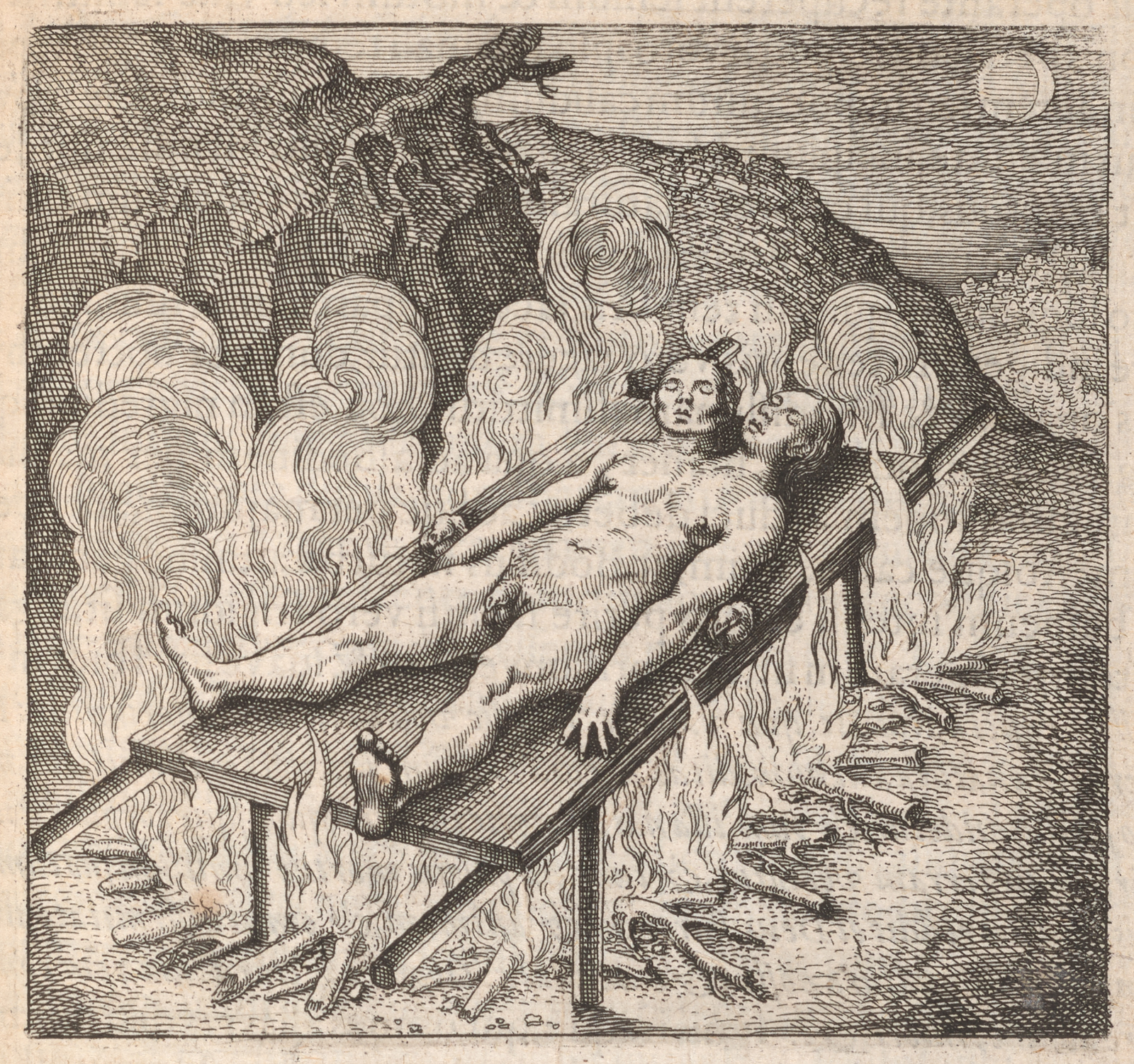
The Hermaphrodite lying in darkness like a dead person encodes the nigredo stage, the blackness of putrefaction from which the work must be revived through carefully graduated heat. The chemical reality is that the combined sulphur-mercury substance, after initial conjunction, appears inert and lifeless. Only the application of fire, first moderate then increasingly strong, drives the transformation from black through white to red. The discourse explicitly states the sequence: blackness as a sign of coldness must be brought to whiteness by increasing fire, and then to redness by still stronger fire.
De Jong identifies the Turba Philosophorum as the source, specifically the sententia of Bonellus: the nature from which moisture has been taken away, when put away during several nights, resembles a dead person, and then that nature needs fire until the spirit of that body has been changed. The Turba passage continues to describe how the matter becomes like a dead man in his grave, then God gives body and soul back, frees it from all imperfection, fortifies and perfects it. The motto instruction to burn without fear until it becomes ashes suitable to receive its spirit encodes the calcination process.
The Phoenix motif introduced in the discourse connects the chemical process to the broader theme of death and resurrection. Maier then pivots to a medical analogy about sex change, describing how increased warmth can cause hidden organs to appear, converting female (cold, moist) nature into male (hot, dry) nature. The Philosophical Hermaphrodite contains both natures, and the transformation of female into male through added heat is the conversion of volatile mercury into fixed sulphur. The reader learns that what appears to be death in the flask is actually the precondition for a more powerful form of life.
Emblem XXXIV
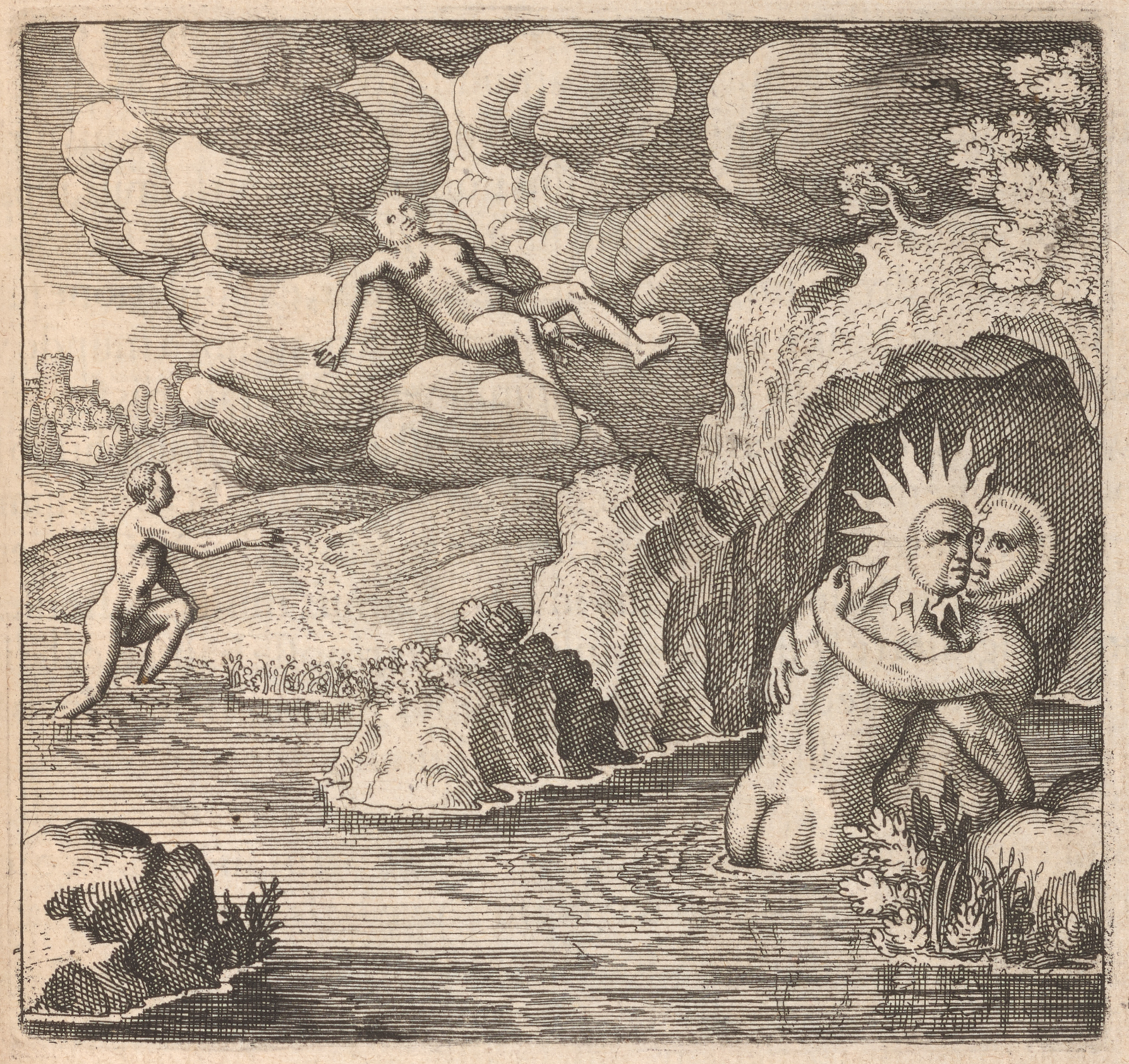
Emblem XXXIV encodes the complete cycle of distillation in a single allegory: the Stone is conceived in the bath (dissolved by tepid, moist warmth), born in the air (the fine matter rises as vapor in the retort), and having become red, strides over the waters (the perfected tincture dominates the liquid metals). The chemical process is taken directly from metallurgical practice: the putrefactio occurs at the bottom of the vessel in darkness and moisture, the birth happens in the alembic or helmet where the airy vapors condense in white, and the final reddening signifies completion.
De Jong traces the source to Senior Zadith's Tabula Chimica and the Scala Philosophorum, supplemented by Rosinus ad Euthiciam. The Rosarium Philosophorum provides the crucial explanation that conception takes place when the earth is dissolved into black matter and starts retaining mercury, while birth occurs in the air at the top of the vessel. Rosinus explains that mountains mean the cucurbitae (pumpkin-shaped receivers), the tops of mountains mean the alembic, and to send from the mountain tops means to distil. This is one of the most transparent decodings in De Jong's entire commentary: the geographical language of mountains, air, and waters is a precise technical vocabulary for laboratory glassware.
The christological parallel is explicit and deliberate. The Stone that strides over waters evokes Christ walking on the sea. De Jong notes that the analogy between the Philosopher's Stone and Christ returns repeatedly, supported by the Rosarium's identification of the primary water with the water of Genesis over which the spirit of God floated. The emblem's epigram states plainly: he is a stone and he is not a stone. Maier makes the reader see laboratory distillation as a recapitulation of cosmic creation, turning the mundane act of heating a flask into a contemplation of divine power working through matter.
Emblem XXXV
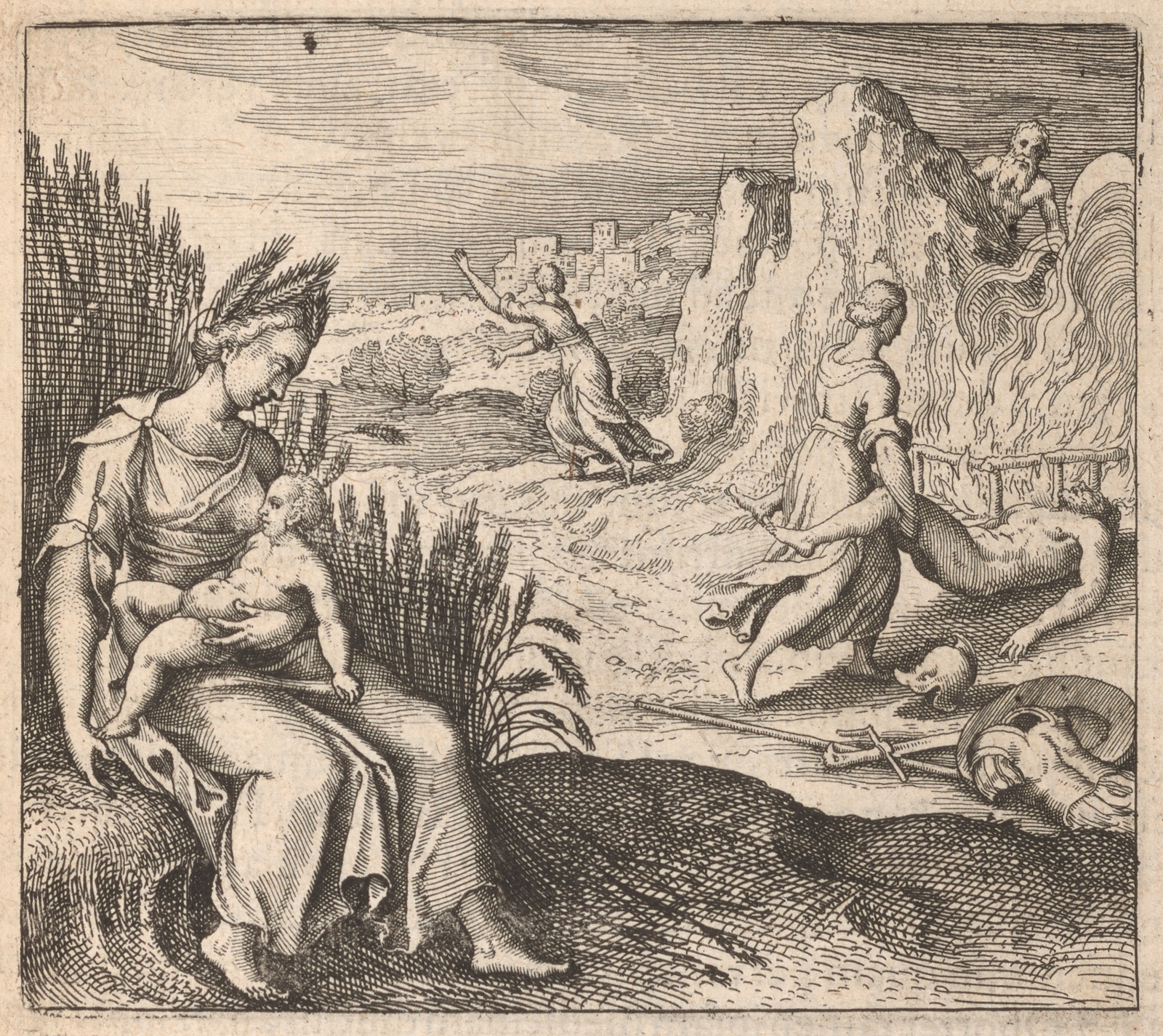
The myths of Ceres hardening Triptolemus in fire and Thetis hardening Achilles encode the principle of gradual habituation: the Stone must be accustomed to fire progressively, just as a child is first nursed on milk and only later exposed to stronger nourishment. The chemical instruction is that the matter should be cooked at increasing temperatures, beginning with the gentlest warmth (like dung) and advancing to full calcination only after the substance has developed sufficient stability. Emiganus in the Turba instructs: look at the suckling child and do not hinder it.
De Jong identifies three sources converging in this emblem: the Turba Philosophorum (Emiganus and Bodillus), Arnoldus de Villanova's Rosarium, and Maier's own Arcana Arcanissima. Bodillus provides the key passage: the fruit should be fed on milk and on a soft fire as long as it is small, then gradually accustomed to fire as its bones grow stronger. Arnoldus states that the medicine should be stewed above the fire until dry and fed like a child at the breast. The metaphor of nursing maps precisely onto the chemical requirement for graduated heat: too much too soon volatilizes the substance, too little allows it to remain inert.
Maier's mythological transformation is characteristically multilayered. Ceres nursing Triptolemus by day and hardening him in fire by night, then sending him through the world on a chariot drawn by serpents to teach agriculture, becomes an allegory for the Stone that is first gently nurtured, then calcined, and finally projected as a tincture guided by mercury (the serpents). The same pattern applies to Achilles, born of earth-father Peleus and sea-mother Thetis. Maier asserts in his discourse that Osiris, Dionysus, and Triptolemus have one and the same meaning, collapsing the entire mythological apparatus into a single chemical narrative of purification through fire.
Emblem XXXVI
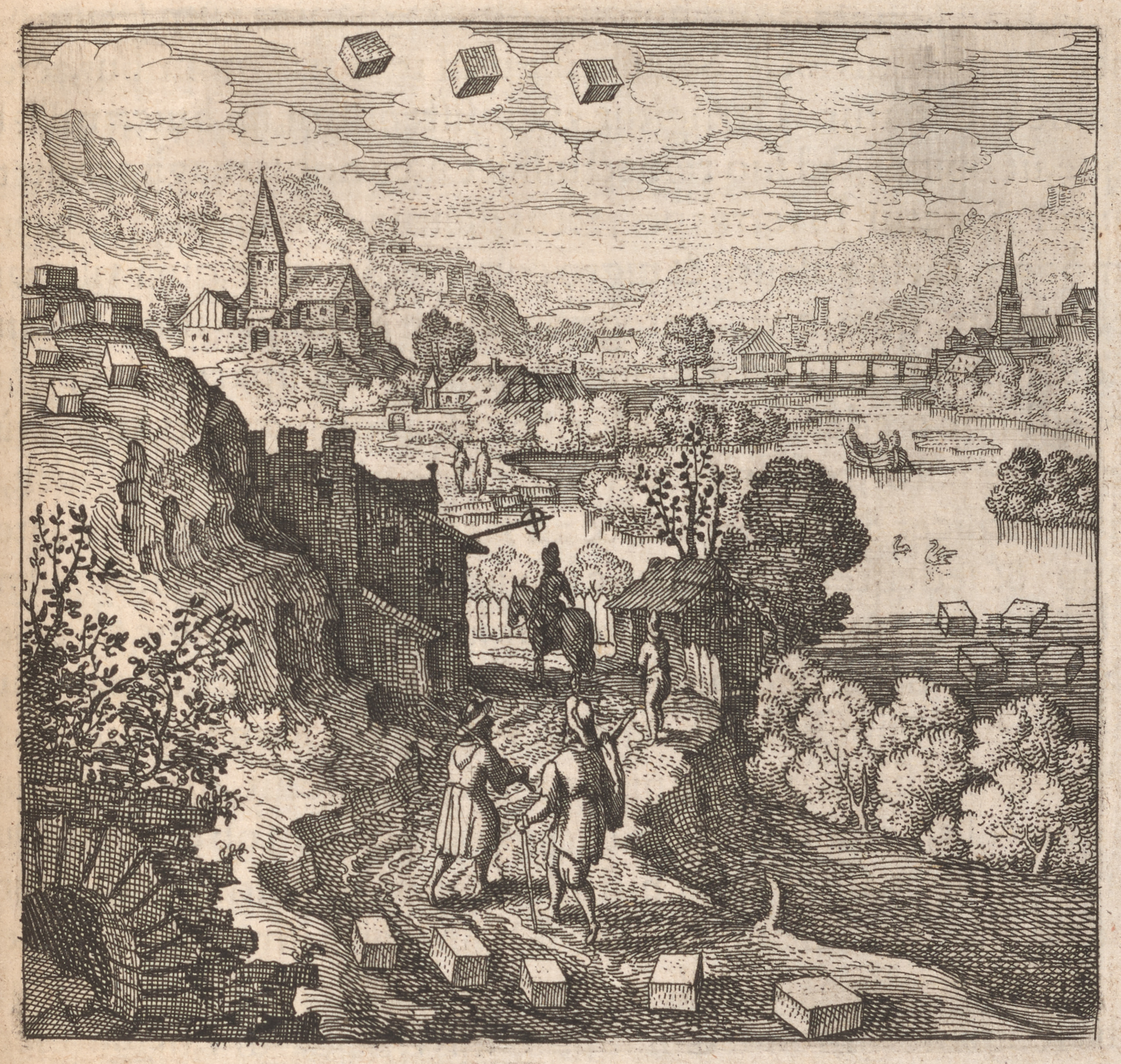
Emblem XXXVI traces the Stone's circular journey through all four elements: thrown onto the earth (the initial black, putrefied state), lifted onto the mountains (sublimation by volcanic fire), living in the air (carried in the belly of the wind, echoing the Tabula Smaragdina), and feeding in the rivers (dissolution in the mercury water). This is the most complete single-emblem summary of the elemental cycle in the entire work, mapping the four classical elements onto four successive laboratory operations: calcination, sublimation, volatilization, and solution.
De Jong traces the motto to Rosinus ad Saratantam Episcopum and the epigram to Morienus, De Transmutatione Metallorum. Morienus provides the famous declaration that the Stone is found with the rich and the poor, thrown onto roads and trampled on dunghills. The Rosarium confirms that the matter of the Philosopher's Stone is water, and that Mercury is called threefold: watery, heavenly, and earthly. Maier adds that Adam took the Stone with him from Paradise and that it is now present in everyone, connecting the laboratory process to the doctrine of the divine spark imprisoned in matter.
The pedagogical strategy is to present the Stone as simultaneously the most common and the most precious thing in existence. Maier compares it to earth itself: what is of less value than mud or excrement, yet what is more precious than Terra Mater? The discourse moves from the despised dung-heap matter through volcanic mountains to the airy heights and flowing rivers, teaching the reader that the alchemical process recapitulates the cosmic circulation of elements. The shaped, rectangular stones in the emblem picture represent the formed soul, in contrast to the unformed stone that Saturn vomited in Emblem XII, connecting the elemental cycle to the spiritual journey from chaos to geometric perfection.
Emblem XXXVII
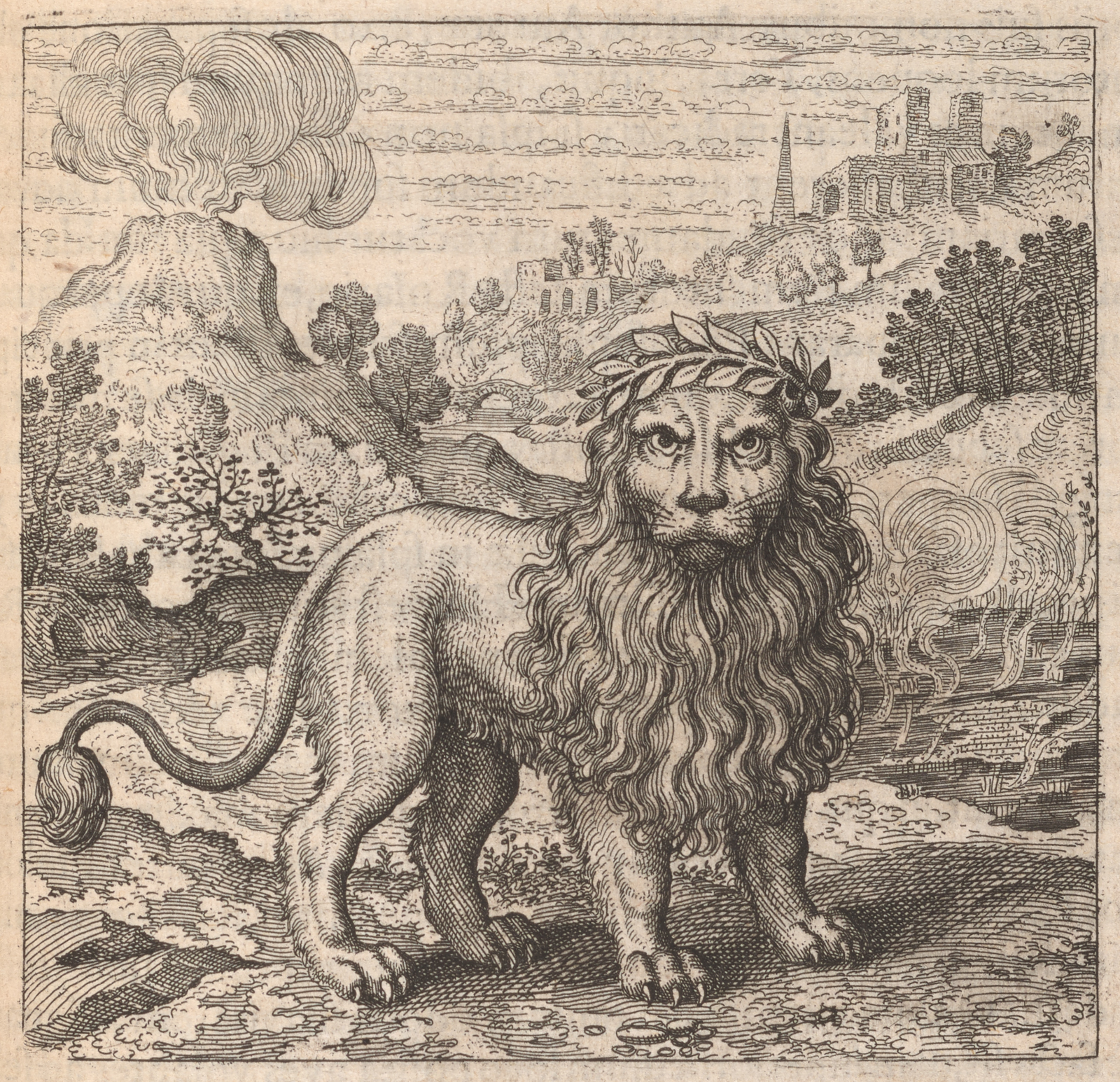
Three substances are declared sufficient for the entire masterpiece: white smoke (the condensed vapor that becomes a powerful solvent), the Green Lion (the ore of Hermes, identified as green vitriol), and stinking water (the putrefied mercurial liquid from which the work begins). These three map onto the three stages of the opus: the stinking water represents the initial putrefactio, the Green Lion the middle stage of active dissolution, and the white smoke the final purified product. In laboratory terms, the stinking water is the sulphurous, grave-smelling liquid of decomposition; the Green Lion is the caustic green vitriol that dissolves gold; and the white smoke is the sublimate or quintessence.
De Jong traces the motto to Morienus, De Transmutatione Metallorum, and the commentary draws heavily on the Consilium Conjugii and the Rosarium Philosophorum. The Rosarium identifies the Green Lion as the gold-ore of the philosophers, also called the Stone known from their writings as vapor, smoke, water, and saliva of the Moon mixed with the light of the Sun. The Green Lion fights the Dragon but is conquered and devoured, and from the dead Lion's mouth comes sweetness, just as honey came from Samson's lion. This biblical allusion transforms the chemical destruction of vitriol into a typological prefiguration of salvation.
Maier warns against literal interpretation: some laboratory workers distilled human and animal excrement after reading about "stinking water" and found only excrement among the excrement. The true stench, if present at all, soon changes into a delicious odor, as Lullius testifies about his Quinta Essentia, which lured birds from the sky. The pedagogical lesson is that alchemical language operates by analogy, not description, and that the three pillars of the work (dissolution, vitriolization, and sublimation) must be understood through their functional relationships rather than their surface names.
Emblem XXXVIII
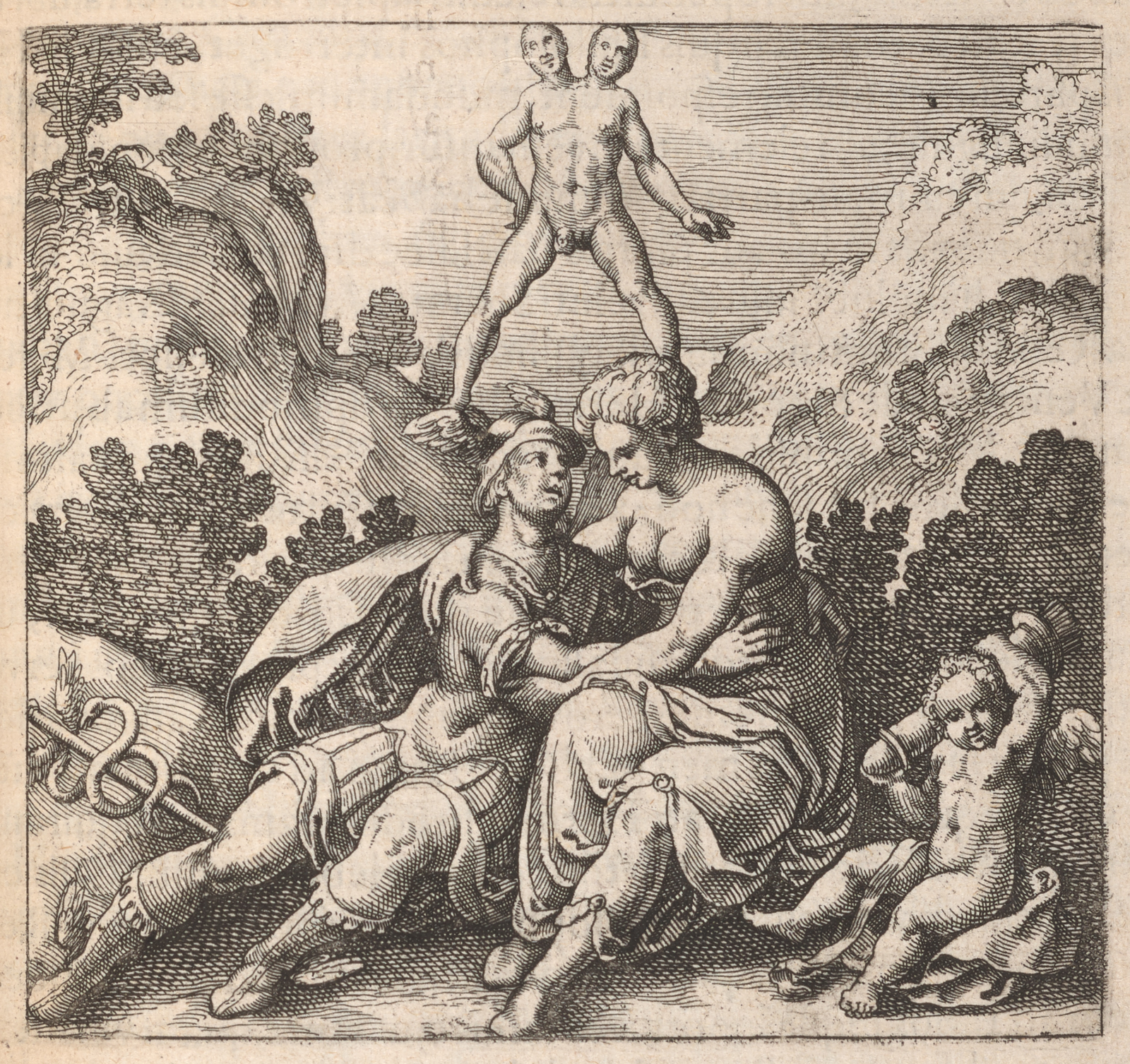
The Hermaphrodite or Rebis born from two mountains, those of Mercury and Venus, encodes the Sulphur-Mercury theory at its most fundamental level. The two mountains represent copper (Venus) and quicksilver (Mercury), and from their union through assiduous boiling-down the bisexual Stone is produced. The chemical process is the prolonged reaction of mercury with copper compounds under sustained heat, producing an amalgam that the alchemists considered to contain both active and passive principles in a single body.
De Jong identifies the primary source as Rosinus ad Saratantam, who instructs: take from the Stone, wherever it may be found, him who is called Rebis and is born in two mountains. Arnoldus de Villanova's Speculum Alchimiae supplements this: the Stone is found in two mountains, and if you desire to find it in its most perfect state, ascend the mountain higher than this world. The Turba Philosophorum provides the theoretical framework for the Hermaphrodite as the union of opposites, containing both male and female natures.
Maier transforms this chemical instruction into an extended maritime metaphor. The philosopher's books are compared to an immense ocean where even experienced seamen lose their bearings. They can determine latitude with astronomical instruments but cannot define longitude, and must navigate by promontories and islands. The two-peaked Parnassus, with Hermes on one summit and Venus on the other, surrounded by Apollo, the Muses, and the Hippocrene spring, becomes the destination that only one in a thousand reaches. The reader learns that the chemical work is a heroic labor requiring both intellectual navigation and physical endurance, with the Rebis as the prize at the summit.
Emblem XXXIX
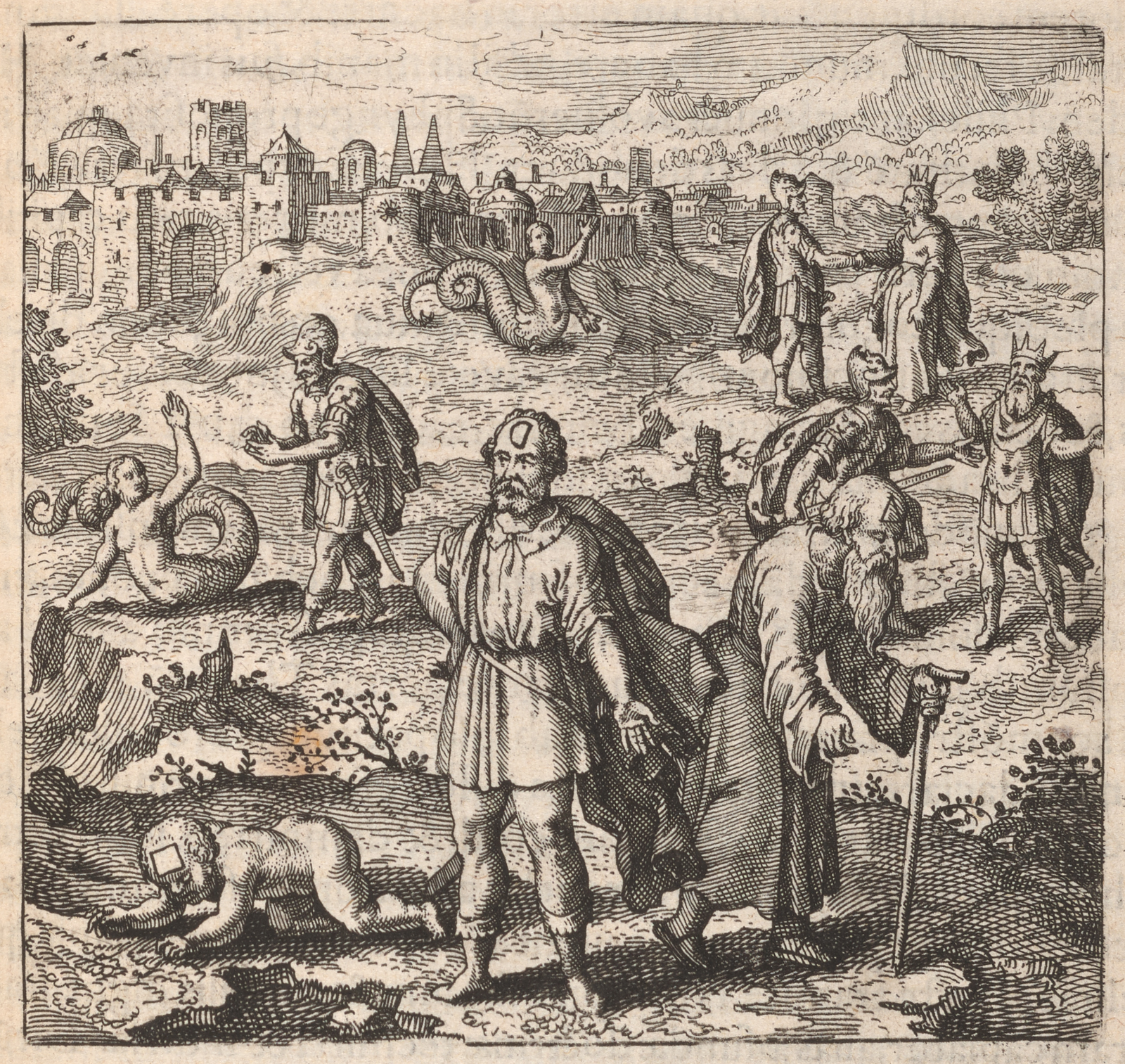
The Oedipus myth encodes the complete alchemical process from prima materia to the Stone. The Sphinx's riddle (what has four feet in the morning, two at noon, and three in the evening) is decoded not as the three ages of man but as the three geometric transformations of matter: the square of the four elements, the hemisphere of Luna made white (two lines, straight and curved), and the triangle of body, soul, and spirit (Sol, Luna, and Mercury). Rhazes confirms in his Epistola that the Stone is a triangle in its essence and a square in its properties, linking directly to the geometric formula of Emblem XXI.
De Jong notes that no direct alchemical source for the motto has been found, suggesting Maier composed it himself from classical and alchemical traditions. The Turba Philosophorum (Bacasser) provides the framing language about the difficulty of the art. The Lullian tradition and Senior Zadith's Tabula Chimica supply the theoretical underpinning for the geometric symbolism. The circular composition of the emblem picture, moving anti-clockwise from the Sphinx through the three ages to the patricide and the marriage of mother and son, mirrors the circular form of the alchemical process itself.
The patricide and incest that complete Oedipus's story encode two essential chemical operations: the active principle (father) is destroyed by its own product (son), and then the product combines with its own source (mother), achieving unity through the reunion of differentiated substances. Oedipus's swollen feet, which make him slow like a toad, hide a great chemical secret: his fixity. Because he cannot run, he reduces other things to a solid condition and is not volatile to fire. Maier teaches the reader that the mythological horror of parricide and incest dissolves into the perfectly rational chemical principle that like rejoices in like, and that the product must return to and unite with its own origin.
Emblem XL
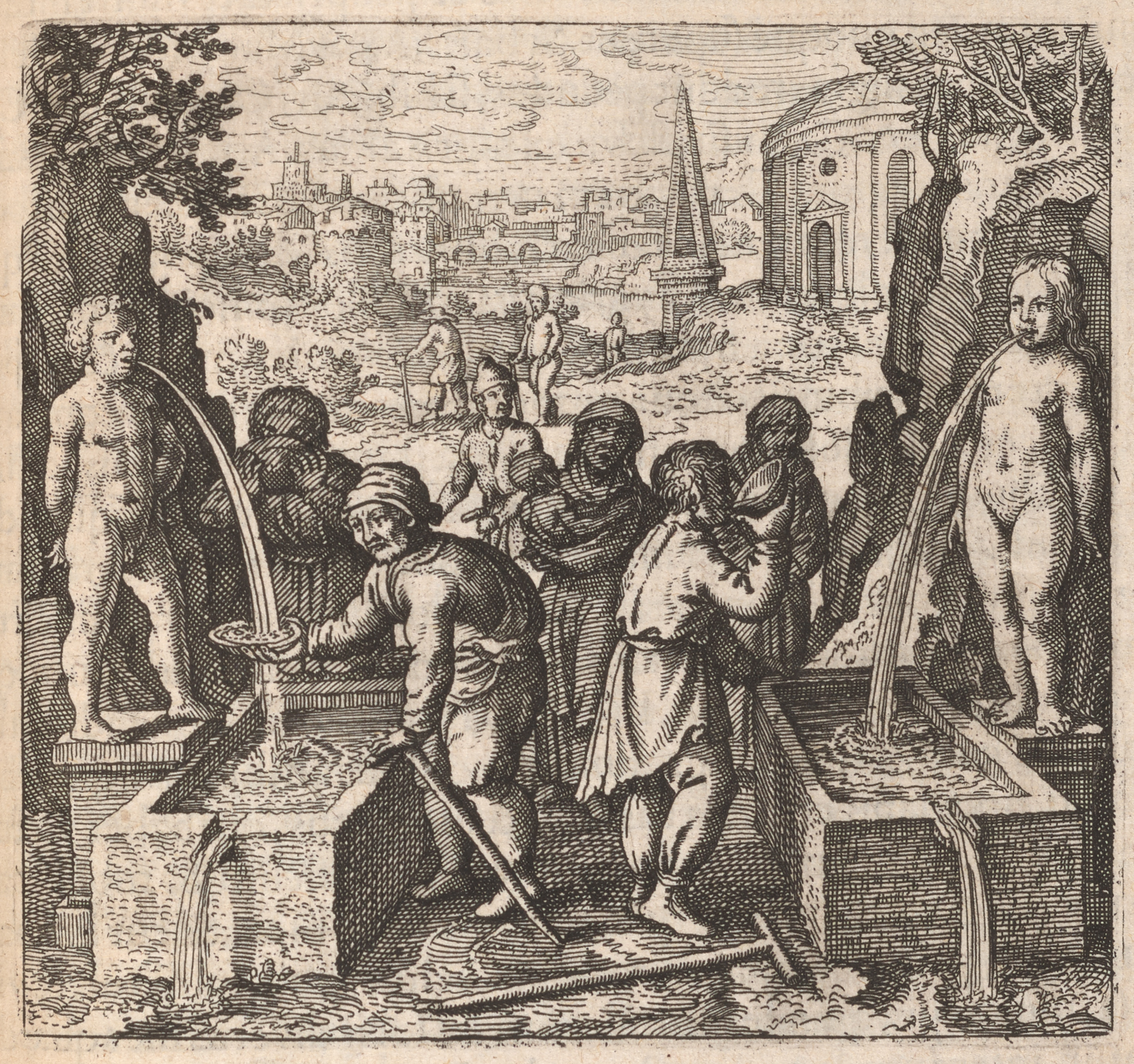
Making one water from two waters encodes the fundamental operation of combining two liquids with opposite properties: one coagulating, hardening, and fixing; the other dissolving, softening, and volatilizing. From these two opposing liquids, a single Stone results that possesses both powers simultaneously. Lullius, in his treatise on the Quinta Essentia, explains that the art requires preparing these two contrary liquids from one nature and a single metal, then combining them into a substance that can coagulate what is not coagulated, harden what is soft, and dissolve what is hard.
De Jong traces the motto to the Rosarium Philosophorum, which quotes Senior: make one water from two waters; if you have understood my short indication, the whole course of action will be under your feet. The Rosarium adds that you should have two waters, one white and one red, and Senior confirms that this is the water in which the powers of whiteness and redness are united. The Pseudo-Aristotle Tractatulus provides additional context for the union of contrary waters as the fundamental philosophical operation.
Maier frames this chemical instruction as a survey of miraculous waters from classical geography: the river Sybaris that blackens cattle, the Aphrodisius that makes women sterile, the source of Jupiter Hammon that is cold by day and hot by night. All these natural wonders pale beside the Philosophical waters. The discourse develops into a sophisticated discussion of whether artificial mixtures (like the Theriac) achieve true natural unity or merely juxtapose ingredients. Maier argues that only the Philosophical water, composed by Nature with the help of art, achieves genuine homogeneous unity, the Quinta Essentia. Szulakowska identifies this emblem as containing a reference to the alchemical sacrament, where the water of life is analogous to both Baptism and the Eucharist.
Emblem XLI
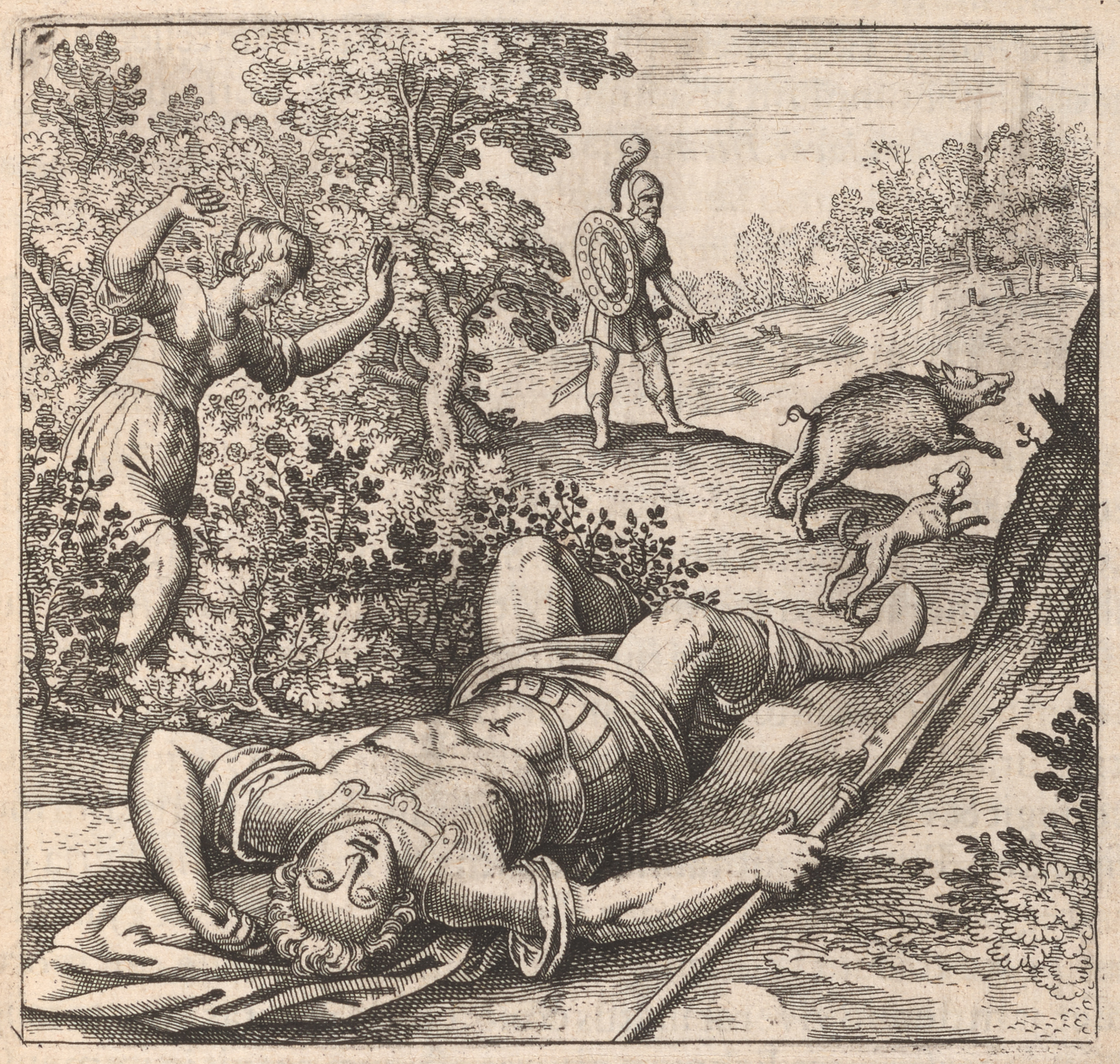
The death of Adonis by the boar and Venus coloring the roses red with her blood encode the putrefactio and the subsequent transition from albedo to rubedo. Adonis is the Philosophical Sun, and all philosophers agree on this identification. The boar represents a very sharp acid or dissolving liquid whose fiery teeth tear apart and dissolve the solar substance. Venus rushing to aid her beloved and placing him among the lettuce represents the mercurial principle collecting and preserving the dissolved matter. The white roses becoming red through Venus's blood traces the exact color sequence of the work: the whiteness of purification preceding the coming into being of the tinctura rubea.
De Jong traces the motto to Ovid's Metamorphoses X:705-740, but notes that Maier's specific detail of Venus coloring roses (rather than Ovid's anemones) may derive from the mythographic tradition recorded by Roscher. The Rosarium Philosophorum provides the alchemical interpretation through the Belinus metaphor, where Sol speaks about himself as Adonis: Saturn separates all my limbs, after which I go to my mother, who collects all my scattered members. The structural parallel to Osiris killed by Typhon (Emblem XLIV) is explicit in the discourse.
Maier insists that the incestuous origin of Adonis (born from the union of Cinyras and his daughter Myrrha) is not depraved but allegorically necessary: in this art nothing is achieved if not father and daughter, or mother and son, are united. The nearer the spouses are related, the more fertile they will be. This transforms the shocking mythological content into a chemical principle: substances of similar nature combine more readily than dissimilar ones. The annual mourning for Adonis in Syria, followed by dancing as if a dead man had risen, maps directly onto the cycle of putrefaction and resurrection that structures the entire opus.
Emblem XLII
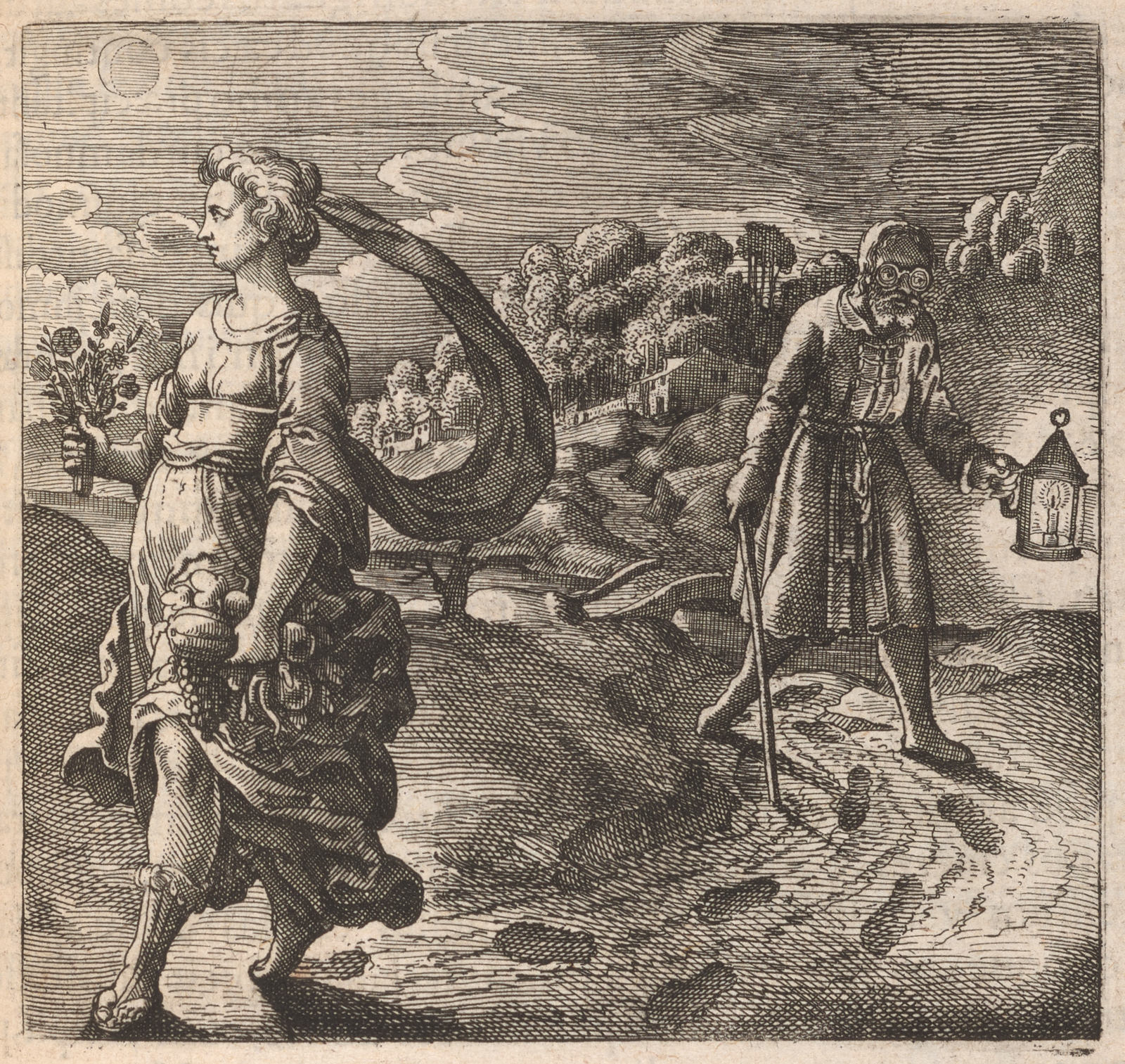
Emblem XLII is Maier's most systematic statement of alchemical methodology, declaring four essential requirements: Nature as guide, Reason as staff, Experience as spectacles, and Literature as lamp. The chemical content is distributed across all four: Nature provides the raw materials and the processes observable in mineral formation; Reason prevents the practitioner from attempting impossibilities; Experience (practical laboratory work) corrects theoretical speculation; and the books of the philosophers illuminate the darkness of ignorance. If any one of these four is missing, the other three are useless.
De Jong finds no single alchemical source for the motto in its entirety, but identifies contributions from the Aurora Consurgens, the Lullian tradition, Pseudo-Aristotle, the Tabula Smaragdina, and the Rosarium Philosophorum. The Turba Philosophorum (Bacasser) provides the culminating warning: whoever believes he can gather fruits from our books more quickly will be deceived in his hopes. The convergence of multiple source traditions in a single emblem reflects Maier's position at the intersection of Arabic, Latin, and Paracelsian alchemical scholarship.
The pedagogical strategy is meta-pedagogical: Maier is teaching the reader how to learn. The discourse uses the metaphor of a traveler on dark, slippery, dangerous roads to describe the student of chemistry, who needs a guide (nature), a walking stick (reason), good eyesight (experience), and a torch (literature). The chemist must first examine how Nature works at its very center, then apply reason to determine what is possible, then test conclusions through experiment, and finally compare results with authoritative texts. This four-part method anticipates the empirical-rational methodology of later natural philosophy while remaining embedded in the Hermetic tradition of prisca sapientia.
Emblem XLIII
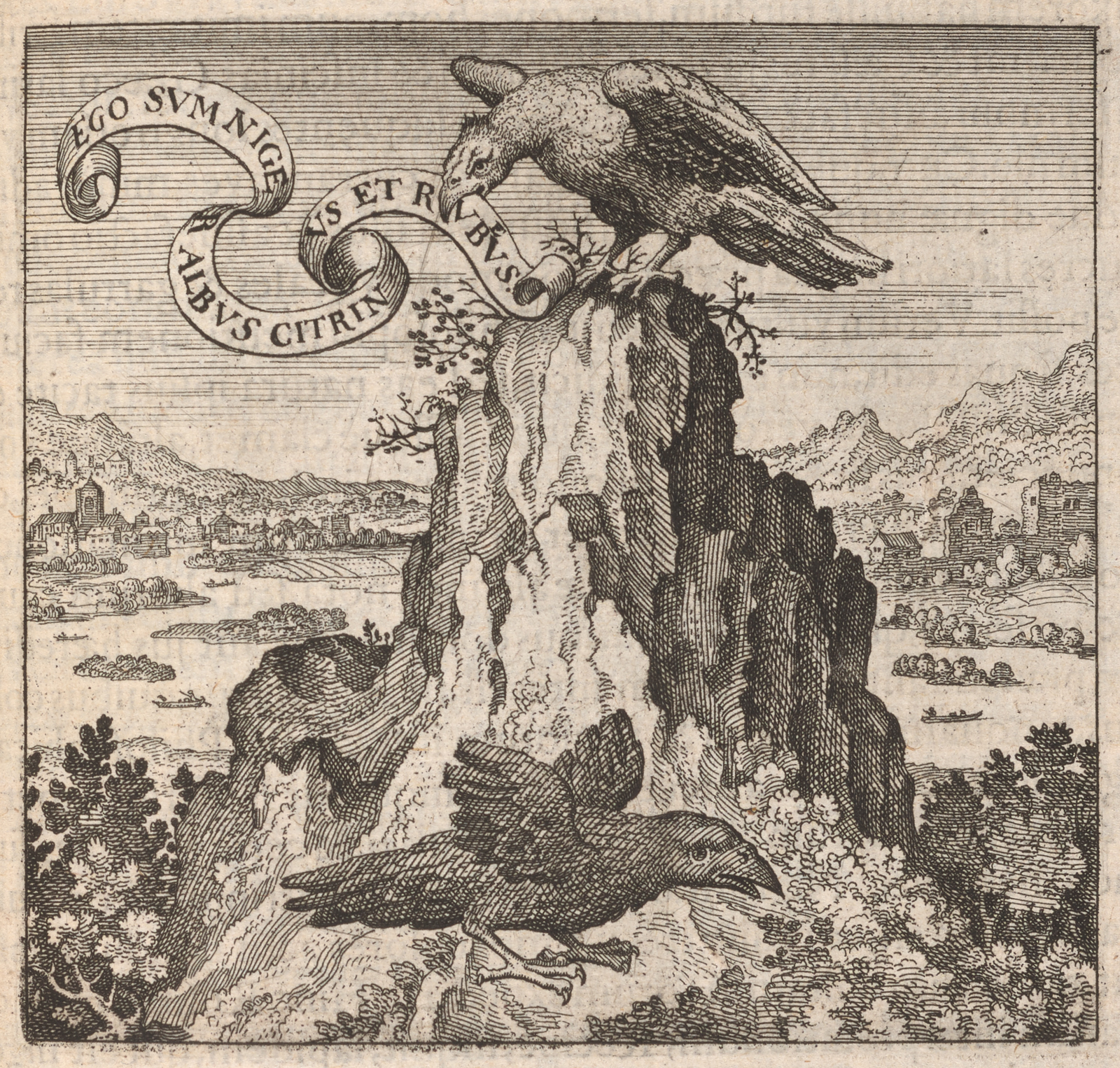
The garrulous vulture calling from the mountaintop encodes the color sequence of the alchemical process and the circular motion through which matter passes from nigredo to rubedo. The vulture proclaims: I am the white of the black, the yellow of the red, and I am very truthful. These four colors (black, white, yellow, red) represent the canonical stages of the opus: putrefactio, albedo, citrinitas, and rubedo. The raven that flies without wings in the dark of night and the clear daylight represents the same substance in its initial black stage, while the vulture represents the completed work containing all stages within itself.
De Jong traces the motto to the Tractatus vere Aureus attributed to Hermes Trismegistus, also cited in the Rosarium Philosophorum. Rosinus ad Saratantam provides the parallel instruction: receive the Stone which is black, white, red and yellow, which is the wonderful bird flying without wings. From the bitterness arising in its throat, color is obtained; from its blood, pure water. Alexander adds: sons, receive the Stone with the four colors. De Jong notes that the Codex Vossianus Chemicus contains a variant illustration showing a crowned retort with the raven at the bottom of a closed globe, with the caption: the beginning of art is the body of the raven and the tail of the snake is its end.
Maier's natural-historical digression on vultures serves the pedagogical function of making the abstract color sequence memorable through zoological analogy. Vultures are black, slow-flying, become pregnant without males, and build nests on high rocks that no one can reach. Each detail corresponds to a chemical property: the blackness of the starting material, the slowness of the process, the self-generating nature of the work, and the inaccessibility of the final product to the uninitiated. The vulture's fight with the Mercury serpent represents Sol fighting with Luna, the fundamental opposition whose resolution produces the Stone.
Emblem XLIV
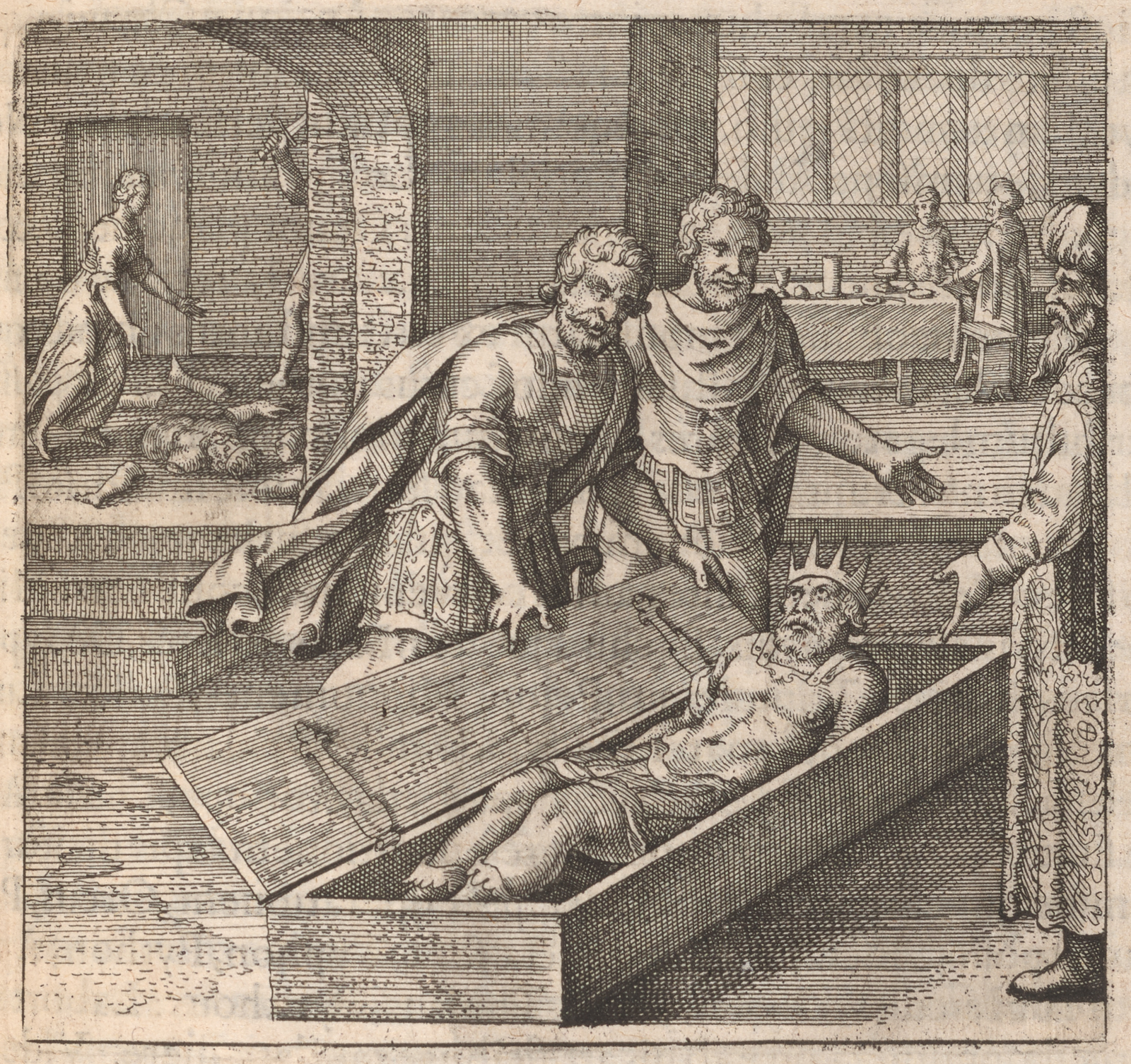
The killing of Osiris by Typhon and the gathering of his scattered limbs by Isis is Maier's most comprehensive mythological encoding of the dissolution-and-reconstitution cycle. Osiris is the Philosophical Sun, the raw material from which the golden medicine is made. Typhon is the fiery spirit of putrefaction that pierces and dismembers the solar substance, reducing it to prima materia. Isis, simultaneously sister, wife, and mother of Osiris, represents the soul or mercurial principle that collects the scattered elements and reconstitutes the whole. The lost phallus, spread over the waves, signifies that the active sulphur principle is temporarily dissolved in the mercurial water.
De Jong identifies Diodorus Siculus as Maier's primary source, confirmed by Maier's own Arcana Arcanissima, which systematically reads Egyptian mythology as encoded chemistry. The discourse provides an extraordinary catalogue of correspondences: Sol equals Osiris, Dionysus, Bacchus, Jupiter, Mars, Adonis, Oedipus, Perseus, Achilles, Triptolemus, Pelops, Hippomenes, and Pollux. Luna equals Isis, Juno, Venus, Atalanta, Latona, and others. Fire is Vulcan, matter and form are Mercury, and the cause of all things is Saturn.
This emblem functions as the key to the entire mythological system of the Atalanta Fugiens. By showing that all the gods and heroes are chemical principles wearing different masks, Maier transforms classical mythology from a collection of stories into a unified technical vocabulary. The annual mourning for Osiris followed by celebration of his resurrection mirrors not only the chemical cycle of death and rebirth in the flask but also, as De Jong observes, the connection between alchemical allegory and the Rosicrucian promise of revelation through the Chymische Hochzeit.
Emblem XLV
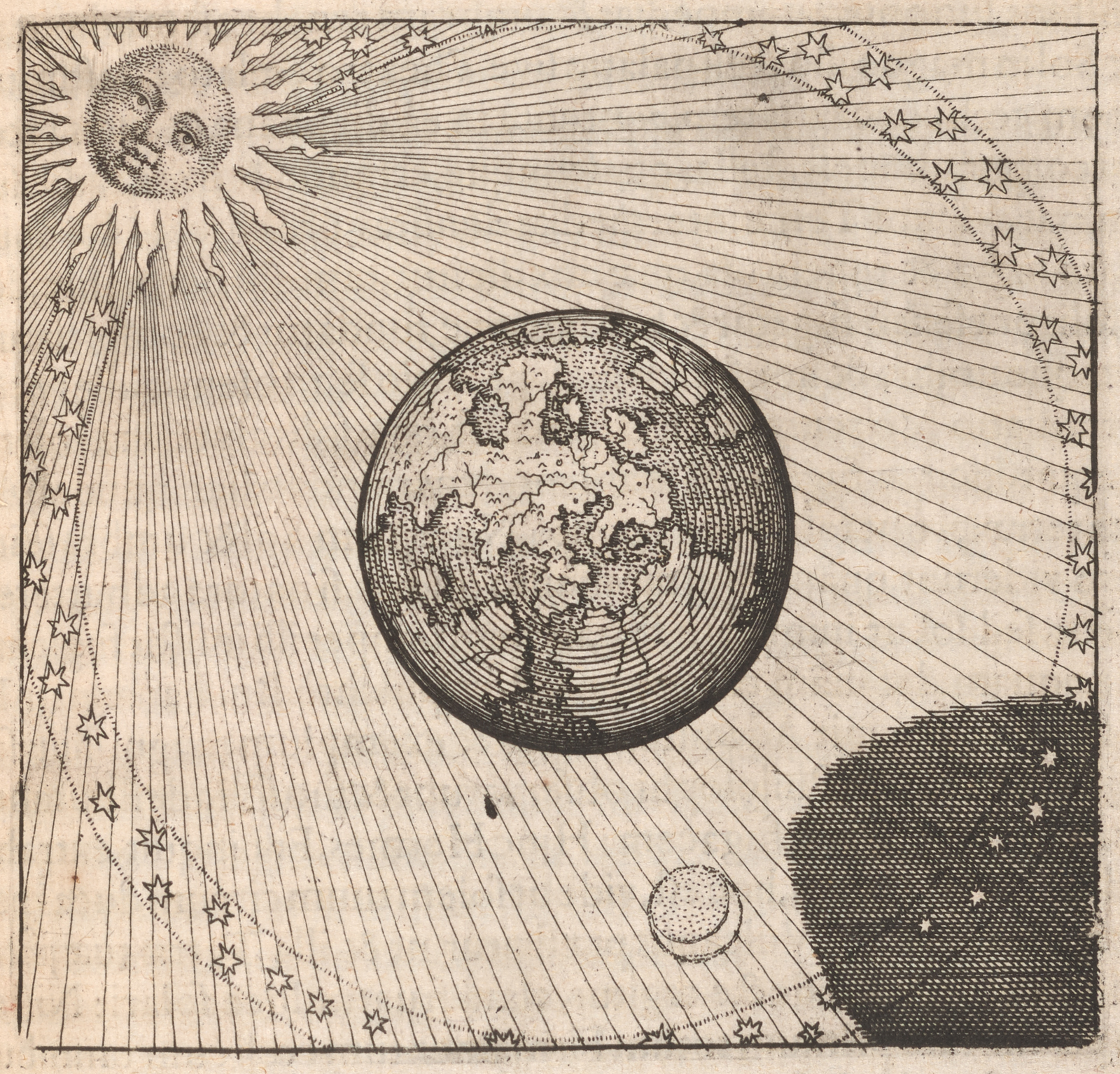
Sol and its shadow completing the work encodes the fundamental sulphur-mercury duality in astronomical terms. The Sun creates day, but cannot do so without the shadow created by the earth's opacity. Likewise, the Philosophical Sun (active sulphur) requires its shadow (passive mercury, the dark Moon) for the work to proceed. The Turba Philosophorum states: the everlasting water is the pure water of life, and no dyeing poison is generated without the sun and its shadow. The Rosarium clarifies that Sol and its shadow are the same as the Sun and its wife, making this another variation of the perpetual Sol-Luna motif.
De Jong traces the motto to the Rosarium Philosophorum and ultimately to the Turba Philosophorum. Democritus, in book three of the golden table, instructs that the shadow should be chased away from Latona and Magnesia by a fiery medicine, connecting this emblem to Emblem XI where Latona's black spots must be made white. The shadow is the nigredo that must be gradually eliminated through increasing heat, just as the astronomical shadow shrinks when the sun reaches its zenith.
The discourse provides remarkably precise practical instructions disguised as astronomical observation. The work should begin when the Sun returns from the South to the northern pole, when it enters Capricorn (winter); the first stage must be completed when the Sun stands in Aries (spring). Then the women's work commences until the Sun stands in Leo (summer), after which one work proceeds from the other until the year seizes its tail with its head like a snake, referencing the ouroboros of Emblem XIV. This mapping of the alchemical timeline onto the astronomical year gives the reader both a calendar for their work and a cosmological framework that connects laboratory practice to celestial order.
Emblem XLVI
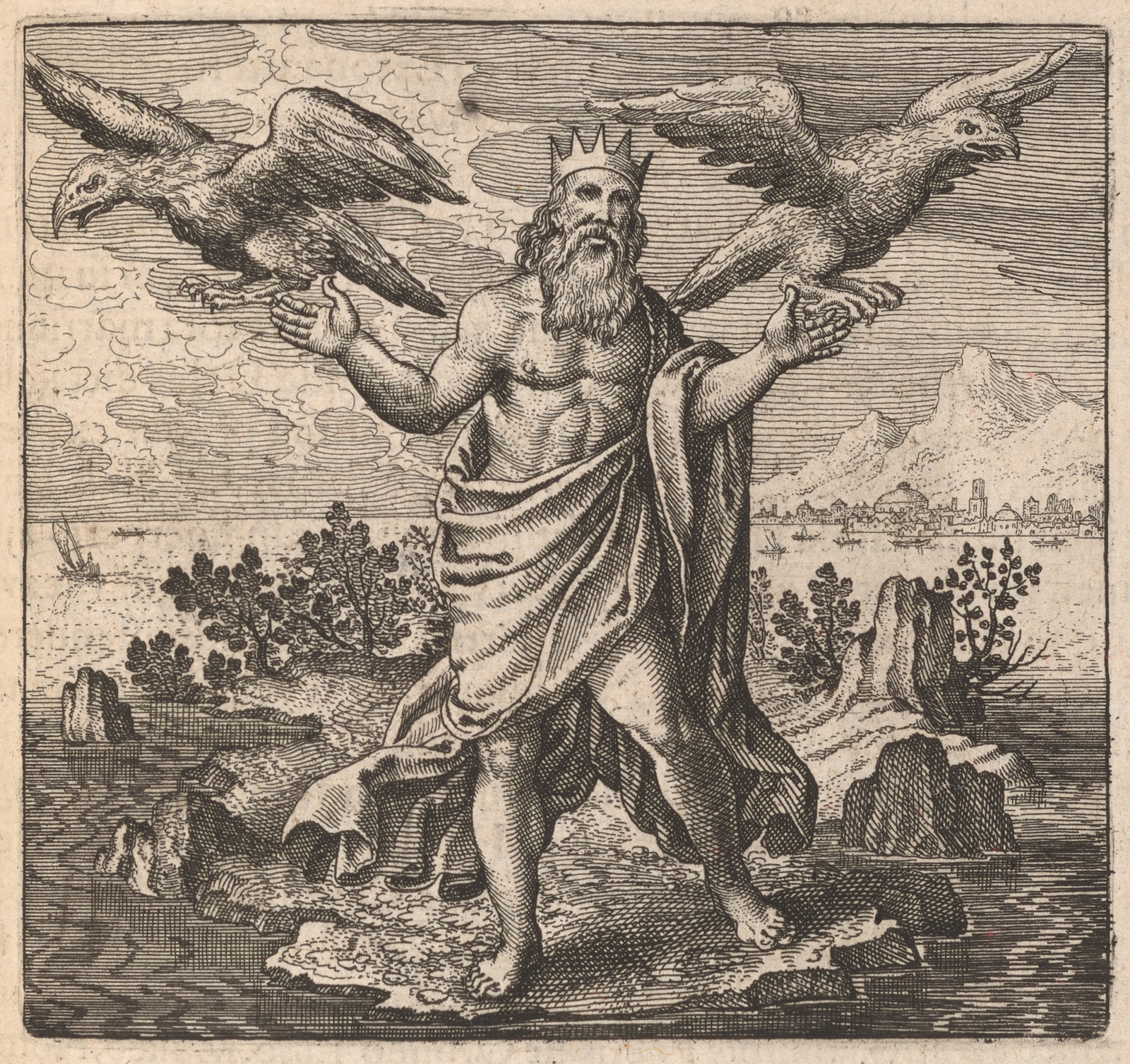
Two eagles meeting from East and West at Delphi, the center of the earth, encode the conjunction of the two principal stones: the white stone appearing in the West above the waters from evening until midnight, and the red stone rising in the East from sunrise until noon. The chemical content is the union of the albedo product (the white, lunar tincture) with the rubedo product (the red, solar tincture) at the midpoint of the work. The Aristotelian letter to Alexander, preserved in the Consilium Conjugii, provides the technical description of these two stones and their contrary motions.
De Jong identifies the Consilium Conjugii, seu de Massa Solis et Lunae as the primary source, confirmed by Maier's own citation of it in the Arcana Arcanissima alongside a discussion of the Apollo sanctuaries at Delphi. Jupiter's eagles prove that Delphi is the center of the earth, and Maier concludes that these are the two eagles that meet at the center, where a golden eagle is set up as a monument. The center of the earth is the center of the Microcosm, parallel with the center of the circle as the symbol for God.
The transformation of chemical instruction into mythological narrative here involves a double movement: from Delphi as a geographical cult site to Delphi as the navel of the alchemical cosmos. The eagle's properties (testing its young against the Sun, casting off those that cannot endure the light, being immune to lightning, fighting with the Dragon) all map onto properties of the Stone. The eagle that renews itself by immersion in a spring and appears rejuvenated encodes the cycle of dissolution and reconstitution. Maier makes Apollo, the chemical Sun born of Vulcan's fire, the presiding deity of this conjunction, teaching the reader that the meeting of East and West is the resolution of all opposition in the perfected Stone.
Emblem XLVII
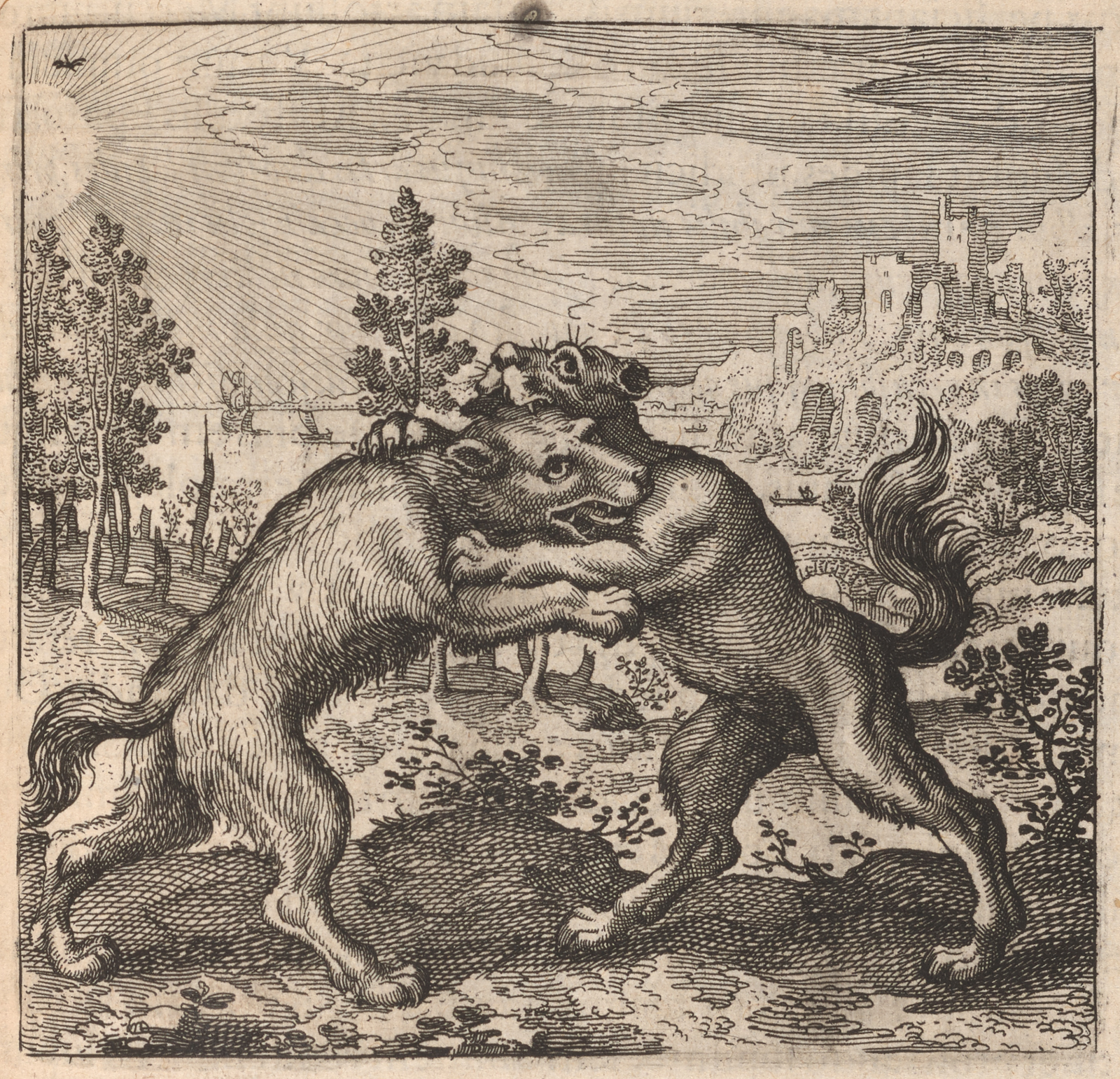
The wolf from the East and the dog from the West biting each other to death encode the mutual destruction of sulphur and mercury that produces both poison and medicine. The wolf is antimony or the sulphur principle, choleric and furious; the dog is the volatile mercury, soft and moldable. Rhazes's Epistola provides the explicit chemical identification: the wolf is found in the East and the dog in the West, they bite each other, become furious, and mutually kill each other, till poison and medicine originate from them both. This is the chemical process of combining antimony (the wolf) with mercury (the dog) under conditions where each substance destroys the other's original form.
De Jong traces the source to the Epistola of Rhazes, cited in Petrus Bonus's Margarita Pretiosa Novella, and identifies the Lambsprinck emblems as providing the closest visual parallel, with the identical motto: Wolf and Dog stay in one house, nevertheless a unity arises from them at the end. Rosinus ad Euthiciam supplies the theoretical framework: sulphur is the most powerful, fights against fire, and from this combination the most precious color arises. Senior Zadith's Tabula Chimica and Pseudo-Aristotle provide additional support for the East-West symbolism.
The pedagogical dimension lies in the paradox of mutual destruction producing a higher unity. The dog gains the first victory on account of its size and half-kills the wolf, but the wolf regains its forces and kills the dog at the expense of all its own strength. Both die, yet from their combined blood the tincture emerges. Maier teaches that the difference between wolf and dog, like the difference between sulphur and mercury, is slight, as they mutually descend from one another. The violence of the imagery, with muzzles wide open in furious rage, dramatizes the intensity of the chemical reaction while the resolution into unity reassures the reader that destruction is the necessary prelude to perfection.
Emblem XLVIII
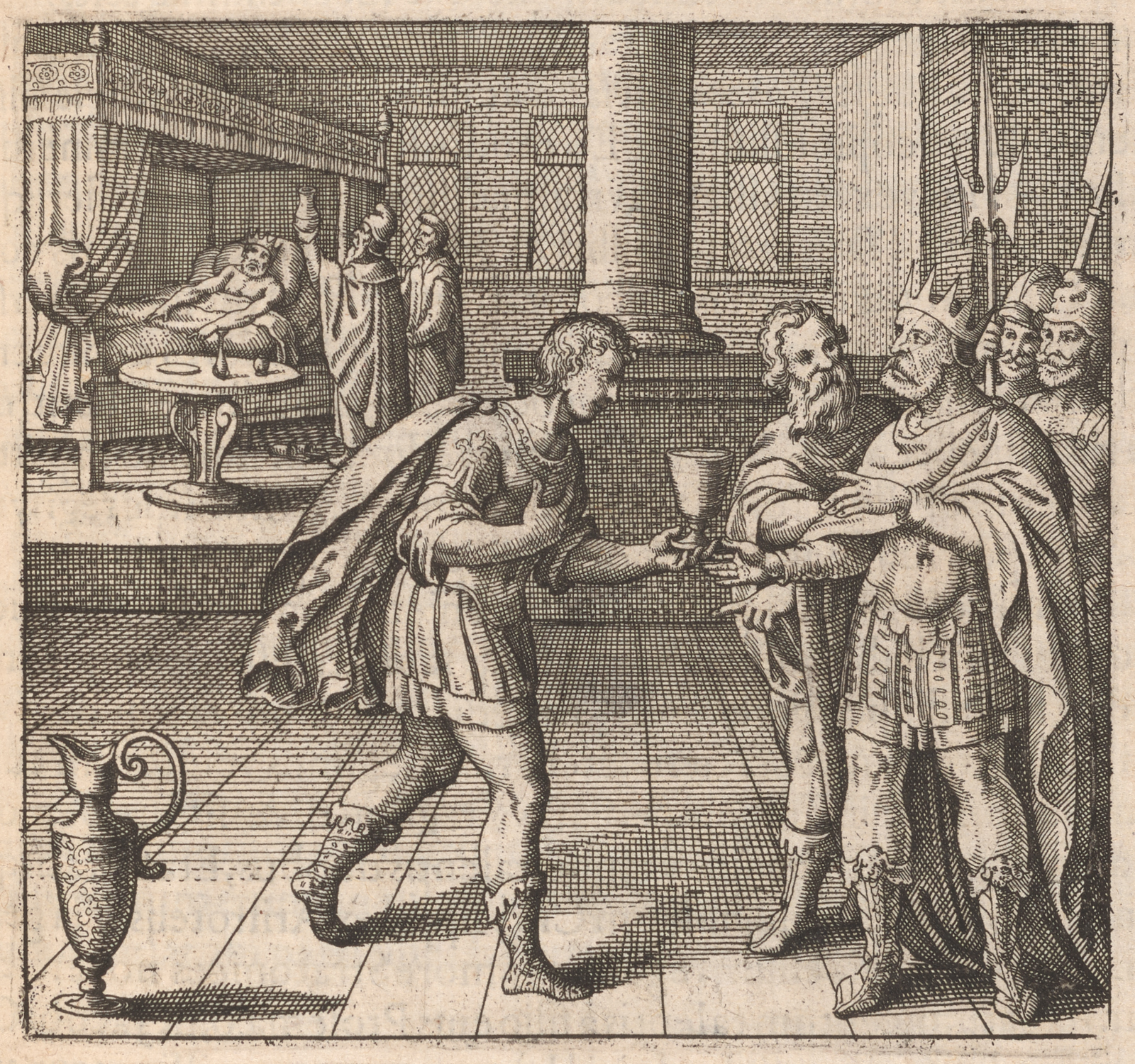
Emblem XLVIII is the most elaborately sourced emblem in the entire Atalanta Fugiens, combining the Merlini Allegory and the Allegory of Bernhardus Trevisanus into a comprehensive medical-chemical narrative. The king who becomes ill from drinking too much water encodes the dissolution of the metallic substance in a sharp solvent liquid (aqua fortis). His treatment by Egyptian physicians (moist, slow fire for putrefaction) and then Alexandrian physicians (dry, hot fire for reconstitution) maps the two-phase process of solve et coagula onto a therapeutic drama. The king is cut to pieces, mixed with medicine, washed, dried, treated with fire until he melts through a perforated bottom into a lower vessel, and finally rises as the Philosopher's Stone.
De Jong's commentary on this emblem, published separately as a dedicated article, identifies the Merlini Allegory from the Artis Auriferae as the primary source for the picture, motto, and key passages of the discourse. The Allegory of Bernard of Treves provides the concluding section about the King of the Spring, who is older than the spring itself and who distributes his garments to the planets in sequence: a golden garment to Saturn for forty days, a black cuirass to Jupiter for twenty days, then to Luna, then his white garment to Mars, then to the Sun. The planetary sequence encodes the color changes and timing of the alchemical process.
The emblem's polyvalent meaning reaches its fullest expression here. The king is simultaneously gold dissolving in acid, a melancholic patient undergoing humoral therapy, the soul submerged in matter awaiting redemption, and Christ who dies and rises. The Galenic theory of the four humors (blood, phlegm, yellow bile, black bile) corresponding to the four elements provides the medical framework, while the Merlini Allegory's sequence of death, dismemberment, washing, and resurrection provides the chemical procedure. De Jong concludes that Maier's pronouncement captures the essential nature of his entire allegorical method: every allegory is at once moral and chemical.
Emblem XLIX
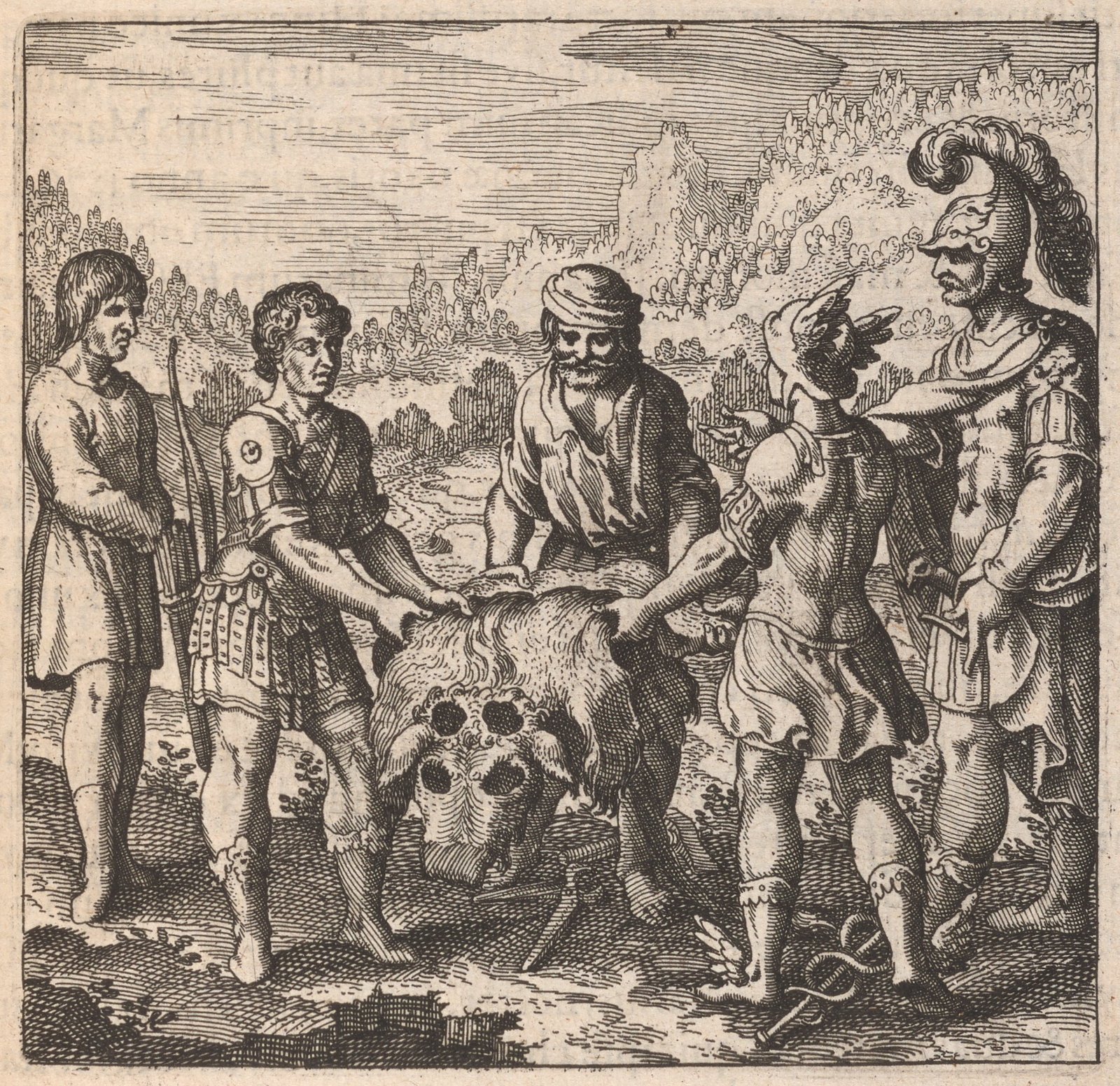
The Philosophical Child acknowledging three fathers, like Orion, encodes the threefold origin of the Philosopher's Stone from Sol (the celestial cause), Vulcan (fire as the active agent), and the Artist (Mercury or skilled technique). The legend of Orion's conception from the combined sperm of Apollo, Vulcan, and Hermes gathered in an ox-hide provides the mythological vehicle. In chemical terms, the Stone requires three things simultaneously: the solar principle (gold or the heavenly Sun acting on matter), heat (the fire that drives the transformation), and mercury (the material and formal cause that the skilled practitioner guides).
De Jong finds no direct alchemical source for the motto but identifies Lullius's Theorica Testamenti as the basis for the threefold fatherhood, cited by Maier in the Symbola Aureae Mensae: the Stone is the son of the Celestial Sun, created by Sol, governed by the Artist, and educated by Vulcan. Robertus Vallensis, De Veritate et Antiquitate Artis Chemicae provides the connection to the Golden Fleece legend, stating that the Golden Fleece was a book written on hides discussing how gold could be made chemically. Ovid's Fasti supplies the classical source for Orion's birth from the ox-hide.
The ox-hide in the emblem picture simultaneously evokes Orion's conception and the Golden Fleece of Jason, connecting the emblem to the entire tradition of reading the Argonautic expedition as an alchemical allegory. Maier says that Sol hands the Philosophical Child to Vulcan and the Artist to perfect it, just as Achilles and Jason were given to Chiron, the centaur educator. The pedagogical message is that the Stone requires not only the right materials and the right heat but also skilled human judgment, the artifex who governs the process. Without all three fathers cooperating, no philosophical child can be born.
Emblem L
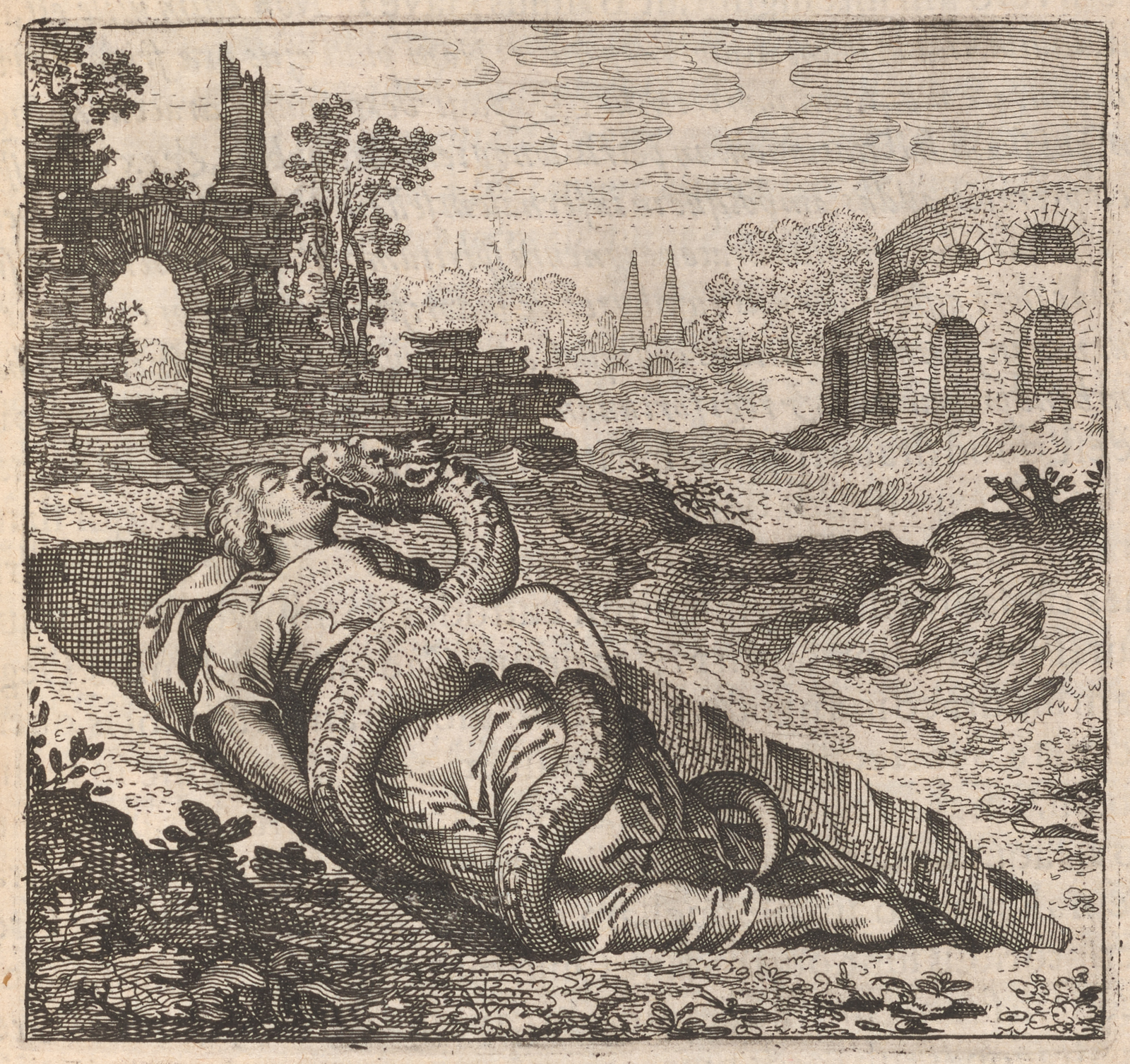
The final emblem brings the fifty-emblem sequence to its culmination with the mutual destruction of the Dragon and the Woman, who together bathe in blood. The Dragon represents the elements earth and fire (the fixed, subterranean principle), while the Woman represents air and water (the volatile, aerial principle). Their intertwining in a grave, each killing the other, produces the prima materia from which the perfected Stone emerges. The blood in which they bathe is the tinctura rubea, the red dye that signifies completion. The chemical process encoded is the final conjunction: fixed sulphur and volatile mercury react with such violence that both original substances are destroyed, and from their combined dissolution a new, indestructible substance precipitates.
De Jong traces the motto to the Turba Philosophorum, specifically Theophilus's sententia: the Dragon never dies, but the philosophers have put to death the woman who killed her husbands, for her intestine is full of poison. The grave must be dug, the woman buried with the dragon, and as it winds itself about her, its body inclines toward death and turns entirely into blood. The philosophers then place it in the Sun until the blood dries and the poison appears. Basil Valentine's Practica provides supplementary imagery of cold dragons in caves emanating fiery spirits, while the Clangor Buccinae and Bernhardus Trevisanus supply the theoretical framework for the dissolution.
De Jong observes that the Atalanta Fugiens ends with the revelation of a secret: what is hidden takes shape. The source text from the Turba concludes with exactly these words. After fifty emblems of mythological disguise, chemical allegory, and medical analogy, the occultum becomes manifestum. Maier has led his reader through the entire cycle of the opus, from the wind carrying the Stone in its belly (Emblem I) to the mutual blood-bath that produces the final tincture. The Dragon and the Woman are the last incarnation of the sulphur-mercury opposition that has appeared as brother and sister, cock and hen, wolf and dog, Sol and Luna, king and queen, and countless other pairings throughout the work. Their death together in the grave is both an ending and a beginning: the poison that kills is the same substance that heals, and the blood of mutual destruction is the elixir of life.