Emblem XVII — Fourfold fire-ball CITRINITAS
Original Source
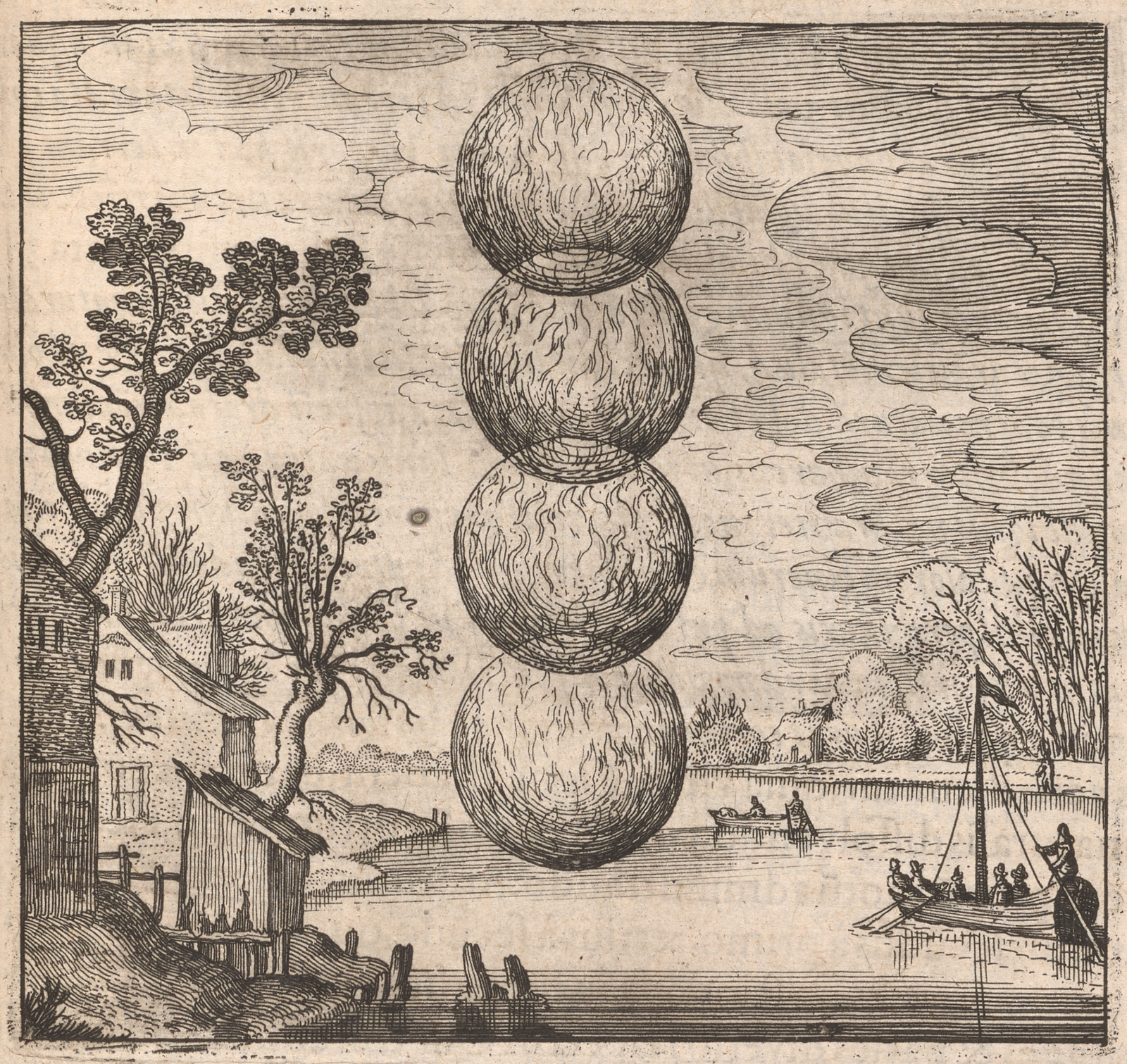
What You See
A spherical fireball, divided into four sections or quadrants, hovers or burns at the center of the composition. Each quadrant may represent a different type of fire or heat. Flames radiate outward from the fourfold sphere. A figure — possibly the alchemist — tends or controls the fire from below. The scene emphasizes the multiplicity of fires needed and the skill required to manage them simultaneously.
A fourfold fire-ball controls this work.
Epigram
A fourfold fire-ball controls this work: There is the fire of the lamp, the fire of the ash-bath, The fire of the substance itself, and the fire of water. Four fires are needed, not one alone; He who knows how to manage them all Has found the key to the art.Discourse Summary
Maier argues that the alchemical work requires not one fire but four distinct types, each governing a different phase of the operation. He identifies these as the fire of the lamp (external heat), the fire of the ash-bath (gentle, sustained warmth), the fire of the substance it self (intrinsic reactive heat), and the fire of the water-bath (moist, temperate heat). The discourse develops the principle that fire transforms by making things fiery — communicating its own nature — but can not make gold directly, only prepare the conditions for gold's emergence. Maier cites this fourfold fire as the master key to the practical art, without which even correct materials will fail.
Overview
Emblem XVII bears the motto: "A fourfold fire-ball controls this work."
Maier's Discourse
Maier argues that the alchemical work requires not one fire but four distinct types, each governing a different phase of the operation. He identifies these as the fire of the lamp (external heat), the fire of the ash-bath (gentle, sustained warmth), the fire of the substance itself (intrinsic reactive heat), and the fire of the water-bath (moist, temperate heat). The discourse develops the principle that fire transforms by making things fiery — communicating its own nature — but cannot make gold directly, only prepare the conditions for gold's emergence.
Source Texts
De Jong's source-critical analysis identifies the textual traditions Maier draws upon for this emblem.
The discourse draws on alchemical sources: Senior Zadith (Muhammad ibn Umail), Tabula Chimica.
Alchemical Significance
H.M.E. de Jong: Four kinds of fire: common fire (Vulcan), fire contrary to nature (Mercury/dragon), fire against nature, and natural fire. Derived from Lullius and the Turba tradition.
Scholarly Commentary
H.M.E. de Jong HIGH
Four kinds of fire: common fire (Vulcan), fire contrary to nature (Mercury/dragon), fire against nature, and natural fire. Derived from Lullius and the Turba tradition.
Citation: Emblem XVII section