Emblem XXXIII — Hermaphrodite lying in darkness needs fire NIGREDO
Original Source
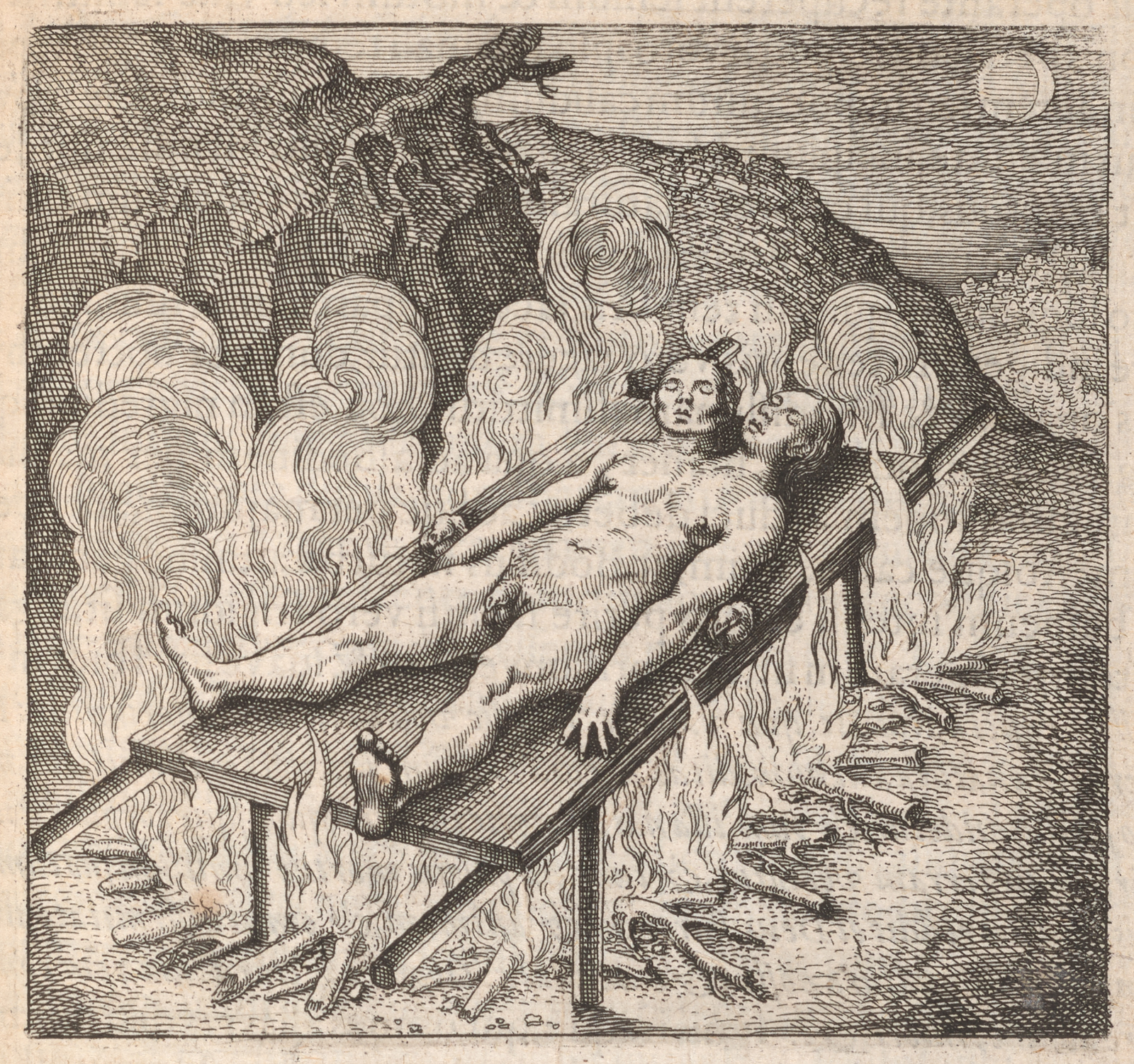
What You See
The Hermaphrodite figure lies in complete darkness on a bier or bed, as in Emblem XXX, but now more explicitly dead or death-like. The surrounding blackness is total — the nigredo at its deepest. Fire or a flame-bearing figure approaches, representing the intervention of heat that will begin the process of revival. The dual-gendered body is still, awaiting transformation.
The Hermaphrodite, lying in darkness like a dead man, needs fire.
Epigram
He is conceived in the bath, And born in the air; Having become red, he walks upon the waters. The Hermaphrodite, child of Sun and Moon, Unites the virtues of both parents, And rules over the kingdoms of Nature.Discourse Summary
Maier returns to the Hermaphrodite-in-darkness motif, now explicitly connecting it to the practice of ritual purification through fire and water. He argues that divine origin was ascribed to certain individuals in antiquity through a process of trial — passing through fire and water — and that the Hermaphrodite must undergo the same or deal. The discourse develops the parallel between baptism (purification by water) and calcination (purification by fire) as the two modes of cleansing that the combined philosophical substance must endure. Maier frames the darkness as a necessary passage: the substance must die fully before it can be reborn in the rubedo.
Overview
Emblem XXXIII bears the motto: "The Hermaphrodite, lying in darkness like a dead man, needs fire."
Maier's Discourse
Maier returns to the Hermaphrodite-in-darkness motif, now explicitly connecting it to the practice of ritual purification through fire and water. He argues that divine origin was ascribed to certain individuals in antiquity through a process of trial — passing through fire and water — and that the Hermaphrodite must undergo the same ordeal. The discourse develops the parallel between baptism (purification by water) and calcination (purification by fire) as the two modes of cleansing that the combined philosophical substance must endure.
Source Texts
De Jong's source-critical analysis identifies the textual traditions Maier draws upon for this emblem.
De Jong identifies the motto source as Turba Philosophorum. The discourse draws on alchemical sources: Rosarium Philosophorum, Senior Zadith (Muhammad ibn Umail), Tabula Chimica. The discourse draws on biblical sources: Solomonic / Biblical Wisdom Tradition (Proverbs).
Alchemical Significance
Paul Miner: Describes blackened hermaphrodite under waxing moon, engulfed in flames. Links to Blake's Gates of Paradise plate 5.
Paul Miner: Miner connects Emblem XXXIII's blackened Hermaphrodite engulfed in flames beneath a waxing moon to Blake's revisions of the 'Fire' plate in For the Sexes: The Gates of Paradise, where Blake darkened Satan's body and added hermaphroditic features.
H.M.E. de Jong: Hermaphroditic imagery tied to transmutation of metals through balancing lunar moisture and solar dryness.
Key Alchemical Concepts
Process: Coniunctio (Coniunctio Oppositorum), Nigredo
Substance: Rebis
Figure: Hermaphrodite (Hermaphroditus), Regina
Source_Text: Turba Philosophorum
Scholarly Commentary
Paul Miner HIGH
Describes blackened hermaphrodite under waxing moon, engulfed in flames. Links to Blake's Gates of Paradise plate 5.
Citation: Discussion of Emblem XXXIII
Paul Miner ICONOGRAPHIC MEDIUM
Miner connects Emblem XXXIII's blackened Hermaphrodite engulfed in flames beneath a waxing moon to Blake's revisions of the 'Fire' plate in For the Sexes: The Gates of Paradise, where Blake darkened Satan's body and added hermaphroditic features.
Citation: p. 367
H.M.E. de Jong HIGH
Hermaphroditic imagery tied to transmutation of metals through balancing lunar moisture and solar dryness.
Citation: Emblem XXXIII section