Emblem XLVII — Emblem XLVII NIGREDO
Original Source
What You See
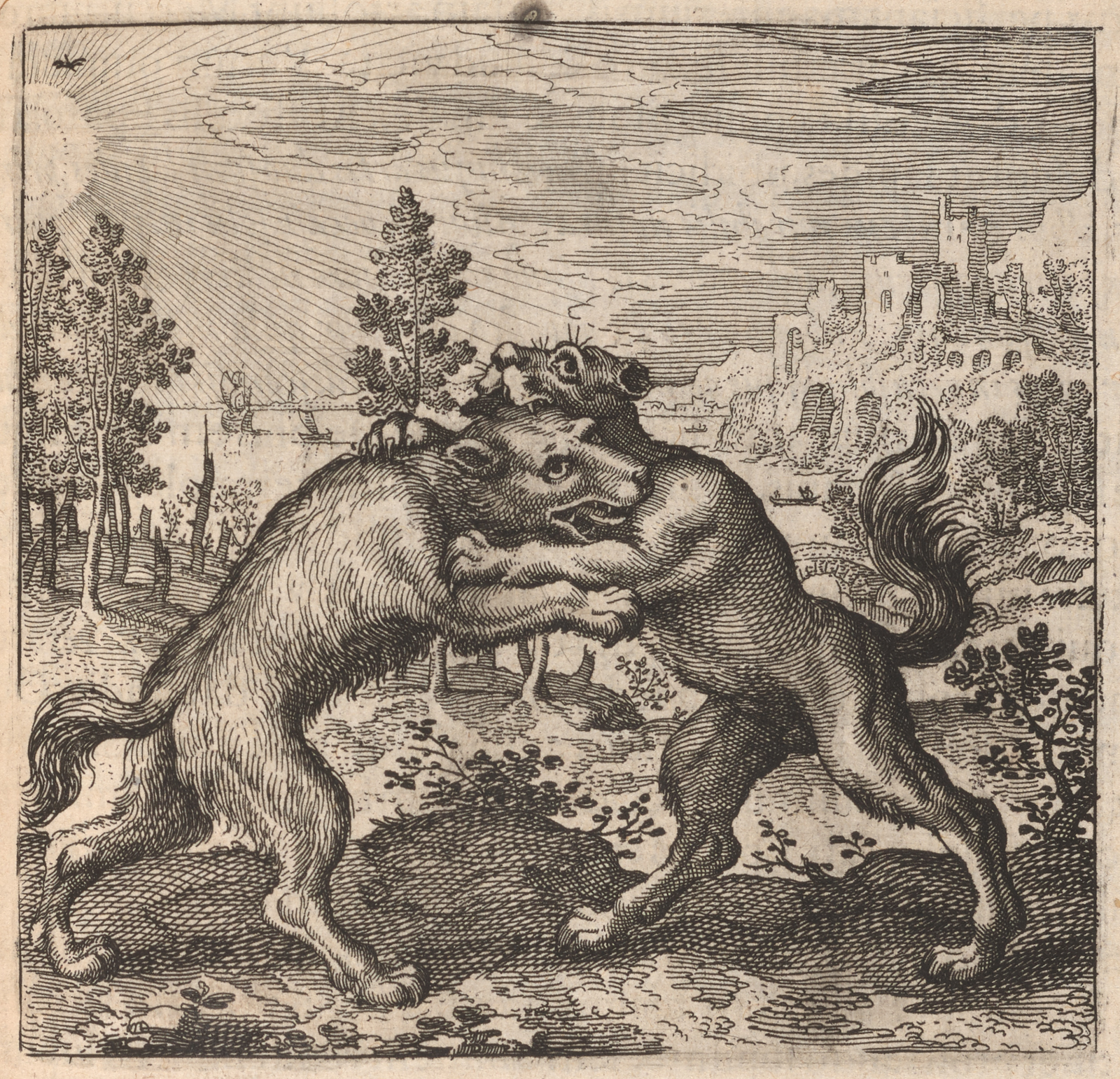
A wolf approaches from one side and a dog from the other, meeting in a violent confrontation. They bite and tear at each other, locked in mutual combat. The wolf is identified with the East and the dog with the West. The landscape suggests a meeting point between two territories, with the struggle occurring on a boundary or threshold.
The wolf coming from the East, and the Dog coming from the West, have bitten each other.
Epigram
The Wolf comes from the place where the Sun rises; But from where the Sun sinks in the West comes the Dog. They bite and tear at each other Until both are consumed by fury. From their mutual destruction The medicine of the philosophers emerges.Discourse Summary
Maier parallels the eagle meeting of Emblem XLVI with a more violent version: the wolf from the East and the dog from the West bite each other in mutual destruction. He argues that while the eagles' conjunction was aerial and spiritual, the wolf-and-dog encounter is terrestrial and material — the same union of opposites enacted at a lower, more physical register. The discourse develops the wolf as the more aggressive, dissolving agent (philosophical mercury in its corrosive aspect) and the dog as the resistant, fixed body that must be broken down. Their mutual biting — each wounding the other — represents the reciprocal action of dissolution, where both substances are transformed by their encounter.
Overview
Emblem XLVII bears the motto: "The wolf coming from the East, and the Dog coming from the West, have bitten each other."
Maier's Discourse
Maier parallels the eagle meeting of Emblem XLVI with a more violent version: the wolf from the East and the dog from the West bite each other in mutual destruction. He argues that while the eagles' conjunction was aerial and spiritual, the wolf-and-dog encounter is terrestrial and material — the same union of opposites enacted at a lower, more physical register. The discourse develops the wolf as the more aggressive, dissolving agent (philosophical mercury in its corrosive aspect) and the dog as the resistant, fixed body that must be broken down.
Source Texts
De Jong's source-critical analysis identifies the textual traditions Maier draws upon for this emblem.
The discourse draws on alchemical sources: Lambsprinck, De Lapide Philosophico, Pseudo-Aristotle, Tractatulus de Practica Lapidis, Senior Zadith (Muhammad ibn Umail), Tabula Chimica.
Alchemical Significance
H.M.E. de Jong: De Jong identifies the sick king allegory in the Merlini tradition and traces the physician's cure through the sequence of Egyptian and Alexandrian doctors to the progressive refinement of alchemical technique. She connects Bernard of Treves's account of the king dressed in black cuirass, white tunic, and purple-red cloak to the three colors of the opus (nigredo, albedo, rubedo).
Scholarly Commentary
H.M.E. de Jong ALCHEMICAL HIGH
De Jong identifies the sick king allegory in the Merlini tradition and traces the physician's cure through the sequence of Egyptian and Alexandrian doctors to the progressive refinement of alchemical technique. She connects Bernard of Treves's account of the king dressed in black cuirass, white tunic, and purple-red cloak to the three colors of the opus (nigredo, albedo, rubedo).