Emblem IV — Join brother and sister NIGREDO
Original Source
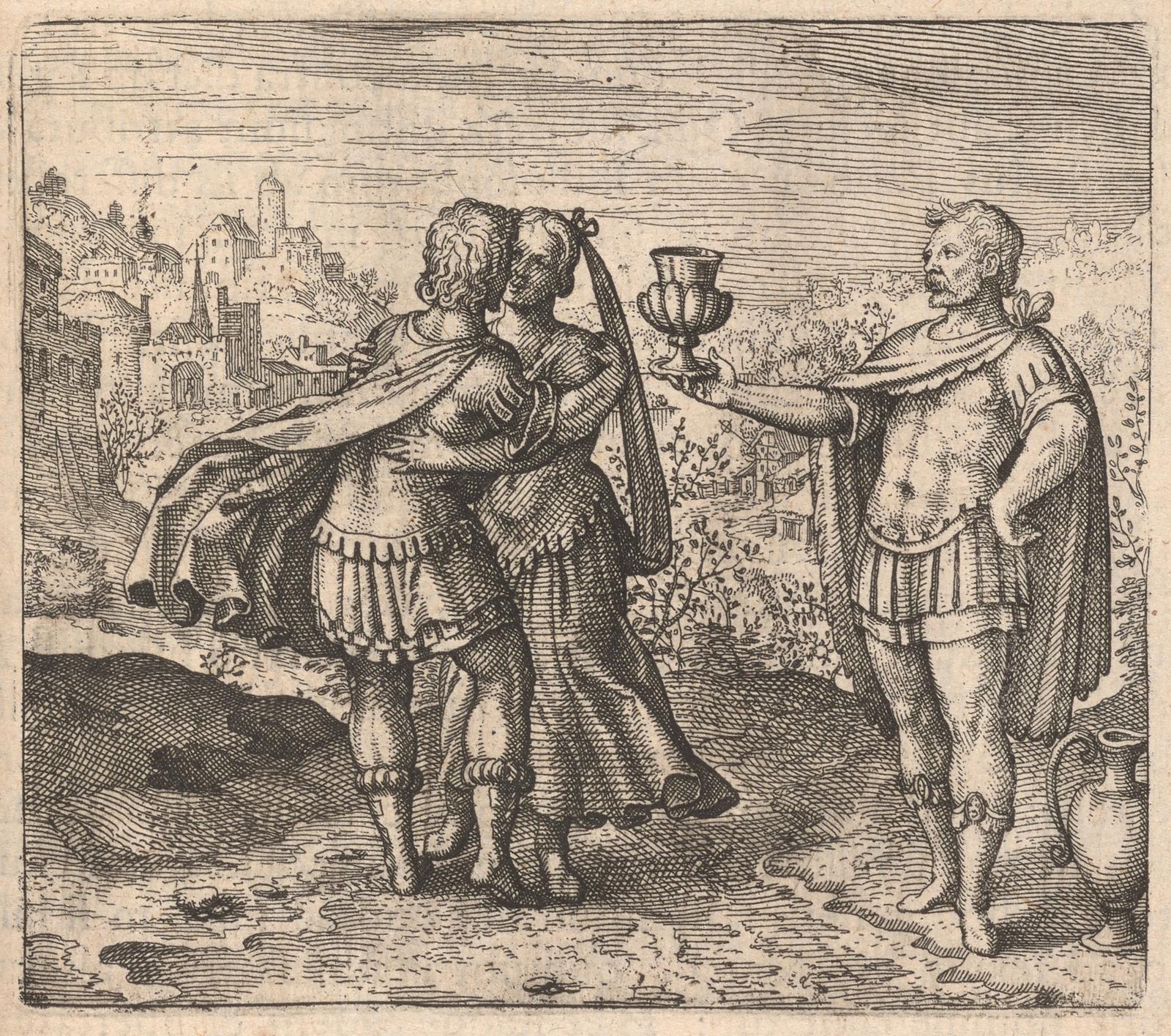
What You See
A young man and woman face each other in a formal garden or courtyard setting, joining hands or exchanging a cup between them. Their postures suggest both greeting and ceremonial union. Behind them, architectural elements frame the scene — an archway or portico. The composition centers on the gesture of joining, with the cup of love serving as the mediating object between the two figures.
Join brother and sister and give them the cup of love.
Epigram
From her own father, Myrrha received the beautiful Adonis. As a marriage of brother and sister they unite: Give them the cup of love, let them drink, And bring forth from the work of their union A nobler offspring than was ever produced By the embraces of Mars and Venus.Discourse Summary
Maier frames the alchemical coniunctio as a marriage between brother and sister — the masculine and feminine principles of the same substance — who must be united by the 'cup of love,' the solvent that dissolves both into a single new body. He draws on Oedipus's unwitting marriage to his mother Jocasta as an analogy for the paradoxical union of opposites that share a common origin. The discourse argues that the philosophical work is fundamentally gendered labor: the masculine role is to beget and govern, the feminine to conceive and nourish. Maier cites both classical mythology and Arabic alchemical sources to establish that this conjunction of fixed and volatile is the central operation of the entire art.
Overview
Emblem IV bears the motto: "Join brother and sister and give them the cup of love."
Maier's Discourse
Maier frames the alchemical coniunctio as a marriage between brother and sister — the masculine and feminine principles of the same substance — who must be united by the 'cup of love,' the solvent that dissolves both into a single new body. He draws on Oedipus's unwitting marriage to his mother Jocasta as an analogy for the paradoxical union of opposites that share a common origin. The discourse argues that the philosophical work is fundamentally gendered labor: the masculine role is to beget and govern, the feminine to conceive and nourish.
Source Texts
De Jong's source-critical analysis identifies the textual traditions Maier draws upon for this emblem.
De Jong identifies the motto source as Pseudo-Aristotle, Tractatulus de Practica Lapidis.
Alchemical Significance
Hereward Tilton: Tilton identifies the 'philothesia' in epigram 4 as a love potion offered at the Saturnalia. The brother-sister conjunction and nectar cup connect to Maier's Rosicrucian enigmas in Symbola Aureae Mensae, linking alchemical marriage to the fraternity's invitation.
H.M.E. de Jong: Brother (hot, dry, choleric) = Fire. Sister (cold, moist, phlegmatic) = Water. Union of contrasts per Empedocles. Related to Emblems XXXIX (Oedipus/mother), XLI (Myrrha/father), XLIV (Osiris/Isis).
Key Alchemical Concepts
Process: Coniunctio (Coniunctio Oppositorum)
Figure: Regina
Concept: Mytho-Alchemy (Mytho-Alchemia)
Source_Text: Tractatulus de Practica Lapidis (Tractatulus de Practica Lapidis Philosophici)
Scholarly Commentary
Hereward Tilton ALCHEMICAL MEDIUM
Tilton identifies the 'philothesia' in epigram 4 as a love potion offered at the Saturnalia. The brother-sister conjunction and nectar cup connect to Maier's Rosicrucian enigmas in Symbola Aureae Mensae, linking alchemical marriage to the fraternity's invitation.
Citation: Ch. IV, pp. 143-144
H.M.E. de Jong HIGH
Brother (hot, dry, choleric) = Fire. Sister (cold, moist, phlegmatic) = Water. Union of contrasts per Empedocles. Related to Emblems XXXIX (Oedipus/mother), XLI (Myrrha/father), XLIV (Osiris/Isis).
Citation: Emblem IV section