Emblem II — Its nurse is the Earth NIGREDO
Original Source
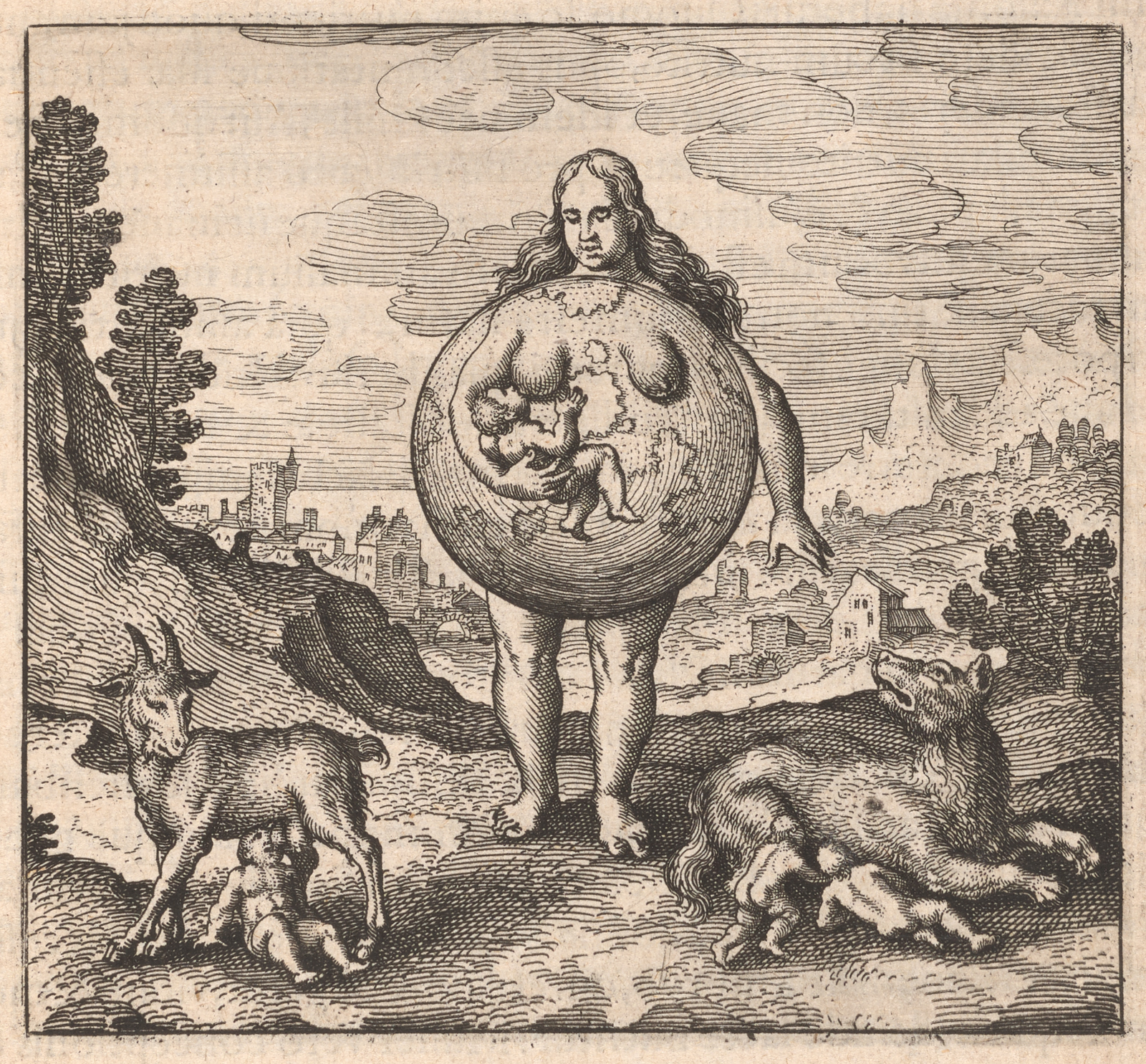
What You See
The same globular earth-mother figure from Emblem I reappears at center, her body forming a living landscape with a small child nursing at her breast. She sits or reclines against a hillside with a town visible in the distance. Animals — a cow and smaller creatures — graze at her feet, reinforcing her identification with the nurturing earth. The composition emphasizes the maternal relationship between the vast earthly body and the tiny philosophical infant.
Its nurse is the Earth.
Epigram
Romulus is said to have been nursed at the coarse udders of a wolf, And Jupiter to have been nursed by a goat, and these facts are said to be believed: Should we then wonder if we assert That the earth suckles the tender Child of the Philosophers with its milk? If an insignificant animal nursed such great heroes, Shall not the Terrestrial Globe be a nurse?Discourse Summary
Maier continues the the me of Emblem I, now emphasizing that the earth is specifically the nurse, not the mother, of the philosophical substance. He distinguishes between generation (which occurs through the volatile principle, the wind) and nourishment (which requires the fixed, earthy body). The discourse argues that just as human food must be converted into the substance of the body it feeds, so the alchemical earth must be assimilated into the growing Stone. Maier draws a careful analogy between the stages of infant feeding — blood in utero, milk after birth, solid food later — and the progressive fixation of the volatile philosophical substance.
Overview
Emblem II bears the motto: "Its nurse is the Earth."
Maier's Discourse
Maier continues the theme of Emblem I, now emphasizing that the earth is specifically the nurse, not the mother, of the philosophical substance. He distinguishes between generation (which occurs through the volatile principle, the wind) and nourishment (which requires the fixed, earthy body). The discourse argues that just as human food must be converted into the substance of the body it feeds, so the alchemical earth must be assimilated into the growing Stone.
Source Texts
De Jong's source-critical analysis identifies the textual traditions Maier draws upon for this emblem.
De Jong identifies the motto source as Tabula Smaragdina (Emerald Tablet). The discourse draws on alchemical sources: Rosarium Philosophorum.
Alchemical Significance
Walter Pagel: Notes the pregnant female with terrestrial globe as 'nurse of tender child.'
Walter Pagel: Pagel identifies Emblem II's pregnant female figure with the terrestrial globe as symbolizing the earth as 'nurse of the tender child of the Philosophers', tracing its iconographic tradition to Albertus Magnus' Philosophia pauperum (1493) and Mylius' Philosophia reformata (1622).
H.M.E. de Jong: Retort (artificial) and nature work together. Art serves Nature as teacher.
Key Alchemical Concepts
Process: Distillatio
Substance: Prima Materia
Figure: Ceres
Source_Text: Tabula Smaragdina
Scholarly Commentary
Walter Pagel HIGH
Notes the pregnant female with terrestrial globe as 'nurse of tender child.'
Citation: Review discussion
Walter Pagel ICONOGRAPHIC MEDIUM
Pagel identifies Emblem II's pregnant female figure with the terrestrial globe as symbolizing the earth as 'nurse of the tender child of the Philosophers', tracing its iconographic tradition to Albertus Magnus' Philosophia pauperum (1493) and Mylius' Philosophia reformata (1622).
Citation: p. 102
H.M.E. de Jong HIGH
Retort (artificial) and nature work together. Art serves Nature as teacher.
Citation: Emblem II section