Emblem XLIX — Emblem XLIX CITRINITAS
Original Source
What You See
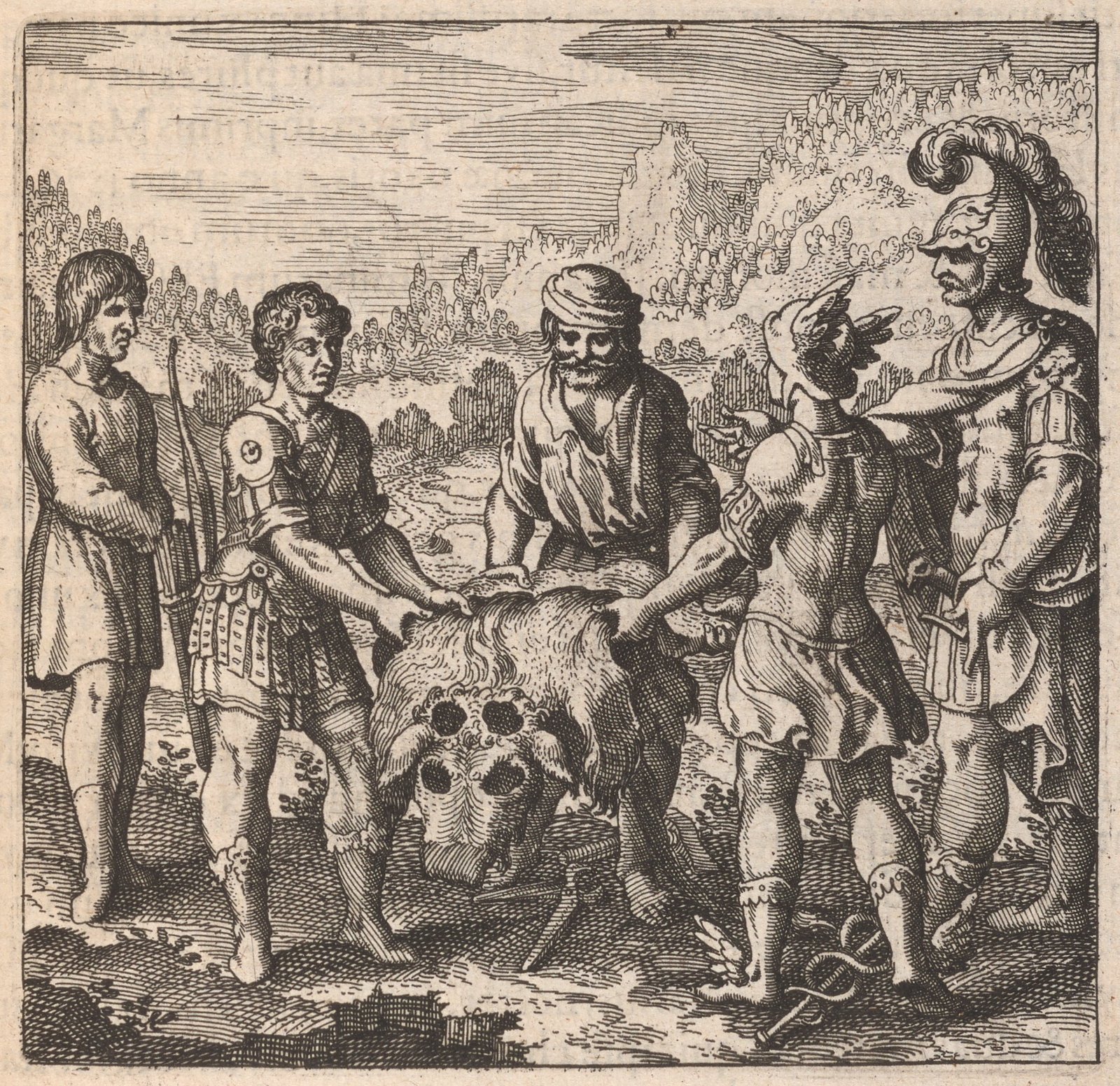
A child — the Philosophical Child — stands or sits at center, flanked by three male figures identified as his three fathers. The child may display characteristics of all three, or the three fathers may each contribute a different gift or quality. The myth of Orion's triple parentage provides the narrative framework: the child born of three fathers rather than one.
The Philosophical Child acknowledges three fathers, just as Orion.
Epigram
The Philosophical Child acknowledges three fathers, Just as Orion was born of three gods. Salt, Sulphur, and Mercury contribute Each their portion to the generation. No single father suffices for the birth; The Stone requires a triple origin.Discourse Summary
Maier argues that the philosopher's stone, like the mythological Orion, acknowledges three fathers — three distinct sources or principles that contribute to its generation. He develops this as an allegory for the tria prima: the stone is born from salt (the bodily principle), sulphur (the soul principle), and mercury (the spirit principle), each 'fat he ring' a different aspect of the complete substance. The discourse draws on the Orion myth — conceived from the combined seed of Zeus, Poseidon, and Hermes — to argue that no single source suffices for the generation of the philosophical child. Maier presents this as one of the final teachings: the stone's triple origin explains why it can not be produced from any single starting material.
Overview
Emblem XLIX bears the motto: "The Philosophical Child acknowledges three fathers, just as Orion."
Maier's Discourse
Maier argues that the philosopher's stone, like the mythological Orion, acknowledges three fathers — three distinct sources or principles that contribute to its generation. He develops this as an allegory for the tria prima: the stone is born from salt (the bodily principle), sulphur (the soul principle), and mercury (the spirit principle), each 'fathering' a different aspect of the complete substance. The discourse draws on the Orion myth — conceived from the combined seed of Zeus, Poseidon, and Hermes — to argue that no single source suffices for the generation of the philosophical child.
Source Texts
De Jong's source-critical analysis identifies the textual traditions Maier draws upon for this emblem.
The discourse draws on alchemical sources: Lullius tradition (via Harmonica Chemica), Robertus Vallensis, De Veritate et Antiquitate Artis Chemicae. The discourse draws on classical sources: Ovid, Metamorphoses X.560-704.
Alchemical Significance
H.M.E. de Jong: Source: No directsourcefound. This | Maieruses thelegendabout Orion’sbirth inorder todepictthethreefoldorigin of the Philosophers’ St one. Ascanbe seen from the Arcana Arcarrissiwna, t his fat her is Hermes Trismegistus and the motherof the St one isthreefold: .....
Key Alchemical Concepts
Source_Text: Fama Fraternitatis
Scholarly Commentary
H.M.E. de Jong ALCHEMICAL HIGH
Source: No directsourcefound. This | Maieruses thelegendabout Orion’sbirth inorder todepictthethreefoldorigin of the Philosophers’ St one. Ascanbe seen from the Arcana Arcarrissiwna, t his fat her is Hermes Trismegistus and the motherof the St one isthreefold: ..... I saw threefacesin onefat her; thus Rosariussays that the matterof the Philosophers’St one consistsof fluid, and thattheliquid of those threeisunderstood by t his, as Hortulanusshows; andthereshould notbe morenor less. And hesays that inthesethree Sol is the man, Luna the Woman and Mercury the sperm".1 So, Sol, Luna and Mercury arethethree maincomponents of the St one. In the discourse, Maierquotes two pronouncementsof Lullius, in which the latter speaksof“twofathers and twomothers”, which refersto the four elements asorigin of...