Emblem XXVI — Lady Sapientia / Tree of Life RUBEDO
Original Source
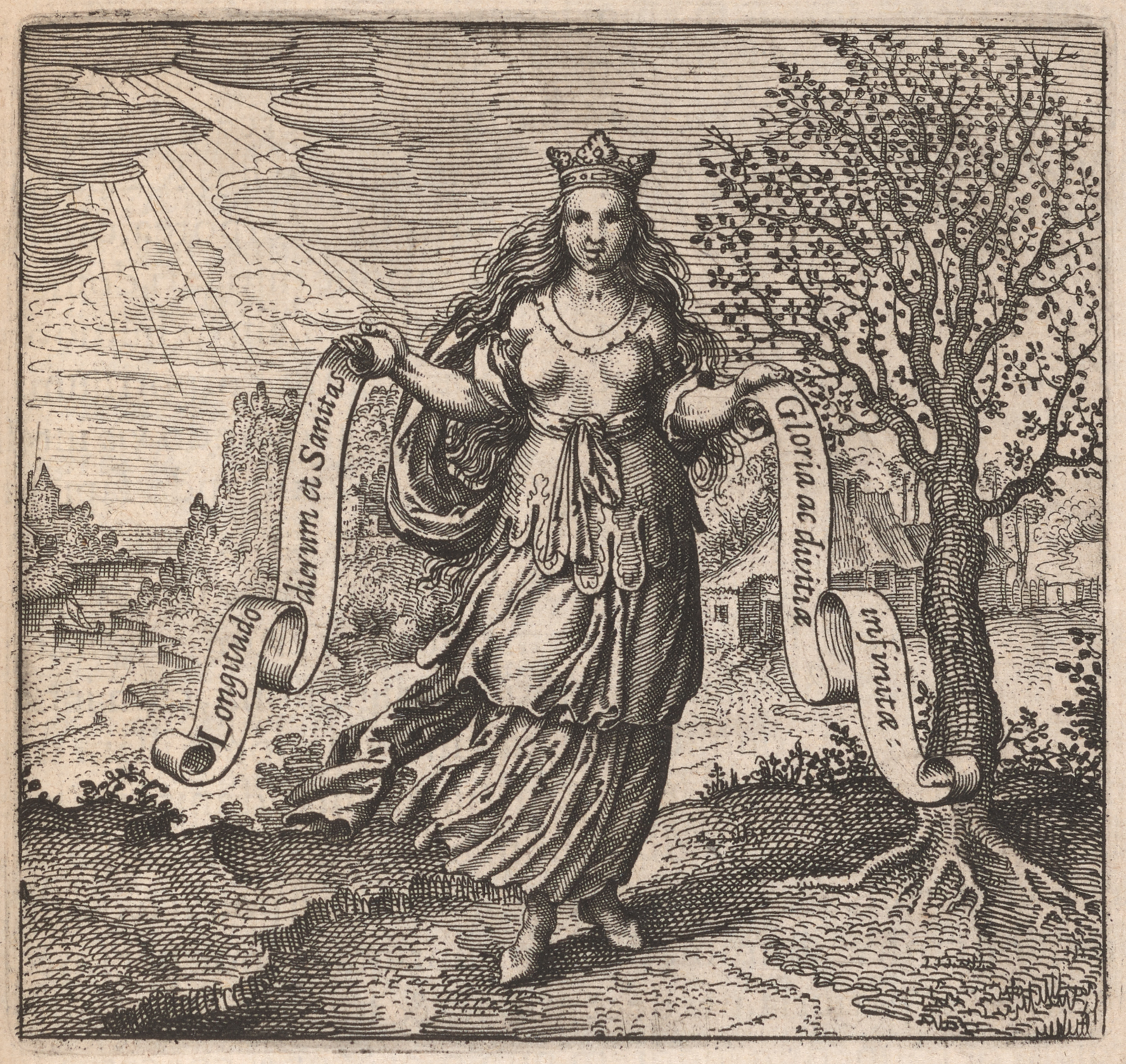
What You See
A female figure identified as Lady Sapientia (Wisdom) stands beside or beneath a large tree bearing golden fruit — the Tree of Life. She may hold a book, a scepter, or extend a hand toward the fruit. The tree is abundant and flourishing, its canopy spreading over the scene. The setting is a garden or paradise landscape, suggesting Eden or the garden of the Hesperides.
The fruit of human wisdom is the Tree of Life.
Epigram
In human affairs there is no greater wisdom Than that from which arise wealth and health. The fruit of human wisdom is the Tree of Life; Whoever eats of it shall never hunger. Seek this tree in the garden of the sages, And you will find what the whole world desires.Discourse Summary
Maier identifies the fruit of human wisdom as the Tree of Life it self, arguing that the philosopher's stone is the true 'wood of life' sought by sages across all traditions. He draws on Cicero's distinction between humans and animals — that only humans possess reason and the capacity for philosophical inquiry — to argue that alchemy is the highest expression of rational wisdom applied to Nature. The discourse connects the Tree of Life to the biblical Garden of Eden, the Hesperides, and the alchemical tradition of the arbor philosophica — the philosophical tree whose roots are mercury and whose fruit is gold. Maier presents this emblem as marking the rubedo: the tree has borne its fruit, wisdom has been attained.
Overview
Emblem XXVI bears the motto: "The fruit of human wisdom is the Tree of Life."
Maier's Discourse
Maier identifies the fruit of human wisdom as the Tree of Life itself, arguing that the philosopher's stone is the true 'wood of life' sought by sages across all traditions. He draws on Cicero's distinction between humans and animals — that only humans possess reason and the capacity for philosophical inquiry — to argue that alchemy is the highest expression of rational wisdom applied to Nature.
Source Texts
De Jong's source-critical analysis identifies the textual traditions Maier draws upon for this emblem.
The discourse draws on patristic sources: Lactantius. The discourse draws on classical sources: Ovid, Metamorphoses X.560-704. The discourse draws on alchemical sources: Rosarium Philosophorum, Aurora Consurgens. The discourse draws on biblical sources: Solomonic / Biblical Wisdom Tradition (Proverbs).
Alchemical Significance
H.M.E. de Jong: Central emblem of the book. Motto from Proverbs 3:18 but through Rosarium, not arbitrary biblical selection. Unusually dense scriptural marginalia. Maier foregrounds religious-sapiential basis of entire work. Links to Emblem XXVII.
Key Alchemical Concepts
Concept: Sapientia
Source_Text: Aurora Consurgens, Divinae Institutiones, Liber Sapientiae, Rosarium Philosophorum
Scholarly Commentary
H.M.E. de Jong HIGH
Central emblem of the book. Motto from Proverbs 3:18 but through Rosarium, not arbitrary biblical selection. Unusually dense scriptural marginalia. Maier foregrounds religious-sapiential basis of entire work. Links to Emblem XXVII.
Citation: Emblem XXVI section