Emblem XXXII — Emblem XXXII RUBEDO
Original Source
What You See
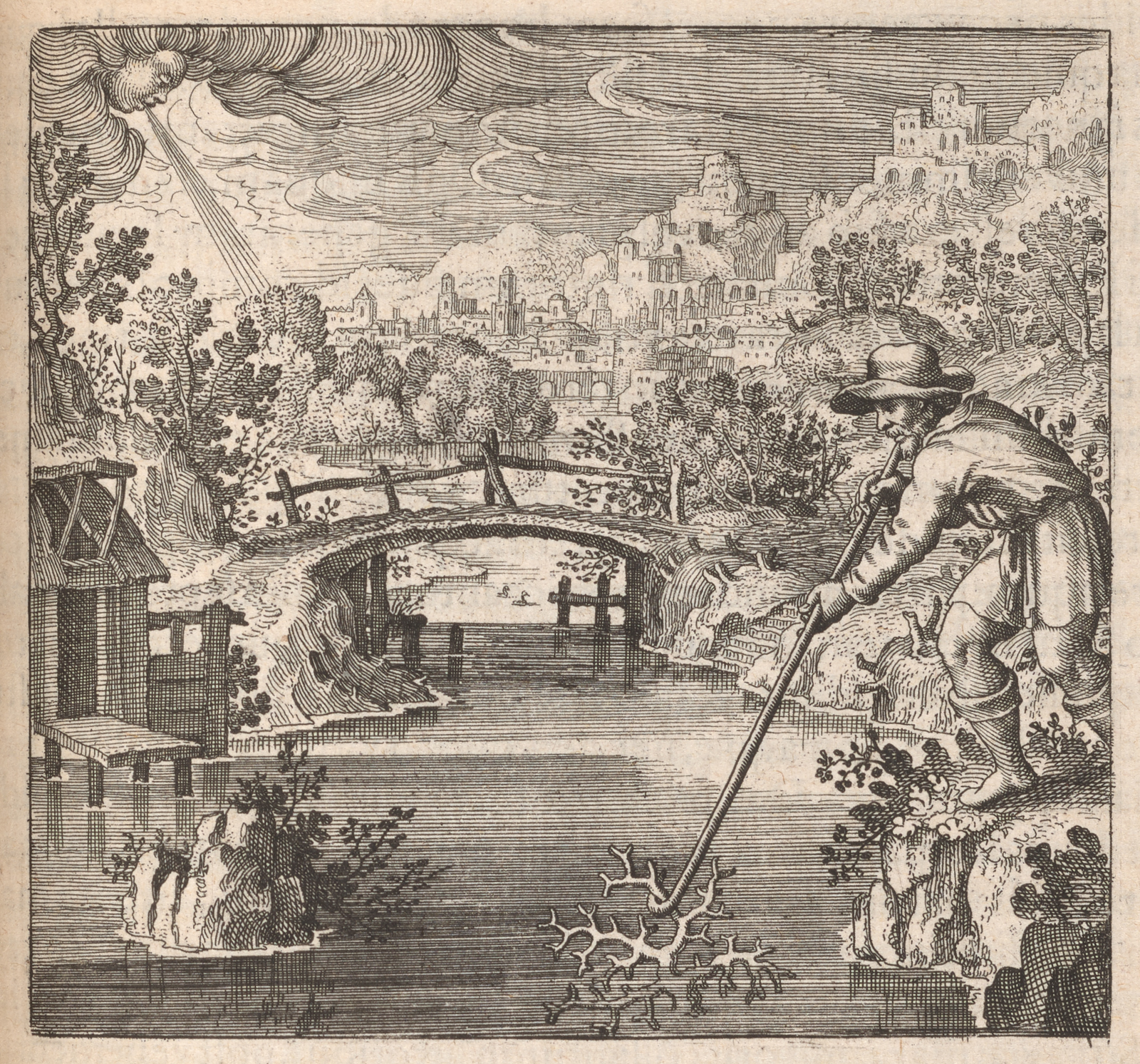
A branch of coral grows underwater, depicted in its natural marine setting with fish and sea creatures nearby. In a second register, the same coral is shown above the waterline, where it has hardened into a rigid, stone-like form. The contrast between the soft, underwater growth and the hard, aerial solid captures the transformation from liquid to fixed.
As coral grows under water and, exposed to the air, gets hard, so also the Stone.
Epigram
As coral grows underwater, Soft and plant-like in the liquid depths, And exposed to the air gets hard as stone, So also the substance of the philosophers: Fluid in the vessel during preparation, It solidifies into the permanent Stone.Discourse Summary
Maier draws on the natural history of coral — soft and plant-like under water but hardening to stone when exposed to air — as an analogy for the philosopher's stone, which is fluid and mutable during preparation but becomes fixed and permanent once complete. He argues that this natural transformation demonstrates the possibility of a substance changing its fundamental state without losing its essential nature. The discourse connects coral's petrifaction to the alchemical fixation process, where the volatile philosophical substance 'hardens' through exposure to air (the volatile spirit) just as coral solidifies above the water line. Maier cites this as evidence that the rubedo — the final reddening — involves a transition from fluid process to solid product.
Overview
Emblem XXXII bears the motto: "As coral grows underwater and, exposed to the air, gets hard, so also the Stone."
Maier's Discourse
Maier draws on the natural history of coral — soft and plant-like underwater but hardening to stone when exposed to air — as an analogy for the philosopher's stone, which is fluid and mutable during preparation but becomes fixed and permanent once complete. He argues that this natural transformation demonstrates the possibility of a substance changing its fundamental state without losing its essential nature.
Source Texts
De Jong's source-critical analysis identifies the textual traditions Maier draws upon for this emblem.
The discourse draws on alchemical sources: Merlini Allegory, Turba Philosophorum.
Alchemical Significance
H.M.E. de Jong: De Jong identifies the source in the Allegoriae super Turbam and traces the coral growth analogy to the alchemical principle of fixation. She demonstrates how the underwater-to-air transition mirrors the philosophical substance's change from volatile fluid to fixed solid during the rubedo completion.
Scholarly Commentary
H.M.E. de Jong ALCHEMICAL HIGH
De Jong identifies the source in the Allegoriae super Turbam and traces the coral growth analogy to the alchemical principle of fixation. She demonstrates how the underwater-to-air transition mirrors the philosophical substance's change from volatile fluid to fixed solid during the rubedo completion.