Emblem IX — Emblem IX NIGREDO
Original Source
What You See
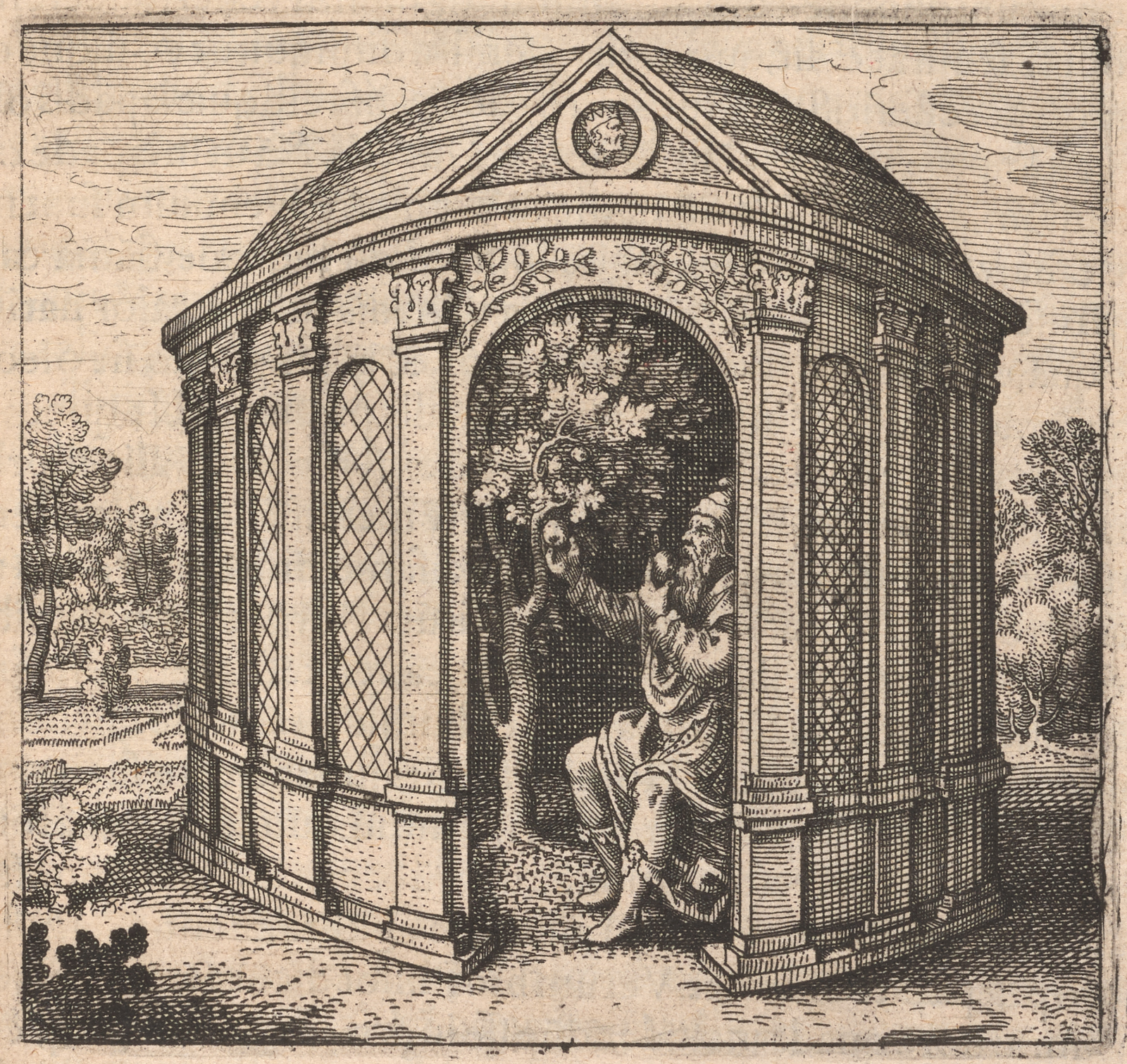
An old man, stooped with age, is fastened or bound to a tree in what appears to be a garden or orchard. Dew or moisture descends from above — sometimes depicted as rain or celestial drops — onto the old man's body. The garden setting is lush, suggesting the dew is a life-giving rather than punishing element. The tree to which the old man is fixed may bear fruit, connecting the scene to ideas of renewal and harvest.
Fix the old man to the tree in the garden of the dew, and the old man becomes young again.
Epigram
Fix the old man to the tree In the garden of celestial dew, And the old man will become young again, Rejuvenated by the moisture from above. The tree gives its fruit to him who tends it, And the aged one grows young with the tree.Discourse Summary
Maier argues that the old man represents the fixed, aged substance of the philosophical body that must be rejuvenated through exposure to celestial dew — the volatile, purifying spirit descending from above. He develops a parallel between this image and classical accounts of rejuvenation through divine intervention, including the myth of Aeson restored to youth by Medea. The discourse emphasizes that the tree functions as the apparatus of fixation: the old body is held in place while the volatile moisture penetrates and renews it. Maier cites the Turba Philosophorum and the pronouncement of Balgus as authorities for this doctrine of rejuvenation through the marriage of fixed and volatile.
Overview
Emblem IX bears the motto: "Fix the old man to the tree in the garden of the dew, and the old man becomes young again."
Maier's Discourse
Maier argues that the old man represents the fixed, aged substance of the philosophical body that must be rejuvenated through exposure to celestial dew — the volatile, purifying spirit descending from above. He develops a parallel between this image and classical accounts of rejuvenation through divine intervention, including the myth of Aeson restored to youth by Medea. The discourse emphasizes that the tree functions as the apparatus of fixation: the old body is held in place while the volatile moisture penetrates and renews it.
Source Texts
De Jong's source-critical analysis identifies the textual traditions Maier draws upon for this emblem.
The discourse draws on alchemical sources: Merlini Allegory, Senior Zadith (Muhammad ibn Umail), Tabula Chimica, Turba Philosophorum. The discourse draws on biblical sources: Solomonic / Biblical Wisdom Tradition (Proverbs).
Alchemical Significance
Hereward Tilton: Tilton reads discourse 9 as Maier's statement that death is the only path to rejuvenation: 'there is nothing that can restore youth to man but death itself.' This encapsulates the paradoxical circular nature of Maier's spiritual alchemy, mirroring the ouroboros.
H.M.E. de Jong: De Jong identifies the motto source in the Aurora Consurgens and connects Maier's image of Christ drawing all men to himself through death and resurrection to the alchemical process of dissolution and reconstitution. She demonstrates that Maier weaves Christian sacrificial imagery into the same allegorical framework as the classical myths.
Scholarly Commentary
Hereward Tilton ALCHEMICAL MEDIUM
Tilton reads discourse 9 as Maier's statement that death is the only path to rejuvenation: 'there is nothing that can restore youth to man but death itself.' This encapsulates the paradoxical circular nature of Maier's spiritual alchemy, mirroring the ouroboros.
Citation: Ch. V, p. 215
H.M.E. de Jong ALCHEMICAL HIGH
De Jong identifies the motto source in the Aurora Consurgens and connects Maier's image of Christ drawing all men to himself through death and resurrection to the alchemical process of dissolution and reconstitution. She demonstrates that Maier weaves Christian sacrificial imagery into the same allegorical framework as the classical myths.