Emblem XI — Emblem XI ALBEDO
Original Source
What You See
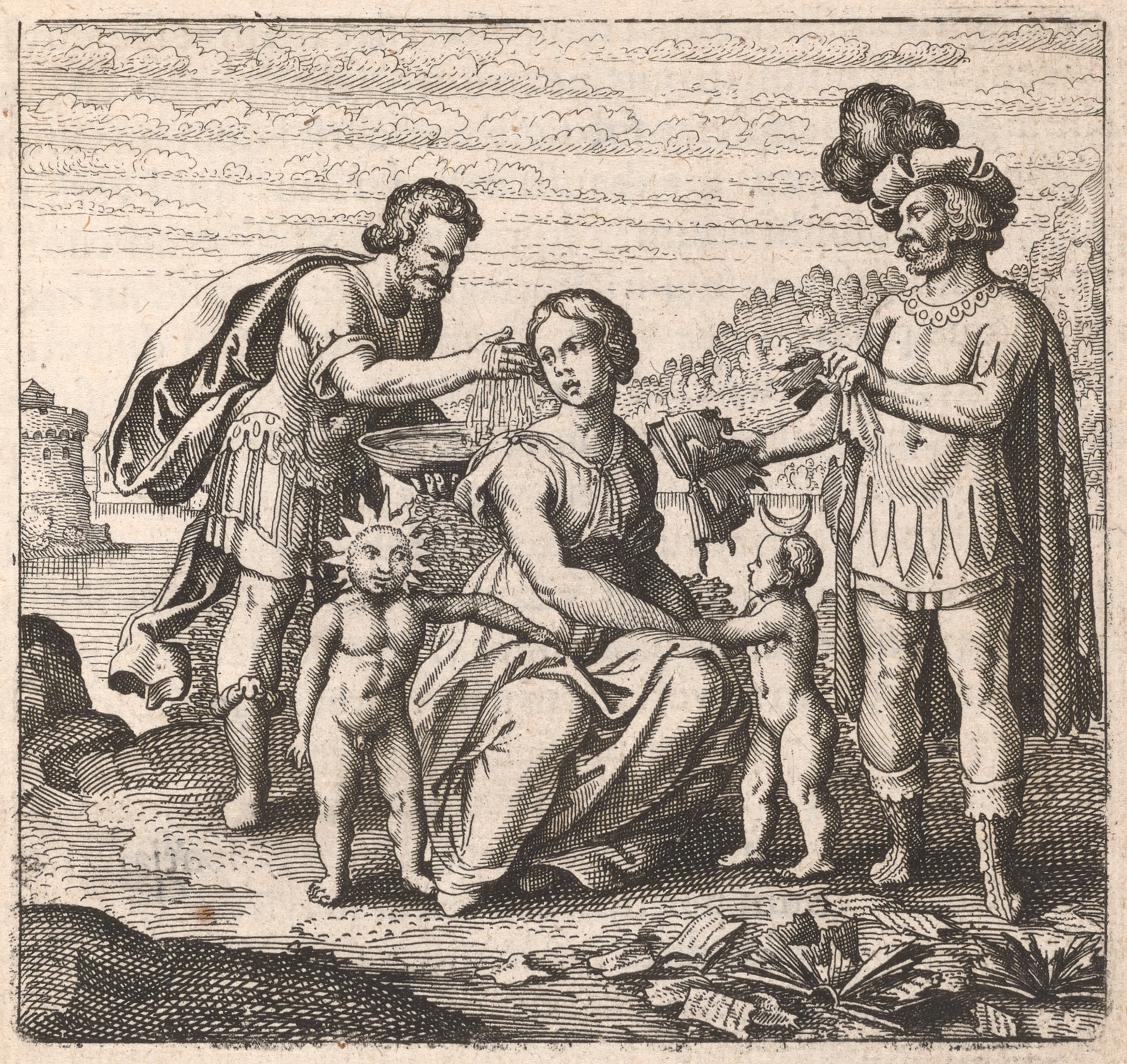
A female figure identified as Latona stands at center, her skin darkened or stained, while attendants or alchemists work to wash or whiten her body. Books or scrolls lie torn or scattered on the ground around her, their destruction commanded by the motto. The scene combines the act of purification — making Latona white — with the rejection of textual authority in favor of direct practice.
Make Latona white and tear up the books.
Epigram
Only one thing of little value is found in the world, Which is the key to the whole Work. Make Latona white and tear up the books, That your heart may not be rent asunder. For knowledge without practice is worth nothing; Practice without knowledge stumbles in darkness.Discourse Summary
Maier commands two simultaneous actions: whiten Latona and tear up the books. He develops Latona as a figure for the imperfect philosophical body — an alloy of Sol and Luna stained with black impurities — that must be purified through the albedo. De Jong traces the name Latona to 'laton,' meaning electrum or yellow silver, connecting the mythological goddess to the metallurgical process of whitening a dark alloy. The instruction to destroy books signals Maier's insistence that neither theory alone nor book-learning can substitute for practical laboratory work — the alchemist must act on matter directly, not merely read about it. The discourse argues that both intellect and manual labor are necessary, but that practice takes precedence.
Overview
Emblem XI bears the motto: "Make Latona white and tear up the books."
Maier's Discourse
Maier commands two simultaneous actions: whiten Latona and tear up the books. He develops Latona as a figure for the imperfect philosophical body — an alloy of Sol and Luna stained with black impurities — that must be purified through the albedo. De Jong traces the name Latona to 'laton,' meaning electrum or yellow silver, connecting the mythological goddess to the metallurgical process of whitening a dark alloy.
Source Texts
De Jong's source-critical analysis identifies the textual traditions Maier draws upon for this emblem.
The discourse draws on alchemical sources: Rosarium Philosophorum. The discourse draws on biblical sources: Solomonic / Biblical Wisdom Tradition (Proverbs). The discourse draws on Hermetic sources: Tabula Smaragdina (Emerald Tablet).
Alchemical Significance
J.B. Craven: Craven summarizes Emblem 11: 'Make Latona white and tear up the books' — the twin race born of Jove (Sun and Moon), with instruction to make Latona white in the face and tear up the books.
H.M.E. de Jong: De Jong identifies the motto source in the Clangor Buccinae and traces the Latona allegory to the metallurgical process of whitening a dark alloy. She demonstrates that 'Latona' derives from 'laton' (electrum or yellow silver), connecting the mythological goddess to the albedo stage of transmutation from black lead through transitional stages to white silver and ultimately red gold.
Scholarly Commentary
J.B. Craven ALCHEMICAL MEDIUM
Craven summarizes Emblem 11: 'Make Latona white and tear up the books' — the twin race born of Jove (Sun and Moon), with instruction to make Latona white in the face and tear up the books.
Citation: p. 90
H.M.E. de Jong ALCHEMICAL HIGH
De Jong identifies the motto source in the Clangor Buccinae and traces the Latona allegory to the metallurgical process of whitening a dark alloy. She demonstrates that 'Latona' derives from 'laton' (electrum or yellow silver), connecting the mythological goddess to the albedo stage of transmutation from black lead through transitional stages to white silver and ultimately red gold.