Emblem III — Go to the woman who washes the sheets ALBEDO
Original Source
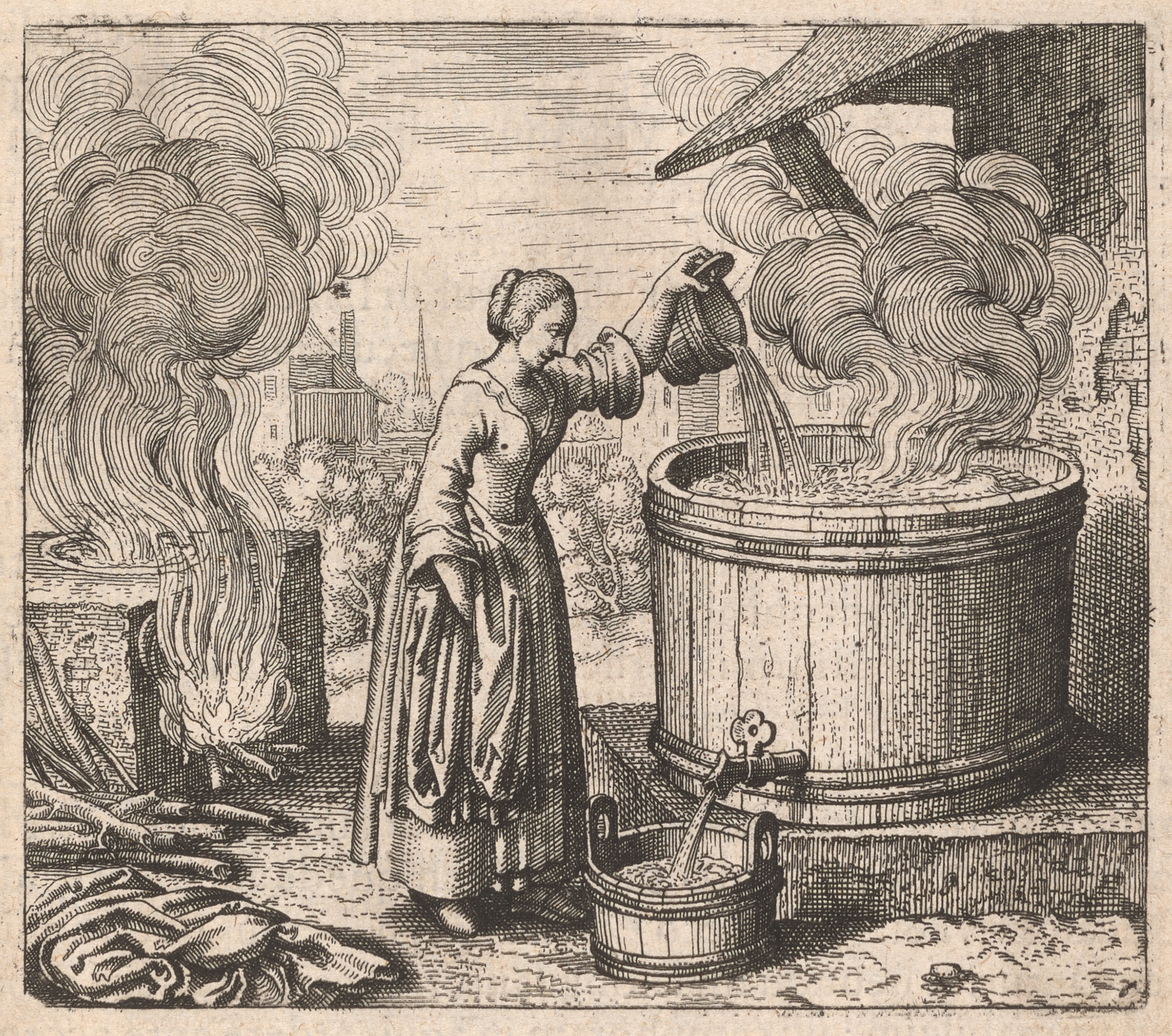
What You See
A woman kneels beside a wooden washing trough in an outdoor setting, scrubbing sheets or linens in soapy water. Her sleeves are rolled up and her posture suggests vigorous labor. A second figure, likely the alchemist-observer, watches from nearby. In the background, linens hang on a line to dry against a landscape of trees and buildings. The scene is emphatically domestic and practical, grounding the alchemical process in the imagery of common housework.
Go to the woman who washes the sheets and do as she does.
Epigram
Go to the woman who washes the sheets and do as she does. She moistens the dirty linen with warm water; Imitate her, and you will not go wrong in your art. For the water washes the blackness from the body, And what was stained by dirt becomes white through repeated washing, Drenched by rain, dried by sun-warmth.Discourse Summary
Maier argues that the alchemical purification process mirrors the everyday work of washing dirty linen: just as earth-stains on fabric are removed by water and then dried by sun and wind, so the impurities of the philosophical substance must be cleansed through repeated washing and exposure to the elements. The discourse develops the principle that what comes from earth is cleaned by the next element in the sequence — water purifies earth, air dries what water has cleaned. Maier presents the was her woman as a figure for the alchemist who must patiently repeat the cycle of dissolution and drying, an operation the tradition calls the albedo or whitening stage.
Overview
Emblem III bears the motto: "Go to the woman who washes the sheets and do as she does."
Maier's Discourse
Maier argues that the alchemical purification process mirrors the everyday work of washing dirty linen: just as earth-stains on fabric are removed by water and then dried by sun and wind, so the impurities of the philosophical substance must be cleansed through repeated washing and exposure to the elements. The discourse develops the principle that what comes from earth is cleaned by the next element in the sequence — water purifies earth, air dries what water has cleaned.
Source Texts
De Jong's source-critical analysis identifies the textual traditions Maier draws upon for this emblem.
De Jong identifies the motto source as Turba Philosophorum. The discourse draws on alchemical sources: Pseudo-Aristotle, Tractatulus de Practica Lapidis, Rosarium Philosophorum.
Alchemical Significance
H.M.E. de Jong: Washing represents all purification processes. Removal of black (nigredo), purification to white (albedo). Medical connection to Saturn's melancholy. Relates to dyeing techniques where bleaching precedes dyeing.
Key Alchemical Concepts
Process: Albedo, Calcination (Calcinatio), Distillatio
Substance: Tinctura
Source_Text: Turba Philosophorum
Scholarly Commentary
H.M.E. de Jong HIGH
Washing represents all purification processes. Removal of black (nigredo), purification to white (albedo). Medical connection to Saturn's melancholy. Relates to dyeing techniques where bleaching precedes dyeing.
Citation: Emblem III section