Emblem I — His nurse is the Earth NIGREDO
Original Source
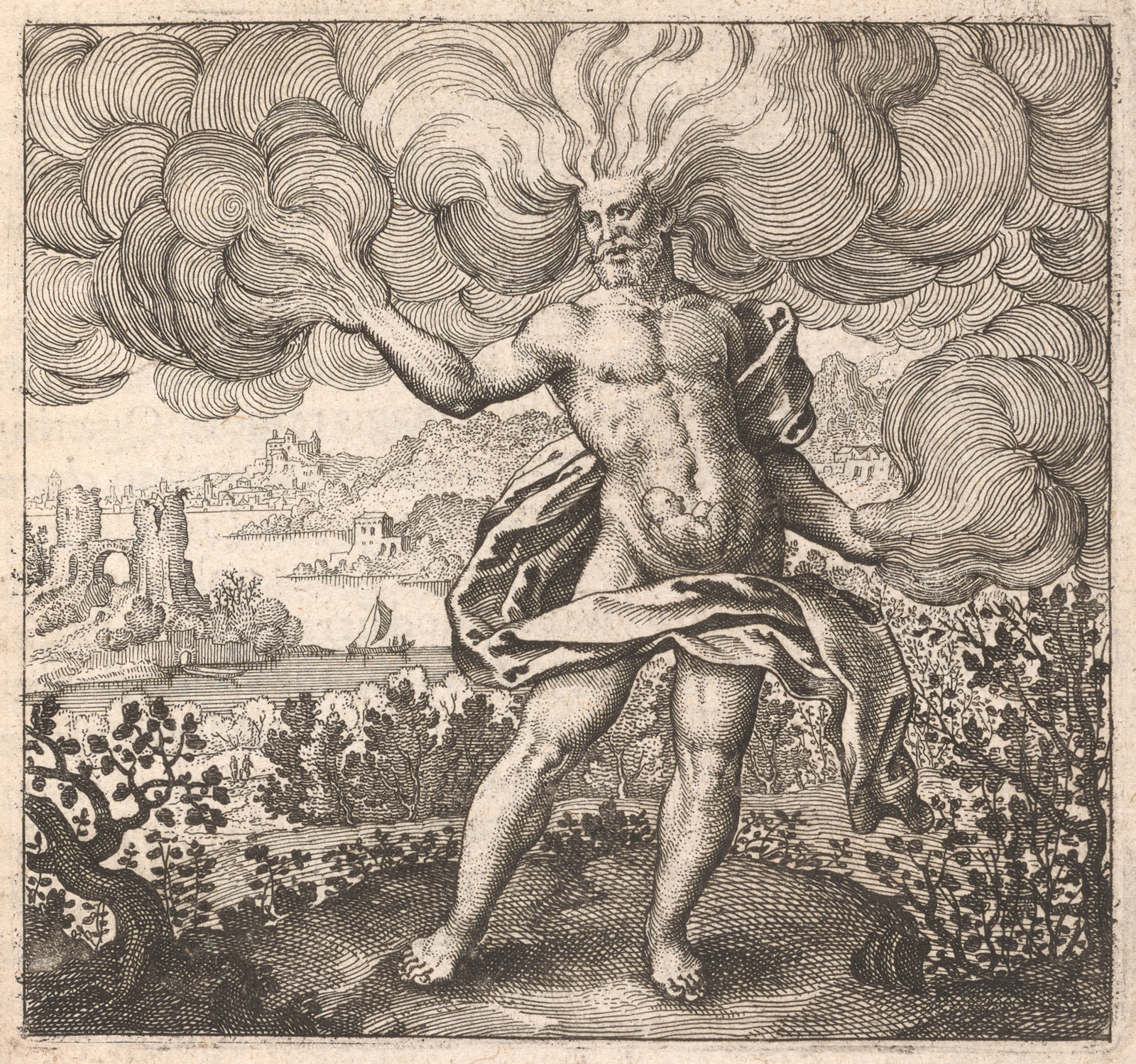
What You See
A muscular male figure, identified as Boreas the North Wind, strides across a rocky landscape carrying a swaddled infant against his torso. The wind god's hair and drapery stream behind him, and billowing clouds fill the sky above. Below, a female earth figure — massive, globular, with exposed breasts — reclines on the ground, her body merging with the landscape itself. A small child nurses at her breast while animals graze nearby, establishing the maternal earth as nurse.
Nutrix ejus terra est
The wind carried it in its belly.
Epigram
Romulus is said to have been nursed at the coarse udders of a wolf, And Jupiter to have been nursed by a goat, and these facts are said to be believed: Should we then wonder if we assert That the earth suckles the tender Child of the Philosophers with its milk? Maier, Examen Fucorum Pseudo-Chymicorum, 41: If an insignificant animal nursed such great heroes, Shall not the Terrestrial Globe be a nurse?Discourse Summary
Maier develops the Tabula Smaragdina's declaration that 'the wind carried it in its belly' into an extended analogy between alchemical generation and natural gestation. He argues that the philosophical substance must first be conceived in air (the volatile spirit) before being nourished by earth (the fixed body), just as an embryo is carried in the womb before being nursed after birth. The discourse draws on Peripatetic natural philosophy to assert that nourishment must share the nature of what it feeds, establishing the principle that the Stone requires earth — that is, a fixed, corporeal substrate — as its nurse. Maier cites Hermes Trismegistus as the ultimate authority for this teaching.
Overview
Emblem I bears the motto: "The wind carried it in its belly."
Maier's Discourse
Maier develops the Tabula Smaragdina's declaration that 'the wind carried it in its belly' into an extended analogy between alchemical generation and natural gestation. He argues that the philosophical substance must first be conceived in air (the volatile spirit) before being nourished by earth (the fixed body), just as an embryo is carried in the womb before being nursed after birth.
Source Texts
De Jong's source-critical analysis identifies the textual traditions Maier draws upon for this emblem.
De Jong identifies the motto source as Tabula Smaragdina (Emerald Tablet). The discourse draws on alchemical sources: Rosarium Philosophorum.
Alchemical Significance
Hereward Tilton: Tilton connects discourse 1 to Maier's critique of Agrippa's claims about extracting spirit from gold. Maier argues Agrippa was impoverished despite his claims, illustrating the futility of charlatanism versus true chemia.
J.B. Craven: Craven summarizes Emblem 1: 'The wind has taken him in the belly' — the fruit concealed in the wind must come living to earth in right measure. The nurse thereof is the earth.
H.M.E. de Jong: Motto derives from Tabula Smaragdina. Food becomes substance of the nourished. Alchemical work mirrors nature's processes.
Key Alchemical Concepts
Substance: Prima Materia
Figure: Atalanta, Boreas, Ceres, Hippomenes
Concept: Opus Magnum
Source_Text: Tabula Smaragdina
Musical: Fugue (Fuga)
Scholarly Commentary
Hereward Tilton ALCHEMICAL MEDIUM
Tilton connects discourse 1 to Maier's critique of Agrippa's claims about extracting spirit from gold. Maier argues Agrippa was impoverished despite his claims, illustrating the futility of charlatanism versus true chemia.
Citation: Ch. IV, p. 123 (cf. Examen Fucorum)
J.B. Craven ALCHEMICAL MEDIUM
Craven summarizes Emblem 1: 'The wind has taken him in the belly' — the fruit concealed in the wind must come living to earth in right measure. The nurse thereof is the earth.
Citation: p. 89
H.M.E. de Jong HIGH
Motto derives from Tabula Smaragdina. Food becomes substance of the nourished. Alchemical work mirrors nature's processes.
Citation: Emblem I section