Frontispiece — The Fleeing Atalanta
Original Source
What You See
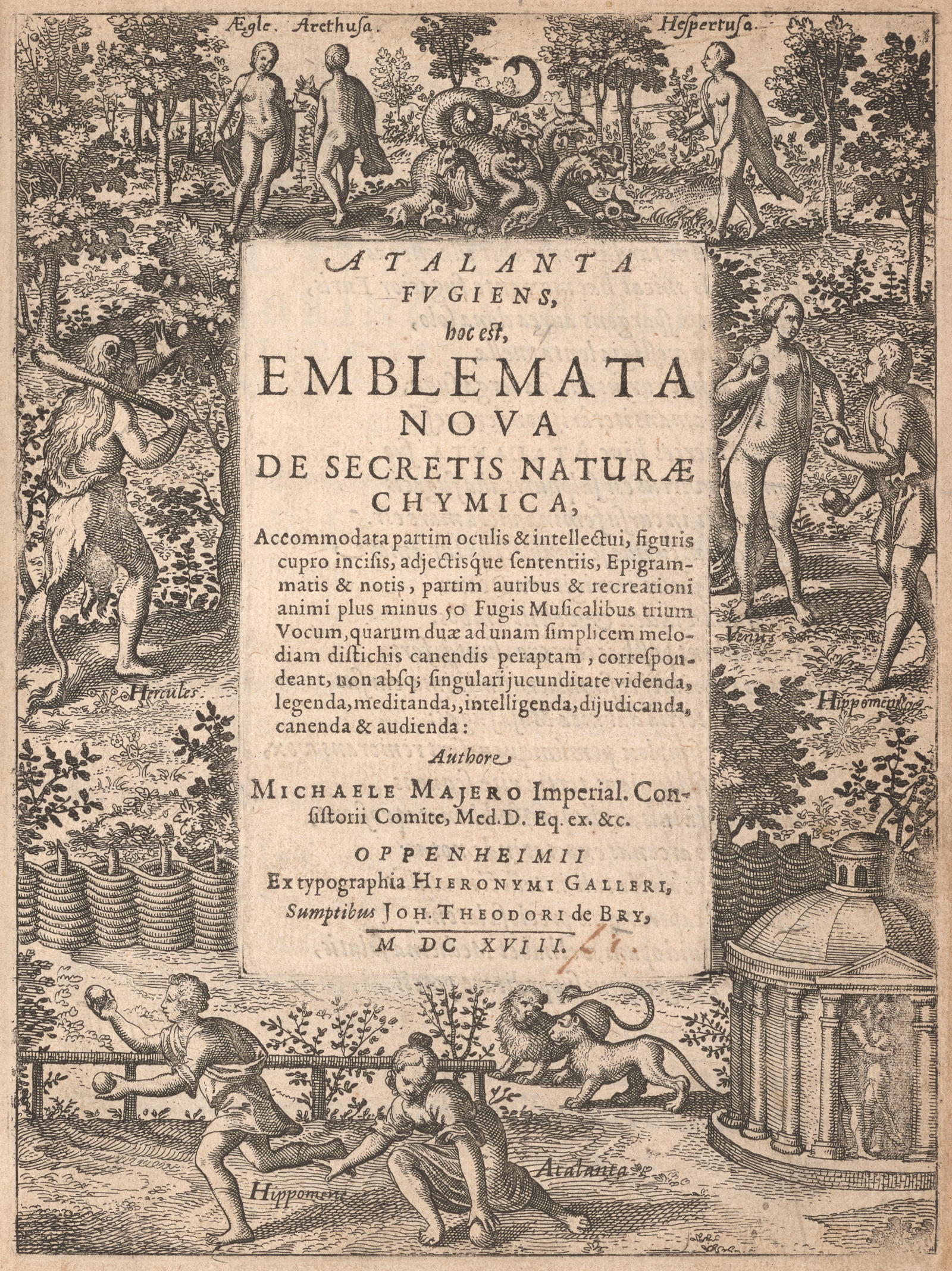
The title-page engraving depicts the race of Atalanta and Hippomenes at the bottom, with Hippomenes in mid-stride casting a golden apple while Atalanta stoops to retrieve one from the ground. At the left margin, Venus extends the golden apples to Hippomenes; at the right, the couple embraces in a temple entrance before emerging behind it as a lion and lioness, their transformation by Cybele. The upper register shows Hercules in his lion-skin approaching the tree of the Hesperides, reaching for the golden fruit while the three Hesperides — Aegle, Arethusa, and Hespertusa — watch from above. The central cartouche frames the title text in an architectural surround, unifying the mythological scenes into a single emblematic program that introduces the work's central conceit.
Motto not yet extracted
Discourse Summary
Maier's introductory apparatus presents Atalanta Fugiens as an exercise in multi-sensory pedagogy: the subtitle promises emblems for the eyes, fugues for the ears, and epigrams for the intellect, engaging sight, he a ring, and reason simultaneously in the pursuit of Nature's secrets. The myth of the footrace serves as a heuristic model for the reader's own engagement — just as Hippomenes must distract the swift Atalanta with golden apples to win the race, the reader must use the sensory enticements of image, music, and verse to catch the fleeting truths of alchemical philosophy. De Jong characterizes this as Maier's 'lusus serius' or serious game, a Renaissance pedagogical strategy in which play, meditation, and intellectual pursuit are fused into a single practice of discovery. The frontispiece thus functions not merely as decoration but as an instruction manual for how to read the fifty emblems that follow — each a puzzle requiring the reader to chase meaning across multiple registers.
Scholarly Commentary
Walter Pagel ALCHEMICAL MEDIUM
Pagel connects the frontispiece imagery to the keynote myth of Atalanta dropping golden apples, the conjunction of Atalanta and Hippomenes, and their metamorphosis into lion and lioness, recognizing the alchemical principles of union of opposites (Sulphur and Mercury).
Citation: p. 100
J.B. Craven ICONOGRAPHIC MEDIUM
Craven describes the frontispiece title-page: Venus handing golden apples to Hippomenes, Atalanta picking up one apple, the temple where the lovers embrace and emerge as lion and lioness, and Hercules reaching for the apples of the Hesperides above.
Citation: pp. 87-88
H.M.E. de Jong HIGH
Frontispiece signals the secret of the opus. Golden apples are catalytic lures. Hippomenes = Sulphur (fixed), Atalanta = Mercury (volatile). Race = difficulty of combining volatile with non-volatile. Lion/lioness = final product.
Citation: Frontispiece section