Emblem VII — Young bird flying from nest and falling back CITRINITAS
Original Source
What You See
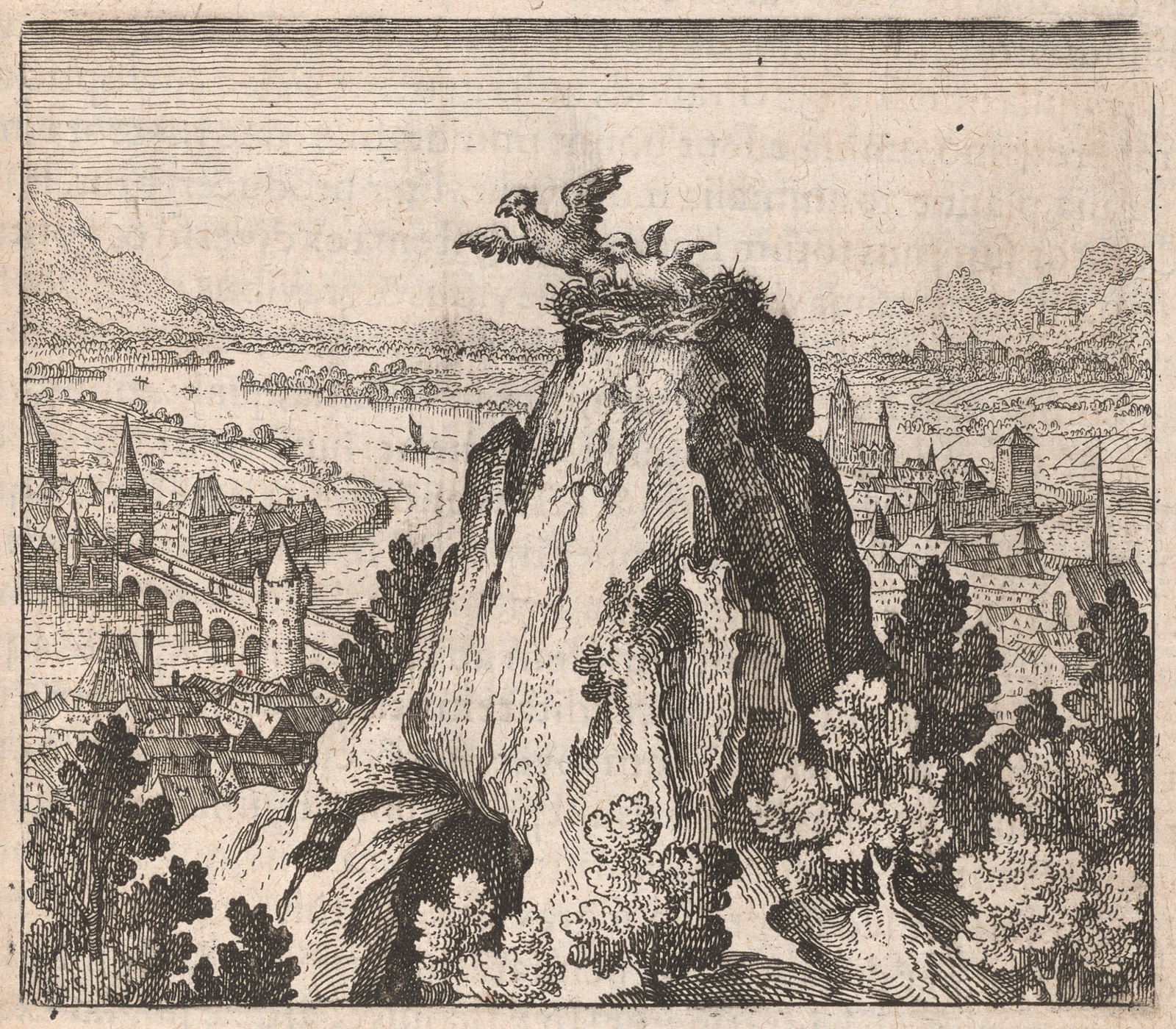
A young bird — identified in the motto as a philosophical chick — launches upward from a nest perched in a tree or rocky outcrop, wings spread in attempted flight. Below, the same or another bird falls back toward the nest, unable to sustain its ascent. The landscape includes trees and possibly a distant town. The dual image of rising and falling captures the cyclical nature of sublimation and descent.
A young bird flies up from the nest and falls back into the nest again.
Epigram
The eagle had built a nest in a hollow rock, In which it hid and fed its young: One of them, trying to fly, fell back into the nest, For the feathers were not yet fully grown. The bird rises again, and falls back, until Its wings have grown strong enough to sustain flight.Discourse Summary
Maier describes a species of bird that flies upward from its nest only to fall back again repeatedly, developing this as an analogy for the alchemical process of sublimation and condensation. He argues that the volatile philosophical substance must be repeatedly driven upward (sublimated) and allowed to fall back (condensed) until it is sufficiently matured to sustain it self. The discourse connects this to the broader principle that Nature works through cyclical repetition rather than linear progress. Maier suggests that the bird's eventual success in flight corresponds to the moment when the volatile spirit is finally fixed and can maintain its elevated state.
Overview
Emblem VII bears the motto: "A young bird flies up from the nest and falls back into the nest again."
Maier's Discourse
Maier describes a species of bird that flies upward from its nest only to fall back again repeatedly, developing this as an analogy for the alchemical process of sublimation and condensation. He argues that the volatile philosophical substance must be repeatedly driven upward (sublimated) and allowed to fall back (condensed) until it is sufficiently matured to sustain itself. The discourse connects this to the broader principle that Nature works through cyclical repetition rather than linear progress.
Source Texts
De Jong's source-critical analysis identifies the textual traditions Maier draws upon for this emblem.
De Jong identifies the motto source as Senior Zadith (Muhammad ibn Umail), Tabula Chimica. The discourse draws on alchemical sources: Aurora Consurgens, Merlini Allegory, Pseudo-Aristotle, Tractatulus de Practica Lapidis, Lambsprinck, De Lapide Philosophico. The discourse draws on classical sources: Ovid, Metamorphoses X.560-704.
Alchemical Significance
J.B. Craven: Craven summarizes Emblem 7: the eagle in a hollow rock nourishes its young; one feathered easily rises while the featherless falls back, illustrating 'It ascends from earth to heaven, and again descends to earth.
H.M.E. de Jong: Winged = volatile/Mercury/Moon/female. Wingless = fixed/Sulphur/Sun/male. Elements bonded despite contrasts. Phoenix symbolism: resurrection through fire and dissolution.
Key Alchemical Concepts
Process: Fixatio
Substance: Luna, Mercurius (Mercurius Philosophorum), Sol, Sulphur
Source_Text: De Lapide Philosophico, Tabula Chimica
Scholarly Commentary
J.B. Craven ALCHEMICAL MEDIUM
Craven summarizes Emblem 7: the eagle in a hollow rock nourishes its young; one feathered easily rises while the featherless falls back, illustrating 'It ascends from earth to heaven, and again descends to earth.'
Citation: p. 89
H.M.E. de Jong HIGH
Winged = volatile/Mercury/Moon/female. Wingless = fixed/Sulphur/Sun/male. Elements bonded despite contrasts. Phoenix symbolism: resurrection through fire and dissolution.
Citation: Emblem VII section