Emblem XXVII — Companion to Sapientia sequence CITRINITAS
Original Source
What You See
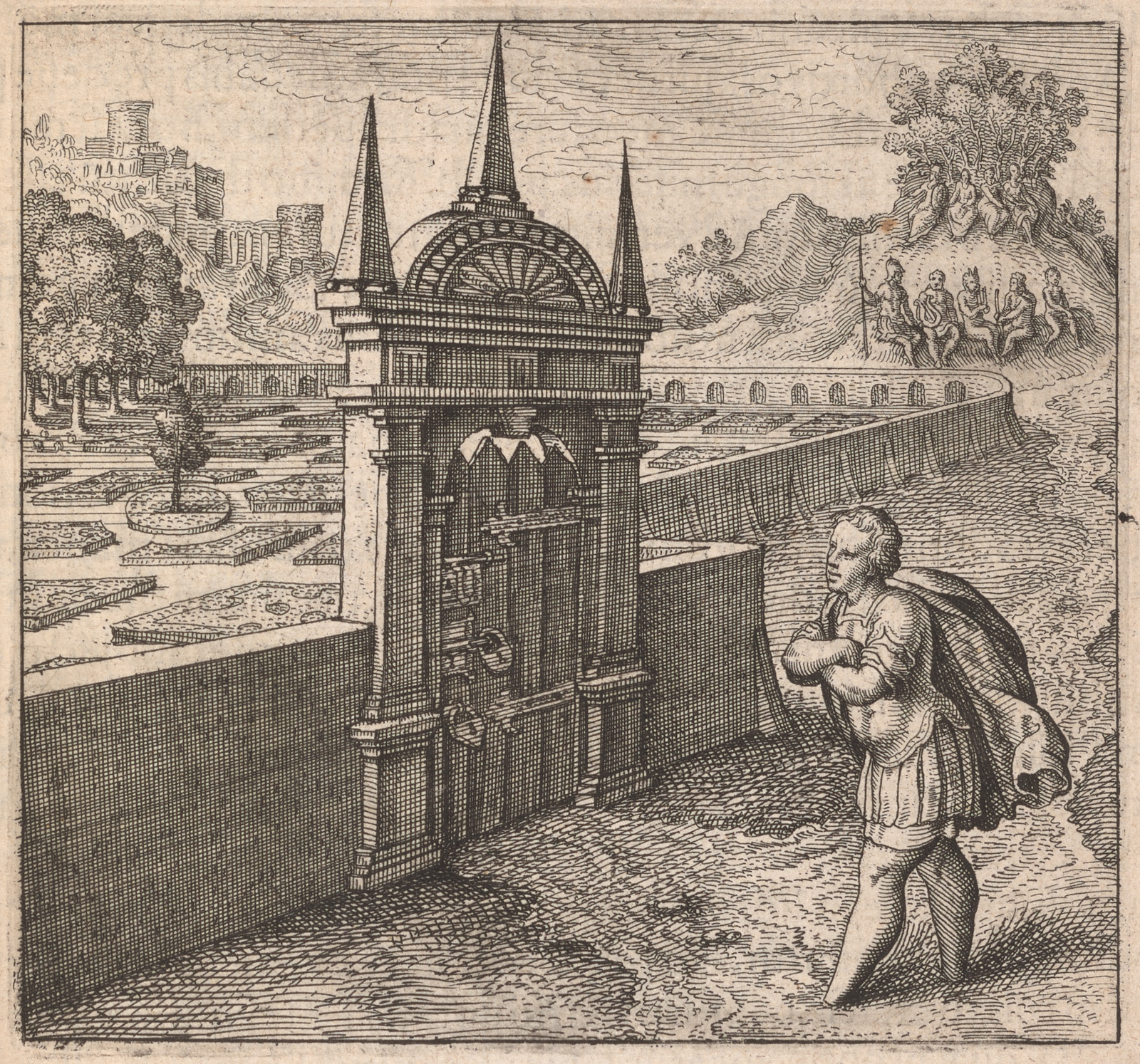
A figure approaches or stands before a walled garden containing rose bushes or flowering plants. A locked gate or door bars entry, and the figure has no key. The garden interior is visible — lush, ordered, containing the philosophical rose — but inaccessible. The composition emphasizes the barrier between the seeker and the sought knowledge.
He who tries to enter the Philosophical Rose-garden without the key is like a man who wants to walk without feet.
Epigram
He who tries to enter the Philosophical Rose-garden without the key Is like a man who wants to walk without feet. The gate is locked with strong bolts; Only the prepared may enter. Three things are needed: patience, knowledge, and labor. Without these, the garden remains forever closed.Discourse Summary
Maier argues that attempting to enter the Philosophical Rose-garden without the proper key is as futile as trying to walk without feet. He develops this as a warning against shortcuts in the alchemical work: the three 'cooking' or 'consuming' processes that occur in the human body — digestion in the stomach, refinement in the liver, and distribution through the blood — mirror the three stages of alchemical preparation that can not be by passed. The discourse grounds this in Old Testament wisdom literature, connecting the rose-garden to the Song of Songs and the Solomonic tradition of enclosed gardens as figures for hidden wisdom accessible only through proper preparation.
Overview
Emblem XXVII bears the motto: "He who tries to enter the Philosophical Rose-garden without the key is like a man who wants to walk without feet."
Maier's Discourse
Maier argues that attempting to enter the Philosophical Rose-garden without the proper key is as futile as trying to walk without feet. He develops this as a warning against shortcuts in the alchemical work: the three 'cooking' or 'consuming' processes that occur in the human body — digestion in the stomach, refinement in the liver, and distribution through the blood — mirror the three stages of alchemical preparation that cannot be bypassed.
Source Texts
De Jong's source-critical analysis identifies the textual traditions Maier draws upon for this emblem.
De Jong identifies the motto source as Rosarium Philosophorum. The discourse draws on alchemical sources: Jodocus Greverus, Secretum Nobilissimorum. The discourse draws on biblical sources: Solomonic / Biblical Wisdom Tradition (Proverbs).
Alchemical Significance
H.M.E. de Jong: Explicitly linked to Emblem XXVI. Coupling with Old Testament texts based on Rosarium.
Key Alchemical Concepts
Concept: Sapientia
Source_Text: Aurora Consurgens, Liber Sapientiae, Rosarium Philosophorum
Scholarly Commentary
H.M.E. de Jong HIGH
Explicitly linked to Emblem XXVI. Coupling with Old Testament texts based on Rosarium.
Citation: Emblem XXVII section