Emblem XXVIII — King Duenech in steam bath NIGREDO
Original Source
What You See
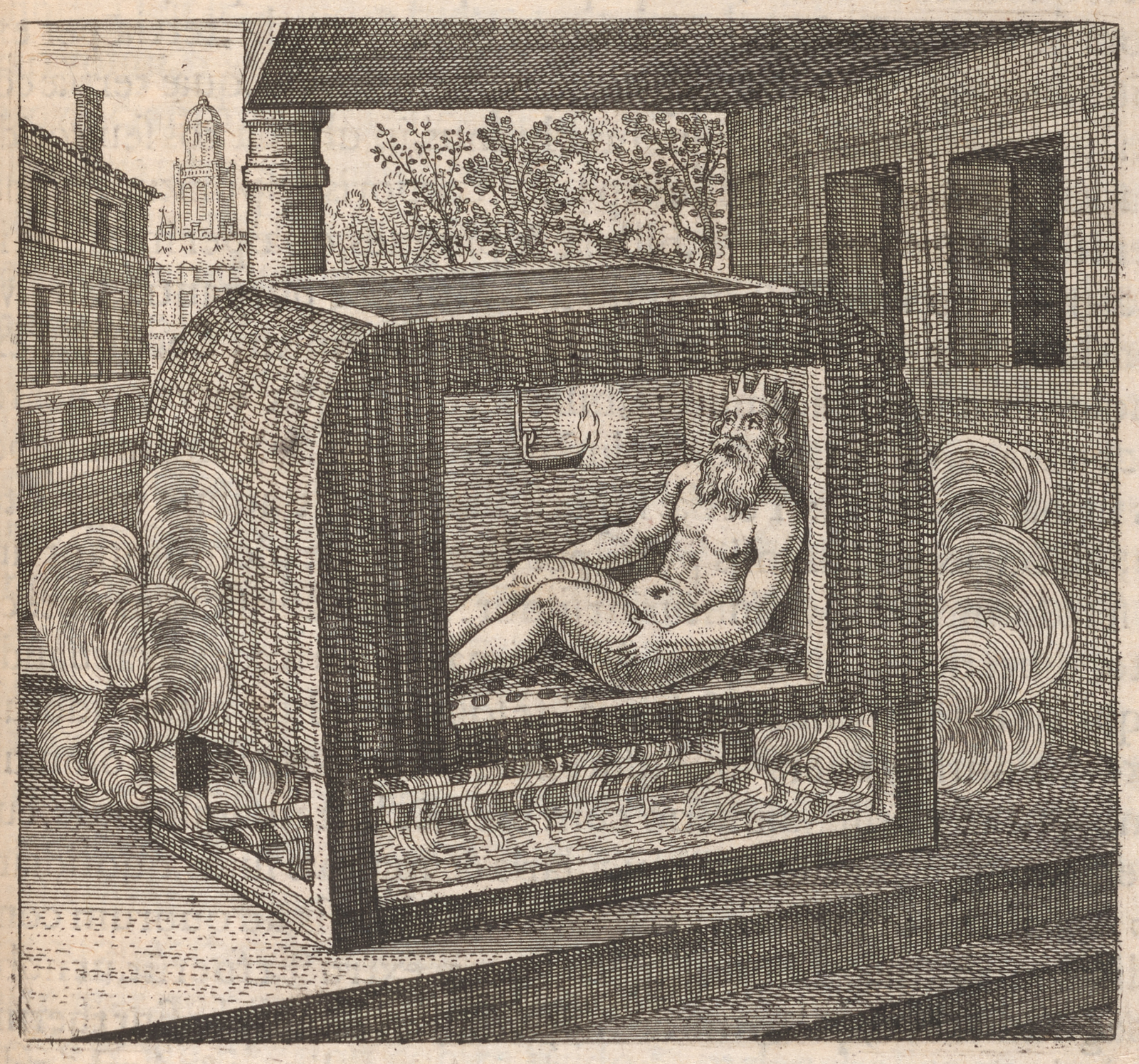
A crowned king sits immersed in a steaming bath or vessel, attended by one or more figures — physicians or servants — who regulate the temperature or administer treatments. Black bile or dark fluid visibly drains from the king's body into the bathwater. The bath vessel is large and prominent, and steam or vapors rise around the royal figure. The attendant is sometimes identified as Pharut.
The king is bathed, sitting in a steam-bath, and is freed from the black bile by Pharut.
Epigram
The king is bathed, sitting in a steam-bath, And is freed from the black bile by Pharut. In the warmth of the moist vapors The saturnine corruption is expelled. The physicians attend him with care, Until health returns to the royal body.Discourse Summary
Maier develops the Allegoria Merlini's narrative of King Duenech, who is bathed in a steam-bath to purge the black bile that ails him. He argues that the king represents philosophical gold in its impure state, and the bath is the vessel in which dissolution occurs: the black bile is the nigredo impurity that must be expelled through gentle, sustained heat. The discourse connects this to the Merlini tradition's account of royal purification, where the king's illness is cured not by violent means but by the patient application of warm moisture. Maier cites the medical practice of therapeutic bathing as a parallel, drawing on his own training as a physician to validate the alchemical analogy.
Overview
Emblem XXVIII bears the motto: "The king is bathed, sitting in a steam-bath, and is freed from the black bile by Pharut."
Maier's Discourse
Maier develops the Allegoria Merlini's narrative of King Duenech, who is bathed in a steam-bath to purge the black bile that ails him. He argues that the king represents philosophical gold in its impure state, and the bath is the vessel in which dissolution occurs: the black bile is the nigredo impurity that must be expelled through gentle, sustained heat. The discourse connects this to the Merlini tradition's account of royal purification, where the king's illness is cured not by violent means but by the patient application of warm moisture.
Source Texts
De Jong's source-critical analysis identifies the textual traditions Maier draws upon for this emblem.
The discourse draws on alchemical sources: Lambsprinck, De Lapide Philosophico, Merlini Allegory, Merlini Allegory.
Alchemical Significance
C. Morris Wescott: Part of Alchemical King sequence. Saturn = Lead = Putrefaction stage. King undergoes purification.
Walter Pagel: King in Turkish bath, purging black bile. Color progression black to red represents alchemical stages.
Hereward Tilton: Tilton reads discourse 28's Duenech allegory as purification through sweating: the melancholic king enters the bath to expel impurities. Maier explains this as purification of both human and metallic bodies. The allegory connects to the Merlini tradition and Maier's own illness while writing Symbola Aureae Mensae.
Walter Pagel: Pagel discusses King Duenech as dropsical and discoloured, presented in a Turkish bath undergoing purgation of black bile until red colour returns, representing the alchemical work's characteristic colour changes from black to red.
C. Morris Wescott: Wescott analyzes Emblem XXVIII's fuga: Atalanta enters at G and Hippomenes imitates at A. The E-flat/E-natural dissonance (minor second) represents the King Duenech's sufferings during his cure from Saturnian melancholy in the steam-bath.
C. Morris Wescott: Wescott identifies King Duenech in Emblem XXVIII as being cured of Saturnian melancholy in the steam-bath, connecting the medical tradition of music curing Saturnian melancholy to the double cleansing function in alchemical operations.
H.M.E. de Jong: De Jong identifies the steam bath allegory's source in the Processus Chemici and the Allegoria Merlini, tracing King Duenech's purification through therapeutic bathing to the medical tradition of humoral purgation. She connects the black bile (aqua foetida) to the nigredo impurity that must be expelled through gentle, sustained moist heat.
Key Alchemical Concepts
Process: Nigredo, Putrefaction (Putrefactio)
Substance: Aqua Regia, Aqua Vitae
Figure: King Duenech (Rex Duenech), Rex
Scholarly Commentary
C. Morris Wescott HIGH
Part of Alchemical King sequence. Saturn = Lead = Putrefaction stage. King undergoes purification.
Citation: Figure 2 discussion
Walter Pagel HIGH
King in Turkish bath, purging black bile. Color progression black to red represents alchemical stages.
Citation: Review discussion
Hereward Tilton ALCHEMICAL MEDIUM
Tilton reads discourse 28's Duenech allegory as purification through sweating: the melancholic king enters the bath to expel impurities. Maier explains this as purification of both human and metallic bodies. The allegory connects to the Merlini tradition and Maier's own illness while writing Symbola Aureae Mensae.
Citation: Ch. IV, pp. 142-143
Walter Pagel ALCHEMICAL MEDIUM
Pagel discusses King Duenech as dropsical and discoloured, presented in a Turkish bath undergoing purgation of black bile until red colour returns, representing the alchemical work's characteristic colour changes from black to red.
Citation: p. 101
C. Morris Wescott MUSICAL MEDIUM
Wescott analyzes Emblem XXVIII's fuga: Atalanta enters at G and Hippomenes imitates at A. The E-flat/E-natural dissonance (minor second) represents the King Duenech's sufferings during his cure from Saturnian melancholy in the steam-bath.
Citation: pp. 3-4
C. Morris Wescott ALCHEMICAL MEDIUM
Wescott identifies King Duenech in Emblem XXVIII as being cured of Saturnian melancholy in the steam-bath, connecting the medical tradition of music curing Saturnian melancholy to the double cleansing function in alchemical operations.
Citation: p. 2
H.M.E. de Jong ALCHEMICAL HIGH
De Jong identifies the steam bath allegory's source in the Processus Chemici and the Allegoria Merlini, tracing King Duenech's purification through therapeutic bathing to the medical tradition of humoral purgation. She connects the black bile (aqua foetida) to the nigredo impurity that must be expelled through gentle, sustained moist heat.