Emblem V — Woman suckling the toad NIGREDO
Original Source
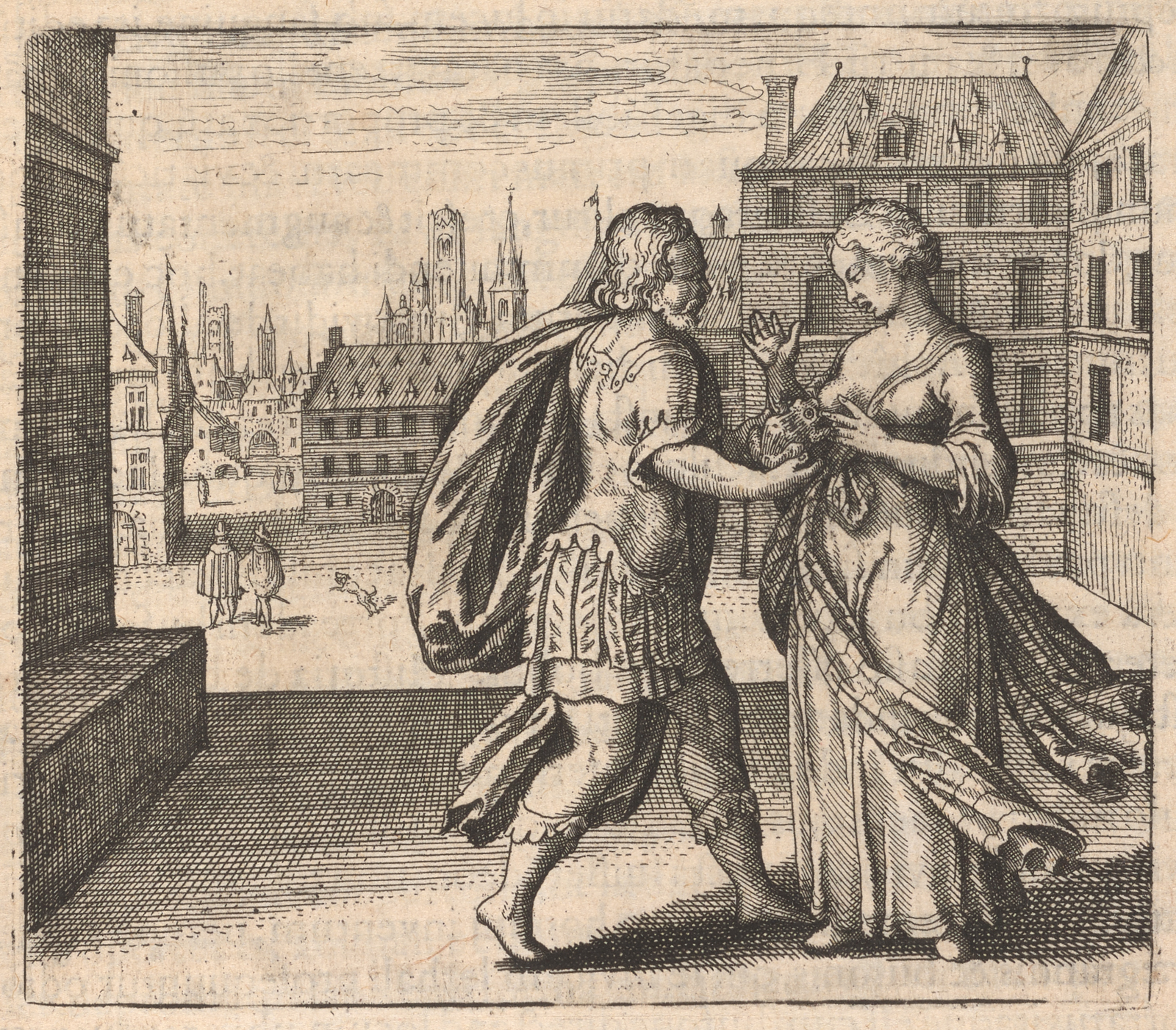
What You See
A woman sits outdoors on a stone bench, her bodice loosened, nursing a large toad at her breast. The toad clings to her chest with its forelimbs, drawing milk while the woman's expression registers calm resignation rather than horror. Behind her, a walled town rises against a hilly landscape with scattered trees. In the foreground, a second smaller toad waits on the ground. The scene inverts the conventional nursing Madonna into an image of productive destruction.
Put a toad to the breasts of a woman, that she may suckle it, and the woman may die and the toad grow big from the milk.
Epigram
Put a cold toad at the breast of a woman, So that it may drink from the source of milk like a child. Let it swell into a large growth, And let the woman become ill and die. Make a noble medicine from it, Which drives the poison out of the human heart and takes away destruction.Discourse Summary
Maier frames the alchemical operation as gendered labor, arguing that the masculine principle be gets and governs while the feminine conceives, bears, and nourishes. He develops the toad as a figure for the volatile, poisonous agent that must be fed by the maternal body of the prima materia — a feeding that kills the nurse but matures the product. Maier draws the analogy to Cleopatra's death by asp-venom, suggesting that the transfer of vital essence from woman to toad mirrors the fixation of the volatile sulphur through prolonged contact with a liquid menstruum. The discourse cites the Pseudo-Aristotelian Tractatulus de Practica Lapidis as the source of this toad-nursing imagery.
Overview
Emblem V bears the motto: "Put a toad to the breasts of a woman, that she may suckle it, and the woman may die and the toad grow big from the milk."
Maier's Discourse
Maier frames the alchemical operation as gendered labor, arguing that the masculine principle begets and governs while the feminine conceives, bears, and nourishes. He develops the toad as a figure for the volatile, poisonous agent that must be fed by the maternal body of the prima materia — a feeding that kills the nurse but matures the product. Maier draws the analogy to Cleopatra's death by asp-venom, suggesting that the transfer of vital essence from woman to toad mirrors the fixation of the volatile sulphur through prolonged contact with a liquid menstruum.
Source Texts
De Jong's source-critical analysis identifies the textual traditions Maier draws upon for this emblem.
De Jong identifies the motto source as Pseudo-Aristotle, Tractatulus de Practica Lapidis. The discourse draws on alchemical sources: Lullius tradition (via Harmonica Chemica), Pseudo-Aristotle, Tractatulus de Practica Lapidis. The discourse draws on classical sources: Ovid, Metamorphoses X.560-704. The discourse draws on Hermetic sources: Tabula Smaragdina (Emerald Tablet).
Alchemical Significance
H.M.E. de Jong: Four stages: decomposition, purification, formation into pliable substance (woman dies, toad grows), hardening into stone. Toad = earth, Woman = water. One nature coagulates only through dissolution of another. Catena Aurea linking microcosm to macrocosm.
Key Alchemical Concepts
Process: Coagulation (Coagulatio), Dissolution (Dissolutio), Solutio
Concept: Catena Aurea, Philosopher's Stone (Lapis Philosophorum), Solve et Coagula
Source_Text: Ars Magna, Tractatulus de Practica Lapidis (Tractatulus de Practica Lapidis Philosophici)
Scholarly Commentary
H.M.E. de Jong HIGH
Four stages: decomposition, purification, formation into pliable substance (woman dies, toad grows), hardening into stone. Toad = earth, Woman = water. One nature coagulates only through dissolution of another. Catena Aurea linking microcosm to macrocosm.
Citation: Emblem V section