Emblem XIV — Emblem XIV NIGREDO
Original Source
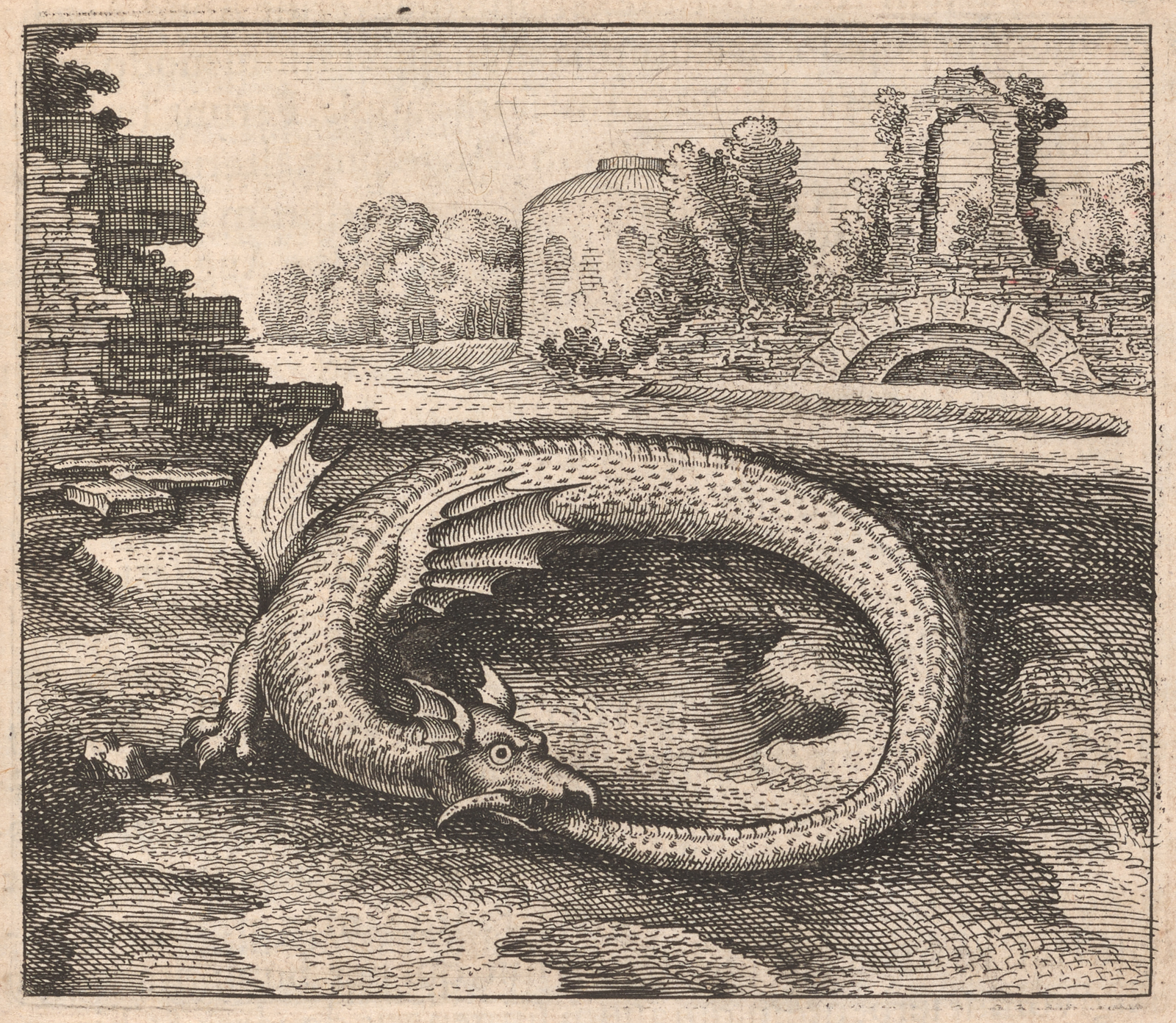
What You See
A serpent coils upon itself, its jaws clamped around its own tail in the classic ouroboros form. A second serpent approaches or confronts the first, and the scene suggests one devouring the other in a transformative act. The setting is sparse — a rocky or barren ground — focusing attention on the intertwined, self-consuming bodies of the serpents.
This is the dragon that devours its own tail.
Epigram
This is the dragon that devours its own tail, The serpent of the philosophers, Which bites itself and generates itself, Dissolving and coagulating itself. A serpent that devours another serpent becomes a dragon; This is the secret of the wise.Discourse Summary
Maier develops the ancient image of the serpent devouring another serpent to become a dragon, an allegory for the dissolution of one metallic substance by another of similar but more active nature. He argues that in antiquity the serpent represented both poison and medicine — the pharmakon — and that the alchemical dragon born from this mutual consumption combines the properties of both parents. The discourse cites classical accounts of dragon-generation and connects them to the Hermetic principle that the Stone is produced when like consumes like. Maier emphasizes that this is a nigredo operation: the death of both serpents precedes the birth of the more powerful dragon.
Overview
Emblem XIV bears the motto: "This is the dragon that devours its own tail."
Maier's Discourse
Maier develops the ancient image of the serpent devouring another serpent to become a dragon, an allegory for the dissolution of one metallic substance by another of similar but more active nature. He argues that in antiquity the serpent represented both poison and medicine — the pharmakon — and that the alchemical dragon born from this mutual consumption combines the properties of both parents. The discourse cites classical accounts of dragon-generation and connects them to the Hermetic principle that the Stone is produced when like consumes like.
Source Texts
De Jong's source-critical analysis identifies the textual traditions Maier draws upon for this emblem.
The discourse draws on alchemical sources: Aurora Consurgens, Lambsprinck, De Lapide Philosophico, Lullius tradition (via Harmonica Chemica), Pseudo-Aristotle, Tractatulus de Practica Lapidis, Rosarium Philosophorum, Senior Zadith (Muhammad ibn Umail), Tabula Chimica.
Alchemical Significance
J.B. Craven: Craven summarizes Emblem 14: the dragon eating its own tail — hunger compels self-consumption and recreation, illustrating 'the strongest of all fortitudes.
H.M.E. de Jong: De Jong identifies the motto source in the Clangor Buccinae and traces the discourse's discussion of Mercury's distillation processes to the same text. She demonstrates how Maier connects the potter's craft of working with wet and dry materials to the alchemical manipulation of mercurial and sulphurous components through successive stages.
Scholarly Commentary
J.B. Craven ALCHEMICAL MEDIUM
Craven summarizes Emblem 14: the dragon eating its own tail — hunger compels self-consumption and recreation, illustrating 'the strongest of all fortitudes.'
Citation: p. 90
H.M.E. de Jong ALCHEMICAL HIGH
De Jong identifies the motto source in the Clangor Buccinae and traces the discourse's discussion of Mercury's distillation processes to the same text. She demonstrates how Maier connects the potter's craft of working with wet and dry materials to the alchemical manipulation of mercurial and sulphurous components through successive stages.