Emblem VIII — Emblem VIII NIGREDO
Original Source
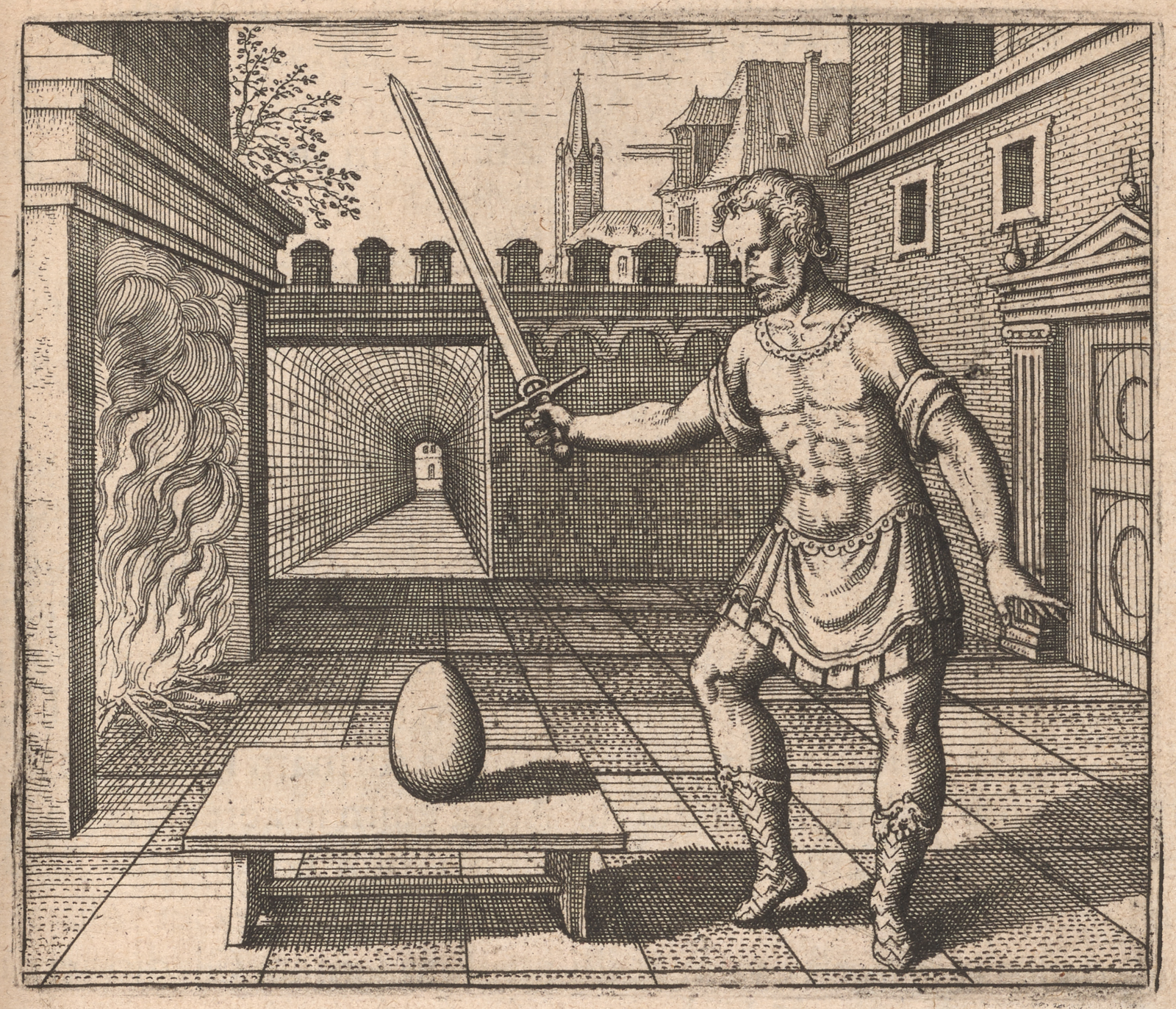
What You See
A hand extends from the left holding a flaming sword, driving it into a large egg that sits on a surface or pedestal at center. The egg cracks under the blade's impact, and flames or vapors escape from the breach. The setting is minimal, focusing attention entirely on the violent yet precise act of piercing the philosophical egg. The fiery sword introduces the element of controlled heat into the self-contained vessel of the egg.
Take the egg and pierce it with a fiery sword.
Epigram
There is a bird in the world, more sublime than all, Whose egg to search for is your only care. A soft white surrounds the yellow yolk; Strike it cautiously with a fiery sword, as is the custom. Let Mars lend his aid to Vulcan: the chick thence arising Shall be the conqueror of iron and fire.Discourse Summary
Maier develops the egg as a figure for the sealed vessel containing the prima materia, arguing that it must be pierced — that is, opened to the action of fire — with a fiery sword to release and transform its contents. The discourse draws on the widespread alchemical tradition of the philosophical egg (ovum philosophicum), where the shell represents the vessel, the white the mercury, and the yolk the sulphur. Maier argues that the sword of fire must be applied with precision — too little heat fails to open the egg, too much destroys the embryonic substance within. The operation described is calcination, the controlled application of heat to break down the initial form of the material.
Overview
Emblem VIII bears the motto: "Take the egg and pierce it with a fiery sword."
Maier's Discourse
Maier develops the egg as a figure for the sealed vessel containing the prima materia, arguing that it must be pierced — that is, opened to the action of fire — with a fiery sword to release and transform its contents. The discourse draws on the widespread alchemical tradition of the philosophical egg (ovum philosophicum), where the shell represents the vessel, the white the mercury, and the yolk the sulphur. Maier argues that the sword of fire must be applied with precision — too little heat fails to open the egg, too much destroys the embryonic substance within.
Source Texts
De Jong's source-critical analysis identifies the textual traditions Maier draws upon for this emblem.
The discourse draws on alchemical sources: Lullius tradition (via Harmonica Chemica), Merlini Allegory, Turba Philosophorum. The discourse draws on classical sources: Ovid, Metamorphoses X.560-704.
Alchemical Significance
J.B. Craven: Craven summarizes Emblem 8: 'Take the Egg and strike it with a glowing sword' — seek help from Mars the fire god, illustrating the strength of superiors and inferiors.
H.M.E. de Jong: De Jong traces the motto to the pronouncement of Balgus in the Turba Philosophorum, where the old man must be fixed to the tree in celestial dew to be rejuvenated. She identifies this as an allegory for the volatile spirit descending upon and renewing the fixed philosophical body, drawing on the Pseudo-Lullian tradition of argent vive as prima materia.
Key Alchemical Concepts
Concept: Philosophical Egg (Ovum Philosophicum), Vas Hermeticum
Scholarly Commentary
J.B. Craven ALCHEMICAL MEDIUM
Craven summarizes Emblem 8: 'Take the Egg and strike it with a glowing sword' — seek help from Mars the fire god, illustrating the strength of superiors and inferiors.
Citation: p. 89
H.M.E. de Jong ALCHEMICAL HIGH
De Jong traces the motto to the pronouncement of Balgus in the Turba Philosophorum, where the old man must be fixed to the tree in celestial dew to be rejuvenated. She identifies this as an allegory for the volatile spirit descending upon and renewing the fixed philosophical body, drawing on the Pseudo-Lullian tradition of argent vive as prima materia.