Emblem XIX — Emblem XIX NIGREDO
Original Source
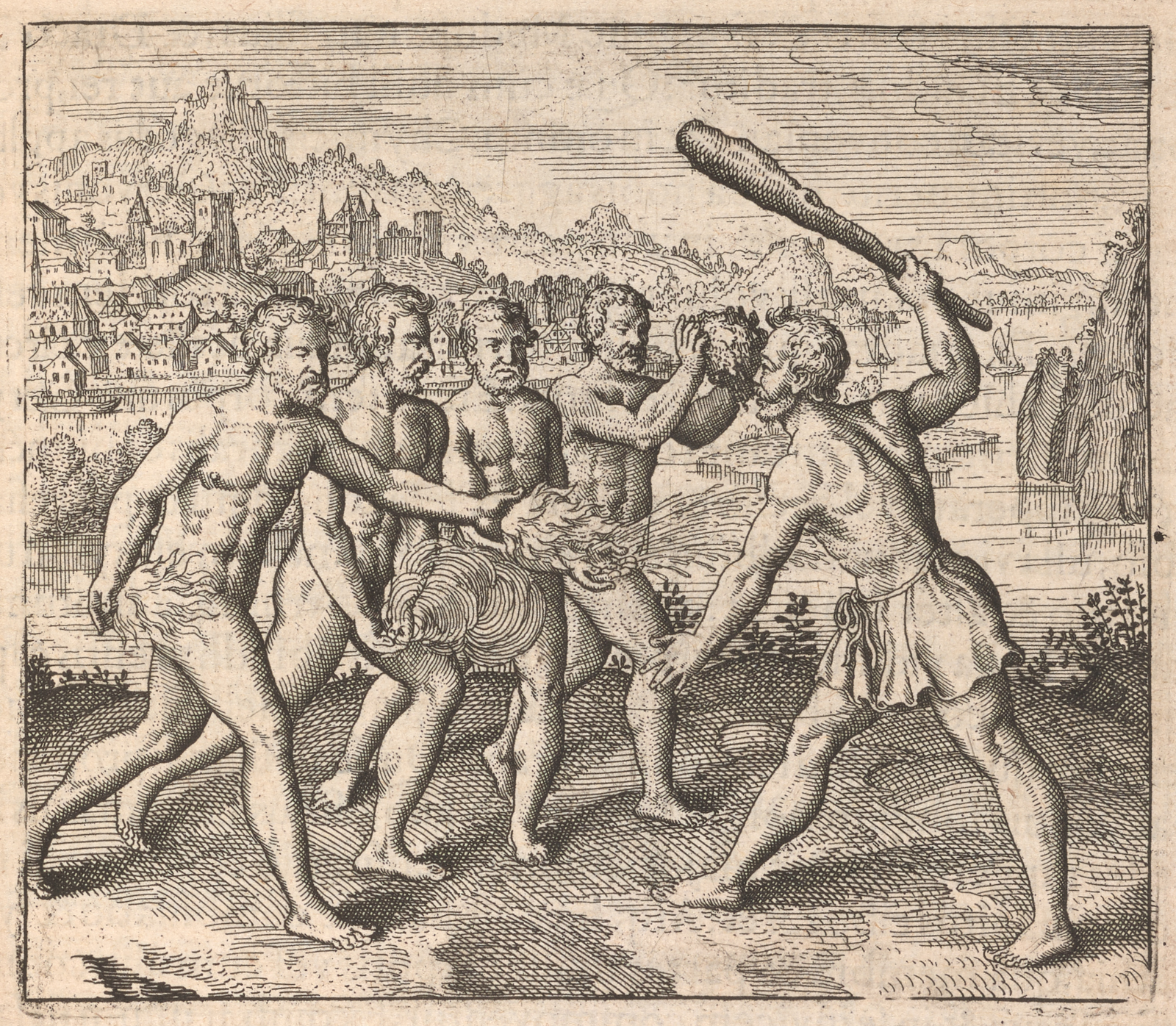
What You See
Four figures stand together in a group — possibly representing four brothers, four elements, or four aspects of a single substance. One figure strikes or kills another while the remaining two look on or collapse. The composition conveys a chain reaction: the death of one precipitates the death of all. The setting is an open space, perhaps a courtyard, with the violence at the center of the scene.
If you kill one of the four, every body will be dead immediately.
Epigram
If you kill one of the four, Everybody will be dead immediately. For the four are bound together so tightly That the death of one means the death of all. Separate them gently, not by force, Or the whole work will be destroyed.Discourse Summary
Maier develops the idea that the four elements or components of the philosophical substance are so intimately connected that destroying one annihilates all. He argues that this demonstrates their essential unity — they are not truly four separate things but four aspects of a single body. The discourse draws on the myth of Geryon, the three-bodied king of Spain, and his pure-bred cattle guarded by the dog Orthrus, developing this as an allegory for the composite nature of the prima materia. Maier uses this to warn the alchemist against violent separation: the elements must be gently distinguished, not forcibly torn apart, lest the entire work be destroyed.
Overview
Emblem XIX bears the motto: "If you kill one of the four, everybody will be dead immediately."
Maier's Discourse
Maier develops the idea that the four elements or components of the philosophical substance are so intimately connected that destroying one annihilates all. He argues that this demonstrates their essential unity — they are not truly four separate things but four aspects of a single body. The discourse draws on the myth of Geryon, the three-bodied king of Spain, and his pure-bred cattle guarded by the dog Orthrus, developing this as an allegory for the composite nature of the prima materia.
Source Texts
De Jong's source-critical analysis identifies the textual traditions Maier draws upon for this emblem.
The discourse draws on alchemical sources: Merlini Allegory, Pseudo-Aristotle, Tractatulus de Practica Lapidis, Rosarium Philosophorum, Turba Philosophorum. The discourse draws on biblical sources: Solomonic / Biblical Wisdom Tradition (Proverbs).
Alchemical Significance
H.M.E. de Jong: De Jong traces the motto source to the Opus Mulierum et Ludus Puerorum and identifies additional sources in Arnold of Villanova and the Turba Philosophorum. She demonstrates how Maier assembles multiple alchemical authorities to construct his threefold maxim that Nature teaches, conquers, and rules Nature.
Scholarly Commentary
H.M.E. de Jong ALCHEMICAL HIGH
De Jong traces the motto source to the Opus Mulierum et Ludus Puerorum and identifies additional sources in Arnold of Villanova and the Turba Philosophorum. She demonstrates how Maier assembles multiple alchemical authorities to construct his threefold maxim that Nature teaches, conquers, and rules Nature.