Emblem VI — Sow your gold in the white foliated earth ALBEDO
Original Source
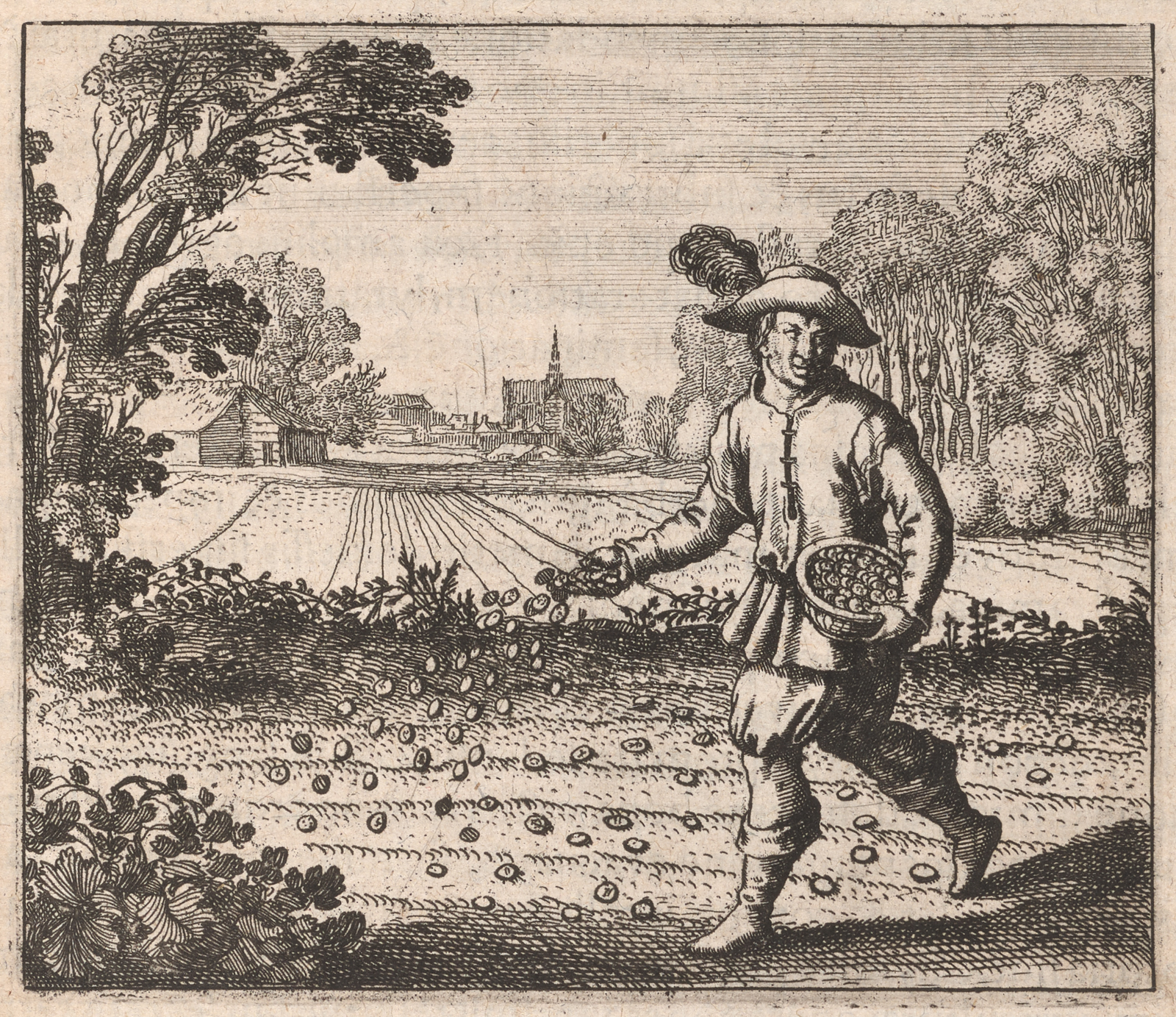
What You See
A farmer figure kneels in a plowed field, sowing seed from a bag or pouch into furrows of white or pale earth. The field is carefully tilled in neat rows, and the landscape behind shows a cultivated countryside with distant buildings and trees. The emphasis falls on the act of sowing — the careful placement of precious material into prepared ground — with the whiteness of the earth itself visually prominent.
Sow your gold in the white foliated earth.
Epigram
The farmers entrust their seed to the fat earth, After having foliated it with the ploughshare; Sow your gold in the white foliated earth, Which will yield you fruit with interest. If you do this, you will rejoice in a rich harvest, When the grain has multiplied in good soil.Discourse Summary
Maier develops an extended agricultural analogy: just as the farmer must sow grain in prepared soil to reap a harvest, the alchemist must 'sow' philosophical gold in 'white foliated earth' — a specially prepared mercurial substrate — to produce the Stone. Drawing on Plato's division of the civic body into physicians and farmers, Maier argues that the alchemist combines both roles, healing metals while cultivating them. The discourse establishes a key principle: the seed (gold) must be of the same species as what it produces, and the earth (mercury) must be receptive and properly tempered. The white, foliated quality of the earth indicates the albedo stage, where the purified substrate is ready to receive the active seed.
Overview
Emblem VI bears the motto: "Sow your gold in the white foliated earth."
Maier's Discourse
Maier develops an extended agricultural analogy: just as the farmer must sow grain in prepared soil to reap a harvest, the alchemist must 'sow' philosophical gold in 'white foliated earth' — a specially prepared mercurial substrate — to produce the Stone. Drawing on Plato's division of the civic body into physicians and farmers, Maier argues that the alchemist combines both roles, healing metals while cultivating them. The discourse establishes a key principle: the seed (gold) must be of the same species as what it produces, and the earth (mercury) must be receptive and properly tempered.
Source Texts
De Jong's source-critical analysis identifies the textual traditions Maier draws upon for this emblem.
The discourse draws on alchemical sources: Jodocus Greverus, Secretum Nobilissimorum, Lullius tradition (via Harmonica Chemica), Pseudo-Aristotle, Tractatulus de Practica Lapidis, Rosarium Philosophorum, Senior Zadith (Muhammad ibn Umail), Tabula Chimica.
Alchemical Significance
Hereward Tilton: Tilton notes that discourse 6 references Ficino's De Vita Libri Tres (1489), raising the possibility that Maier was directly influenced by Ficino's Neoplatonic musical philosophy. This connects AF's fugal structure to Renaissance Hermetic musical cosmology.
H.M.E. de Jong: Agricultural metaphor. Physician's work = Chemist's work, both imitate and perfect Nature. Gold must be scattered over white fields (white lead/purified matter).
Key Alchemical Concepts
Process: Albedo, Fermentatio, Multiplicatio
Substance: Aqua Regia, Aurum Philosophicum, Sol, White Lead (Plumbum Album)
Figure: Latona
Scholarly Commentary
Hereward Tilton HISTORICAL MEDIUM
Tilton notes that discourse 6 references Ficino's De Vita Libri Tres (1489), raising the possibility that Maier was directly influenced by Ficino's Neoplatonic musical philosophy. This connects AF's fugal structure to Renaissance Hermetic musical cosmology.
Citation: Ch. V, pp. 183-184
H.M.E. de Jong HIGH
Agricultural metaphor. Physician's work = Chemist's work, both imitate and perfect Nature. Gold must be scattered over white fields (white lead/purified matter).
Citation: Emblem VI section