Emblem XLIII — Emblem XLIII ALBEDO
Original Source
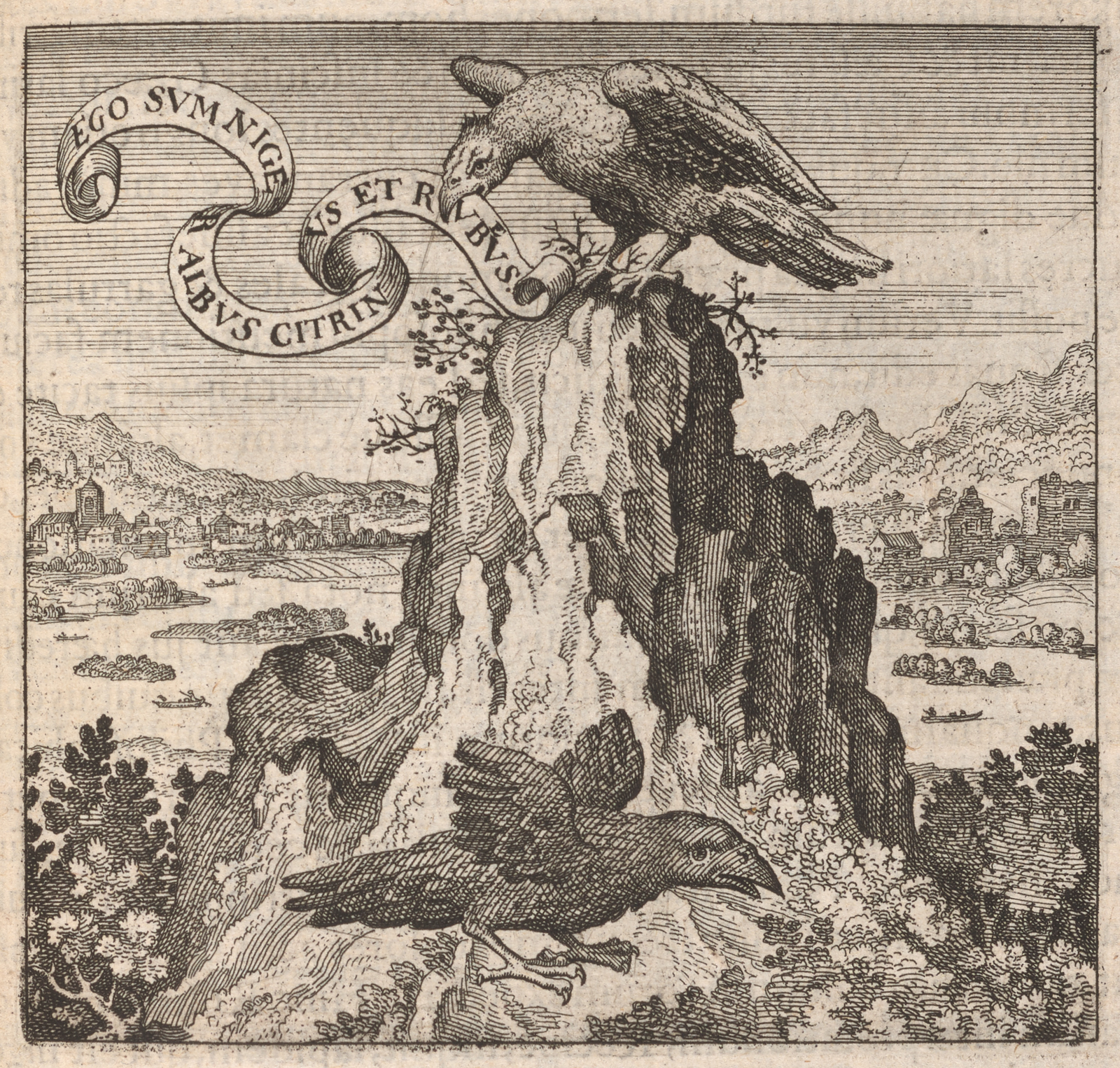
What You See
A screech owl or night bird perches prominently, its beak open as if calling. Nearby, water flows — a stream, fountain, or rain — and the scene is set at dusk or in dim light. Other birds may be visible in the evening sky, their calls contrasting with the owl's solitary voice. The composition emphasizes listening: the viewer is directed to attend to the owl's cry and the water's sound.
Listen to the screech owl's voice, which it produces it self, and the water and do not heed any bird that cries in the evening.
Epigram
Listen to the screech owl's voice, Which it produces itself, and the water. Do not heed any bird that cries in the evening; For the owl alone speaks truth in the darkness. The philosophical mercury is nocturnal; Only by night-wisdom is the Stone found.Discourse Summary
Maier instructs the alchemist to listen to the screech owl's voice and the sound of running water while ignoring the cries of evening birds — a parable about discerning true signals from false. He develops the owl as a figure for philosophical mercury (the lunar, nocturnal principle) whose call reveals the correct path, while the other birds represent misleading doctrines and false alchemists. The discourse connects the biblical story of Naaman (Emblem XIII) to this emblem, reprising the the me of purification through water. Maier argues that the alchemist must develop sensory discernment — learning to hear and see what Nature reveals — rather than following the loud but empty promises of charlatans.
Overview
Emblem XLIII bears the motto: "Listen to the screech owl's voice, which it produces itself, and the water and do not heed any bird that cries in the evening."
Maier's Discourse
Maier instructs the alchemist to listen to the screech owl's voice and the sound of running water while ignoring the cries of evening birds — a parable about discerning true signals from false. He develops the owl as a figure for philosophical mercury (the lunar, nocturnal principle) whose call reveals the correct path, while the other birds represent misleading doctrines and false alchemists. The discourse connects the biblical story of Naaman (Emblem XIII) to this emblem, reprising the theme of purification through water.
Alchemical Significance
J.B. Craven: Craven summarizes Emblem 43: Atalanta listens to the Vulture declaring 'I alone am the white and black, the lemon yellow and the red' — the four colours of the alchemical work, from which the whole art proceeds.
H.M.E. de Jong: Source: , arededicated to Apollo, the Sun-god—-and areat the sametimeasymbol of the Philosophers’St one, asappears from Maier’slastparagraphof thediscourse. Thealchemistor the Rosicrucianshouldaim atreaching thetop of the Heliconor of the Parnassus, and toachieve t his, putrefactionor Saturn isnecessary.
Scholarly Commentary
J.B. Craven ALCHEMICAL MEDIUM
Craven summarizes Emblem 43: Atalanta listens to the Vulture declaring 'I alone am the white and black, the lemon yellow and the red' — the four colours of the alchemical work, from which the whole art proceeds.
Citation: p. 91
H.M.E. de Jong ALCHEMICAL HIGH
Source: , arededicated to Apollo, the Sun-god—-and areat the sametimeasymbol of the Philosophers’St one, asappears from Maier’slastparagraphof thediscourse. Thealchemistor the Rosicrucianshouldaim atreaching thetop of the Heliconor of the Parnassus, and toachieve t his, putrefactionor Saturn isnecessary. Just asin t his | That Naarnan the Syrian, at the instanceof theprophet, wentto Judea and washedhimself in the river Jordan seven times, isto beascribed to the beliefof Naamanin theprophet; but thatby that washing hewasfreed from leprosyisa miracleof God Almighty. Forleprosy, which hat its seatin the blood, in the rootof the humanbody, asit were, spreads likea cancer, and can not becuredbyexternalablutions and stilllessby cold Jordanwater. In thesamewayit islittle shortofa.miracle that the...