Emblem XLII — Emblem XLII RUBEDO
Original Source
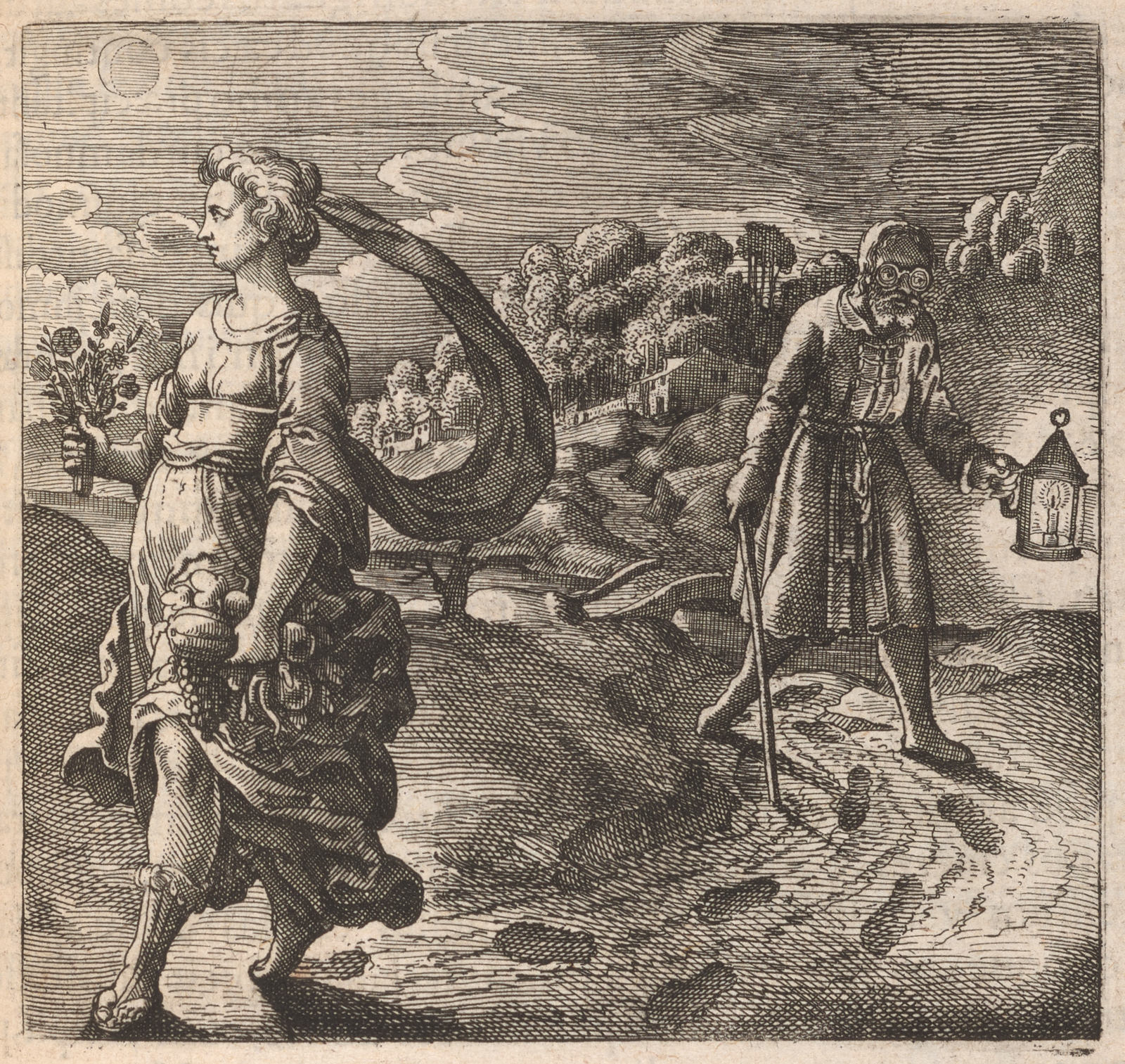
What You See
Four figures or personifications are arranged in the composition, each representing one of the guides to the alchemical work: Nature (a female figure), Reason (perhaps holding a book or compass), Experience (a laboratory figure), and Reading (a scholar with books). They may surround or point toward a central vessel, furnace, or stone. The arrangement suggests the four pillars supporting the practice.
What Nature, Reason, Experience and Reading teach you, let that be the fire, the vessel, the water and the earth.
Epigram
What Nature, Reason, Experience, and Reading teach you, Let that be the fire, the vessel, the water, and the earth. Four guides attend the alchemist: Nature shows the way, Reason illuminates, Experience confirms, and Reading transmits The wisdom of earlier masters.Discourse Summary
Maier develops the Tabula Smaragdina's teaching by identifying four guides that together constitute the alchemical method: Nature provides the raw material and model, Reason supplies theoretical understanding, Experience offers practical knowledge gained through trial, and Reading transmits the wisdom of earlier masters. He argues that these four correspond to the fire, the vessel, the water, and the earth of the work — each indispensable, none sufficient alone. The discourse emphasizes the balance between textual learning and hands-on practice, a the me running through the entire Atalanta Fugiens. Maier presents this emblem as a methodological summation of the principles scattered across the preceding forty-one.
Overview
Emblem XLII bears the motto: "What Nature, Reason, Experience and Reading teach you, let that be the fire, the vessel, the water and the earth."
Maier's Discourse
Maier develops the Tabula Smaragdina's teaching by identifying four guides that together constitute the alchemical method: Nature provides the raw material and model, Reason supplies theoretical understanding, Experience offers practical knowledge gained through trial, and Reading transmits the wisdom of earlier masters. He argues that these four correspond to the fire, the vessel, the water, and the earth of the work — each indispensable, none sufficient alone.
Source Texts
De Jong's source-critical analysis identifies the textual traditions Maier draws upon for this emblem.
The discourse draws on alchemical sources: Aurora Consurgens, Lambsprinck, De Lapide Philosophico, Lullius tradition (via Harmonica Chemica), Pseudo-Aristotle, Tractatulus de Practica Lapidis. The discourse draws on classical sources: Ovid, Metamorphoses X.560-704. The discourse draws on biblical sources: Solomonic / Biblical Wisdom Tradition (Proverbs). The discourse draws on Hermetic sources: Tabula Smaragdina (Emerald Tablet).
Alchemical Significance
Hereward Tilton: Tilton connects emblem 42 to Daniel Stoltzius's reception of Maier. Nature, reason, experience and reading are the guide, staff, spectacles and lamp of the alchemist. Maier insists the first intention must be to discover through intimate contemplation how Nature proceeds — a staple of medieval alchemical literature reinforced by Paracelsian empiricism.
H.M.E. de Jong: De Jong traces the four guides (Nature, Reason, Experience, Reading) to the Tabula Smaragdina tradition, identifying them as Maier's systematic summation of the alchemical method. She demonstrates how Maier maps these four onto fire, vessel, water, and earth — the essential components of the practical work.
Key Alchemical Concepts
Process: Citrinitas
Figure: Ulysses / Odysseus (Ulysses)
Concept: Cauda Pavonis
Scholarly Commentary
Hereward Tilton ALCHEMICAL MEDIUM
Tilton connects emblem 42 to Daniel Stoltzius's reception of Maier. Nature, reason, experience and reading are the guide, staff, spectacles and lamp of the alchemist. Maier insists the first intention must be to discover through intimate contemplation how Nature proceeds — a staple of medieval alchemical literature reinforced by Paracelsian empiricism.
Citation: Ch. VI, pp. 238-239
H.M.E. de Jong ALCHEMICAL HIGH
De Jong traces the four guides (Nature, Reason, Experience, Reading) to the Tabula Smaragdina tradition, identifying them as Maier's systematic summation of the alchemical method. She demonstrates how Maier maps these four onto fire, vessel, water, and earth — the essential components of the practical work.