Emblem XXXIV — Celestial conception / hierogamy RUBEDO
Original Source
What You See
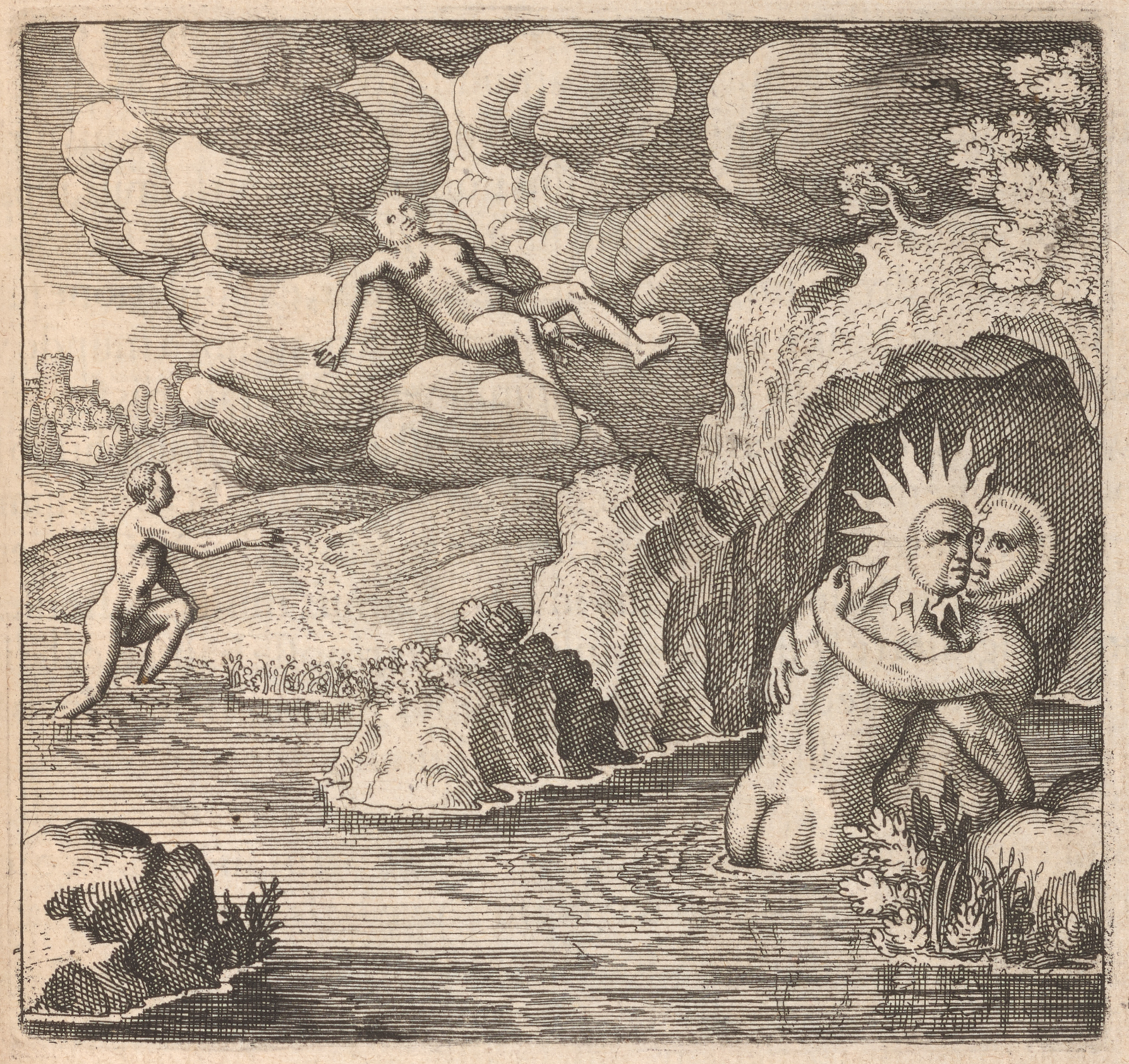
A celestial scene depicts a conception or hierogamy — a sacred marriage between heavenly figures. Rays of light or celestial fire descend from above onto a figure below who receives or conceives from the divine influence. Stars, planets, or zodiacal imagery may appear in the sky. The composition elevates the alchemical process from the laboratory to the cosmos.
He is conceived in the bath and born in the air, but having become red he walks upon the waters.
Epigram
He is conceived in the bath and born in the sky, But having become red, he walks upon the waters. From the sacred marriage of heaven and earth The divine child descends, Bearing the power to transform all things From imperfection to perfection.Discourse Summary
Maier develops the motto — 'He is conceived in the bath and born in the air' — as an allegory for the philosophical substance that begins in the liquid phase (conception in the bath) and emerges in the aerial or volatile state (birth in the air), before finally walking upon the waters as a perfected, red tincture. He argues that this threefold progression — liquid, aerial, solid — mirrors the three stages of generation in nature. The discourse connects the celestial conception to the Hermetic doctrine of 'as above, so below,' with the heavenly hierogamy producing its earthly analogue in the alchemist's vessel. Maier frames this as the rubedo moment: the substance has been perfected and can now act upon lesser metals.
Overview
Emblem XXXIV bears the motto: "He is conceived in the bath and born in the air, but having become red he walks upon the waters."
Maier's Discourse
Maier develops the motto — 'He is conceived in the bath and born in the air' — as an allegory for the philosophical substance that begins in the liquid phase (conception in the bath) and emerges in the aerial or volatile state (birth in the air), before finally walking upon the waters as a perfected, red tincture. He argues that this threefold progression — liquid, aerial, solid — mirrors the three stages of generation in nature.
Source Texts
De Jong's source-critical analysis identifies the textual traditions Maier draws upon for this emblem.
The discourse draws on alchemical sources: Rosarium Philosophorum, Senior Zadith (Muhammad ibn Umail), Tabula Chimica, Turba Philosophorum. The discourse draws on biblical sources: Solomonic / Biblical Wisdom Tradition (Proverbs).
Alchemical Significance
Paul Miner: Birth image above, solar-lunar erotic embrace below. Read as alchemical conjunction. Provides prototype for Blake's Jerusalem 99.
Paul Miner: Miner identifies Emblem XXXIV's imagery of a foetus emerging head-first from a supine nude female among clouds as a source for Blake's Marriage of Heaven and Hell plate 3, where a similar birth scene appears. The motto addresses 'conception' of a male 'born in the sky' relating to transmutation of metals.
Paul Miner: Miner argues the lower portion of Emblem XXXIV, showing a nude masculine sun (with huge halo-like flames) and nude feminine moon kissing and sexually embracing, influenced Blake's hierogamos scene in Jerusalem 99.
J.B. Craven: Craven calls Emblem 34 'probably the most curious picture' in AF, showing the Sun and Moon in human form in the act of coition standing in a pool of water.
H.M.E. de Jong: De Jong traces the source to Senior's Tabula Chimica and the Scala Philosophorum, connecting the digestion-and-fire imagery to Ceres tempering Triptolemus and Thetis dipping Achilles. She identifies the underlying principle as graduated calcination — the slow, repeated application of heat to fix and harden the volatile components.
Key Alchemical Concepts
Process: Coniunctio (Coniunctio Oppositorum)
Substance: Rebis
Figure: Hermaphrodite (Hermaphroditus)
Concept: Cauda Pavonis, Pelicanus
Scholarly Commentary
Paul Miner HIGH
Birth image above, solar-lunar erotic embrace below. Read as alchemical conjunction. Provides prototype for Blake's Jerusalem 99.
Citation: Discussion of Emblem XXXIV
Paul Miner ICONOGRAPHIC MEDIUM
Miner identifies Emblem XXXIV's imagery of a foetus emerging head-first from a supine nude female among clouds as a source for Blake's Marriage of Heaven and Hell plate 3, where a similar birth scene appears. The motto addresses 'conception' of a male 'born in the sky' relating to transmutation of metals.
Citation: pp. 366-367
Paul Miner ICONOGRAPHIC MEDIUM
Miner argues the lower portion of Emblem XXXIV, showing a nude masculine sun (with huge halo-like flames) and nude feminine moon kissing and sexually embracing, influenced Blake's hierogamos scene in Jerusalem 99.
Citation: p. 367
J.B. Craven ICONOGRAPHIC MEDIUM
Craven calls Emblem 34 'probably the most curious picture' in AF, showing the Sun and Moon in human form in the act of coition standing in a pool of water.
Citation: p. 89
H.M.E. de Jong ALCHEMICAL HIGH
De Jong traces the source to Senior's Tabula Chimica and the Scala Philosophorum, connecting the digestion-and-fire imagery to Ceres tempering Triptolemus and Thetis dipping Achilles. She identifies the underlying principle as graduated calcination — the slow, repeated application of heat to fix and harden the volatile components.