Emblem XXXVIII — Standing hermaphrodite RUBEDO
Original Source
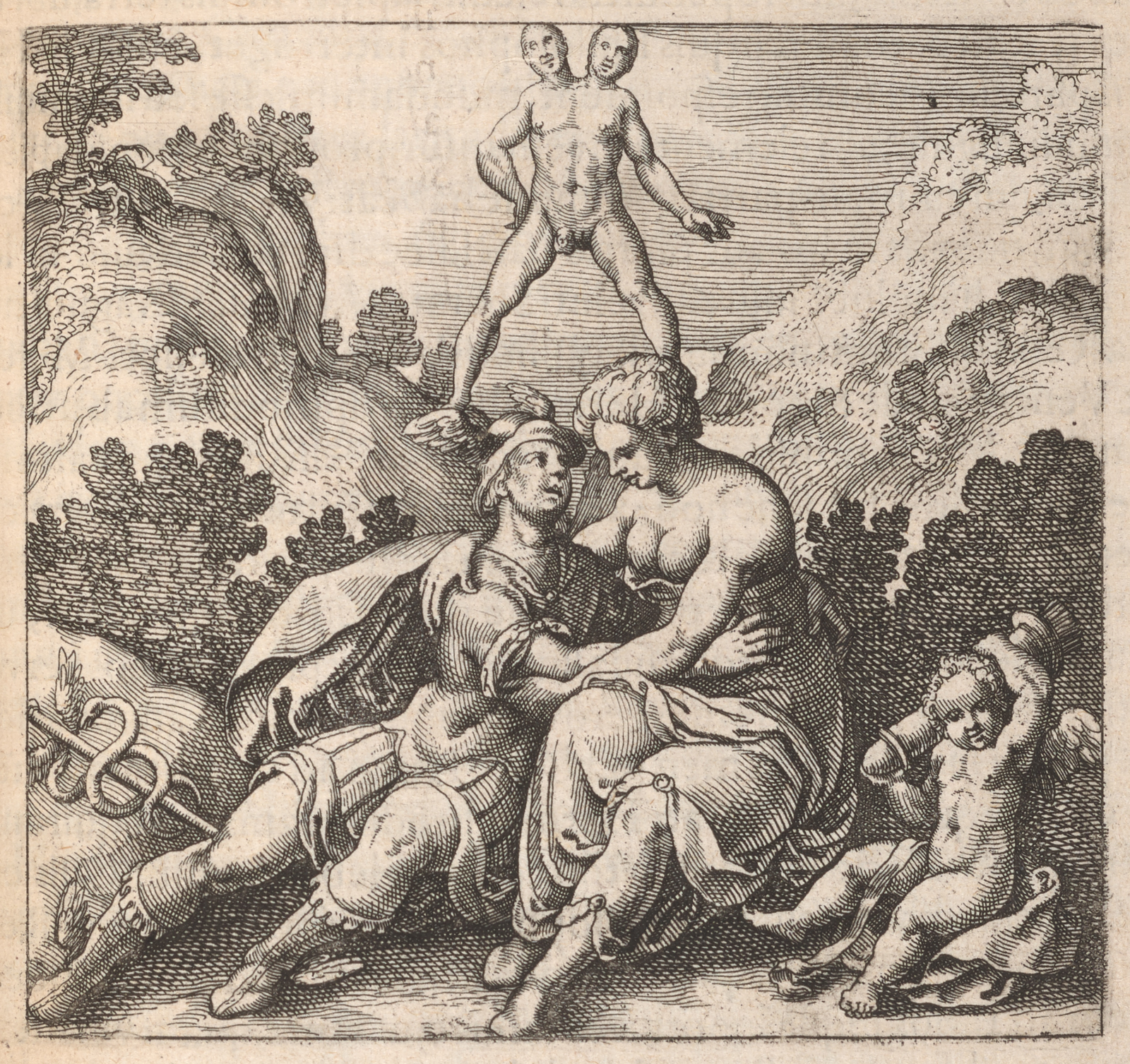
What You See
The Hermaphrodite stands upright and fully formed, displaying both male and female attributes in a single body. Unlike the prostrate Hermaphrodite of Emblems XXX and XXXIII, this figure is erect, active, and complete — the product of the union of opposites now realized. The figure stands on or between two mountains, identified in the motto as the mountains of Mercury and Venus.
The Hermaphrodite, born of two mountains, of Mercury and Venus.
Epigram
By his art, Oedipus made the Sphinx kill herself, The Sphinx, who was terrifying everybody with her riddle. The Hermaphrodite, born of two mountains, Stands complete, combining male and female. What was divided is now united; The work of conjunction is accomplished.Discourse Summary
Maier presents the standing Hermaphrodite — born of the two mountains of Mercury and Venus — as the completed product of the alchemical work. He develops Socrates' declaration that he was a citizen not of one city but of the world as an analogy for the Hermaphrodite who inhabits two domains simultaneously. The discourse argues that the Rebis has been successfully produced: the philosophical Mercury and Venus have been permanently united, and the resulting substance stands on its own — no longer needing the fire that revived it from darkness (Emblems XXX, XXXIII). Maier frames this as the culmination of the rubedo, where the joined substance achieves autonomous stability.
Overview
Emblem XXXVIII bears the motto: "The Hermaphrodite, born of two mountains, of Mercury and Venus."
Maier's Discourse
Maier presents the standing Hermaphrodite — born of the two mountains of Mercury and Venus — as the completed product of the alchemical work. He develops Socrates' declaration that he was a citizen not of one city but of the world as an analogy for the Hermaphrodite who inhabits two domains simultaneously. The discourse argues that the Rebis has been successfully produced: the philosophical Mercury and Venus have been permanently united, and the resulting substance stands on its own — no longer needing the fire that revived it from darkness (Emblems XXX, XXXIII).
Source Texts
De Jong's source-critical analysis identifies the textual traditions Maier draws upon for this emblem.
The discourse draws on alchemical sources: Turba Philosophorum.
Alchemical Significance
Paul Miner: Another hermaphrodite image in the same symbolic family as Emblem XXXIII.
Paul Miner: Miner references Emblem XXXVIII's nude standing Hermaphrodite as a further instance of Maier's hermaphroditic imagery that may have influenced Blake's visual vocabulary.
H.M.E. de Jong: De Jong identifies the standing Hermaphrodite as the completed product of the conjunction, drawing on the Rosarium Philosophorum's account of the Rebis as the final stage of the rubedo where masculine and feminine principles achieve permanent, autonomous stability.
Key Alchemical Concepts
Process: Coniunctio (Coniunctio Oppositorum)
Substance: Rebis
Figure: Hermaphrodite (Hermaphroditus)
Scholarly Commentary
Paul Miner HIGH
Another hermaphrodite image in the same symbolic family as Emblem XXXIII.
Citation: Reference to Emblem XXXVIII
Paul Miner ICONOGRAPHIC MEDIUM
Miner references Emblem XXXVIII's nude standing Hermaphrodite as a further instance of Maier's hermaphroditic imagery that may have influenced Blake's visual vocabulary.
Citation: p. 367 n.8
H.M.E. de Jong ALCHEMICAL MEDIUM
De Jong identifies the standing Hermaphrodite as the completed product of the conjunction, drawing on the Rosarium Philosophorum's account of the Rebis as the final stage of the rubedo where masculine and feminine principles achieve permanent, autonomous stability.