Emblem XLV — Emblem XLV RUBEDO
Original Source
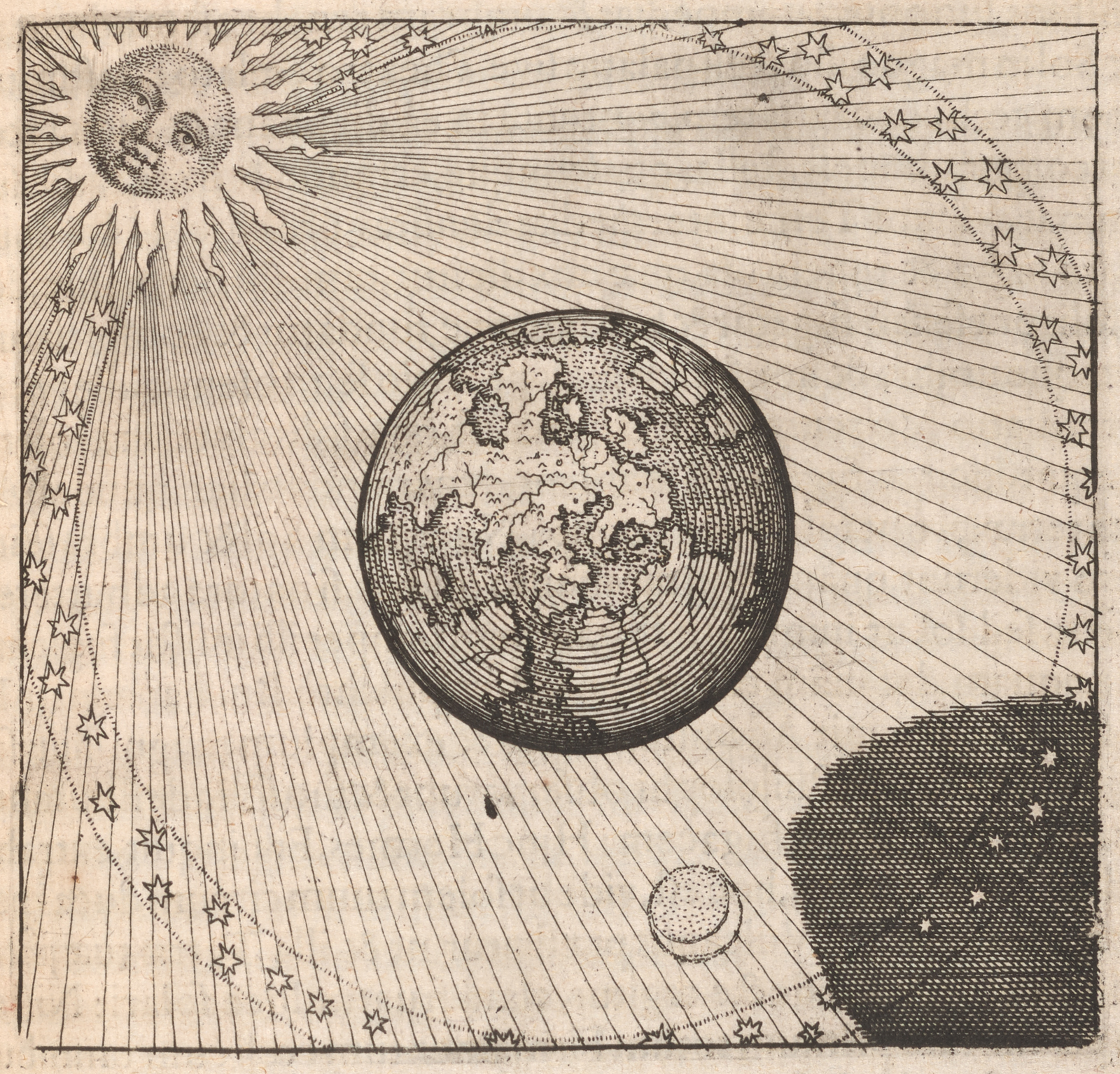
What You See
Sol and Luna — depicted as a king and queen, or as the sun and moon personified — stand together with their shadows visible or prominent. The shadows may merge or interact in ways the figures themselves do not, suggesting that the hidden, shadow aspect of the work is where the real operation occurs. The composition pairs the luminous celestial figures with their dark counterparts.
Sol and his shadow complete the work.
Epigram
Sol and his shadow complete the work. Two stones are given, one manifest, one hidden; The visible and invisible aspects of a single substance. Neglect neither the light nor the dark; Both are needed for the final projection, When the stone achieves its full power.Discourse Summary
Maier argues that Sol and his shadow together complete the work — the visible, noble gold (Sol) must be joined with its shadowy, hidden counterpart (the impure, dark aspect) to produce the philosopher's stone. He develops the principle that the stone requires both the light and dark aspects of the same substance, and that ignoring the shadow — the nigredo remainder — makes completion impossible. The discourse draws on the Consilium Conjugii and the Massa Solis et Lunae tradition to argue that the two stones spoken of by the philosophers are actually the manifest and hidden aspects of a single substance. Maier presents this penultimate teaching as the key to unlocking the entire series.
Overview
Emblem XLV bears the motto: "Sol and his shadow complete the work."
Maier's Discourse
Maier argues that Sol and his shadow together complete the work — the visible, noble gold (Sol) must be joined with its shadowy, hidden counterpart (the impure, dark aspect) to produce the philosopher's stone. He develops the principle that the stone requires both the light and dark aspects of the same substance, and that ignoring the shadow — the nigredo remainder — makes completion impossible.
Source Texts
De Jong's source-critical analysis identifies the textual traditions Maier draws upon for this emblem.
The discourse draws on alchemical sources: Lambsprinck, De Lapide Philosophico, Pseudo-Aristotle, Tractatulus de Practica Lapidis.
Alchemical Significance
J.B. Craven: Craven summarizes Emblem 45: the earth in space with motto 'Sol et ejus umbra perficiunt opus' — silver as the shadow of gold, the Dragon must become as the Salamander in fire.
H.M.E. de Jong: De Jong traces the wolf-and-dog allegory to Rhazes's Epistola as cited in Petrus Bonus, identifying the terrestrial counterpart to the aerial eagle-conjunction of the preceding emblem. She demonstrates how the mutual biting represents reciprocal dissolution at the material register.
Key Alchemical Concepts
Figure: Adonis, Venus
Source_Text: Metamorphoses
Scholarly Commentary
J.B. Craven ALCHEMICAL MEDIUM
Craven summarizes Emblem 45: the earth in space with motto 'Sol et ejus umbra perficiunt opus' — silver as the shadow of gold, the Dragon must become as the Salamander in fire.
Citation: p. 92
H.M.E. de Jong ALCHEMICAL HIGH
De Jong traces the wolf-and-dog allegory to Rhazes's Epistola as cited in Petrus Bonus, identifying the terrestrial counterpart to the aerial eagle-conjunction of the preceding emblem. She demonstrates how the mutual biting represents reciprocal dissolution at the material register.