Emblem XL — Emblem XL RUBEDO
Original Source
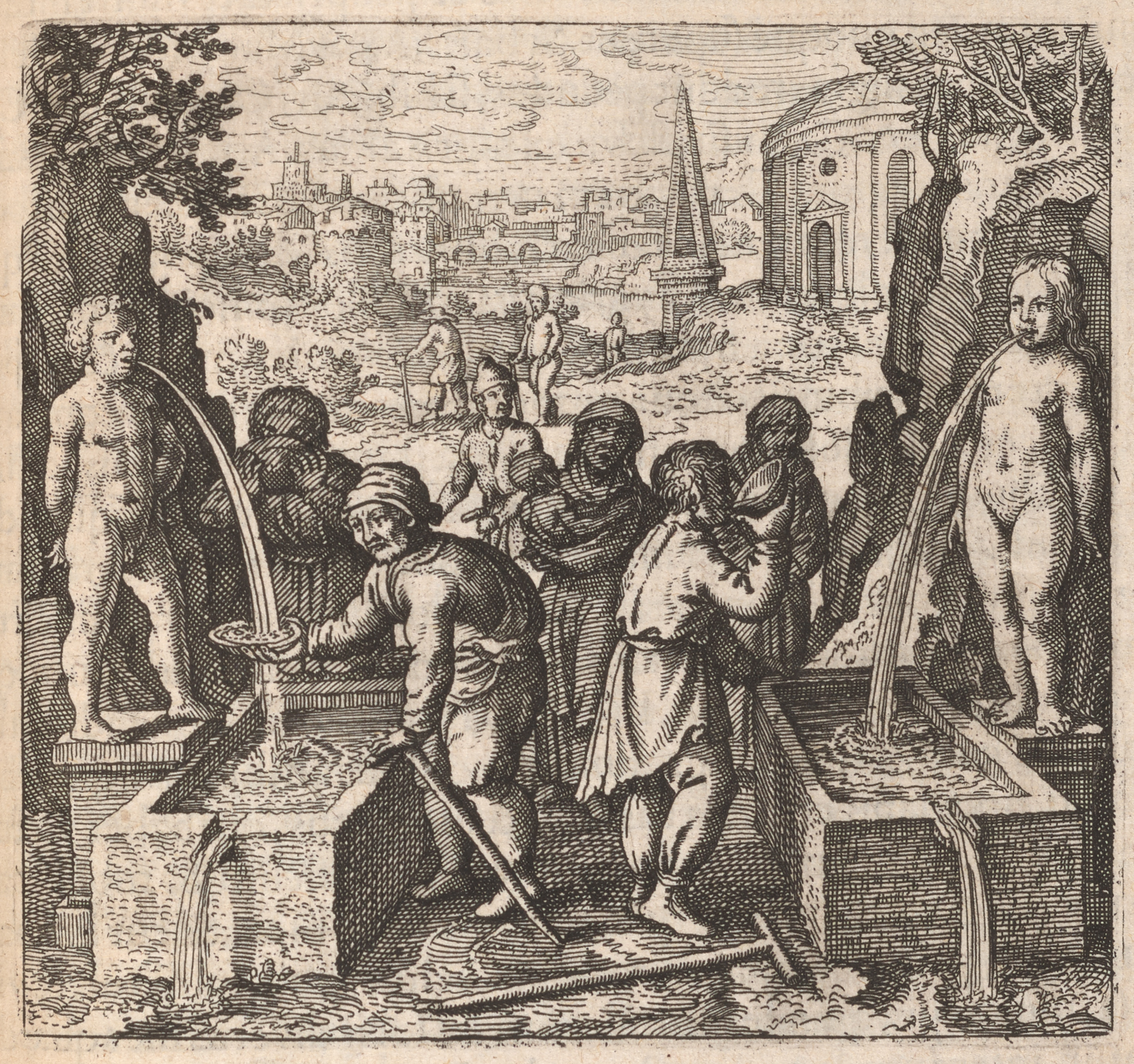
What You See
Two streams or bodies of water flow toward each other and merge into a single river or pool. The two waters may be distinguished by color — one clear, one dark, or one golden, one silver. A figure may direct or channel the confluence. The merging point is the focal center of the composition, where the two become one.
Make one water out of two waters, and it will be the water of holiness.
Epigram
Make one water out of two waters, And it will be the water of holiness. Let the volatile and the fixed unite, The ascending and the descending merge. From this marriage of two contrary streams The universal medicine is born.Discourse Summary
Maier instructs the alchemist to make one water from two waters, producing the 'water of holiness.' He develops this as the final mercurial conjunction: the two philosophical waters — one volatile and ascending, the other fixed and descending — must be combined into a single, unified menstruum. The discourse connects this to the Hermetic tradition of the two serpents of the caduceus and to the mystical waters of baptism that cleanse and renew. Maier argues that this united water is the universal solvent that can dissolve all metals and serve as the medium for the final projection. The rubedo is achieved when the two contrary waters cease to separate and remain permanently joined.
Overview
Emblem XL bears the motto: "Make one water out of two waters, and it will be the water of holiness."
Maier's Discourse
Maier instructs the alchemist to make one water from two waters, producing the 'water of holiness.' He develops this as the final mercurial conjunction: the two philosophical waters — one volatile and ascending, the other fixed and descending — must be combined into a single, unified menstruum. The discourse connects this to the Hermetic tradition of the two serpents of the caduceus and to the mystical waters of baptism that cleanse and renew. Maier argues that this united water is the universal solvent that can dissolve all metals and serve as the medium for the final projection.
Source Texts
De Jong's source-critical analysis identifies the textual traditions Maier draws upon for this emblem.
The discourse draws on alchemical sources: Pseudo-Aristotle, Tractatulus de Practica Lapidis.
Alchemical Significance
H.M.E. de Jong: De Jong identifies the source in the Opus Mulierum and traces Maier's alchemical reading of the two waters (volatile ascending and fixed descending) to the Hermetic tradition of the caduceus. She connects the 'water of holiness' to both baptismal and Lullian elixir symbolism.
Scholarly Commentary
H.M.E. de Jong ALCHEMICAL HIGH
De Jong identifies the source in the Opus Mulierum and traces Maier's alchemical reading of the two waters (volatile ascending and fixed descending) to the Hermetic tradition of the caduceus. She connects the 'water of holiness' to both baptismal and Lullian elixir symbolism.