Emblem XLI — Emblem XLI NIGREDO
Original Source
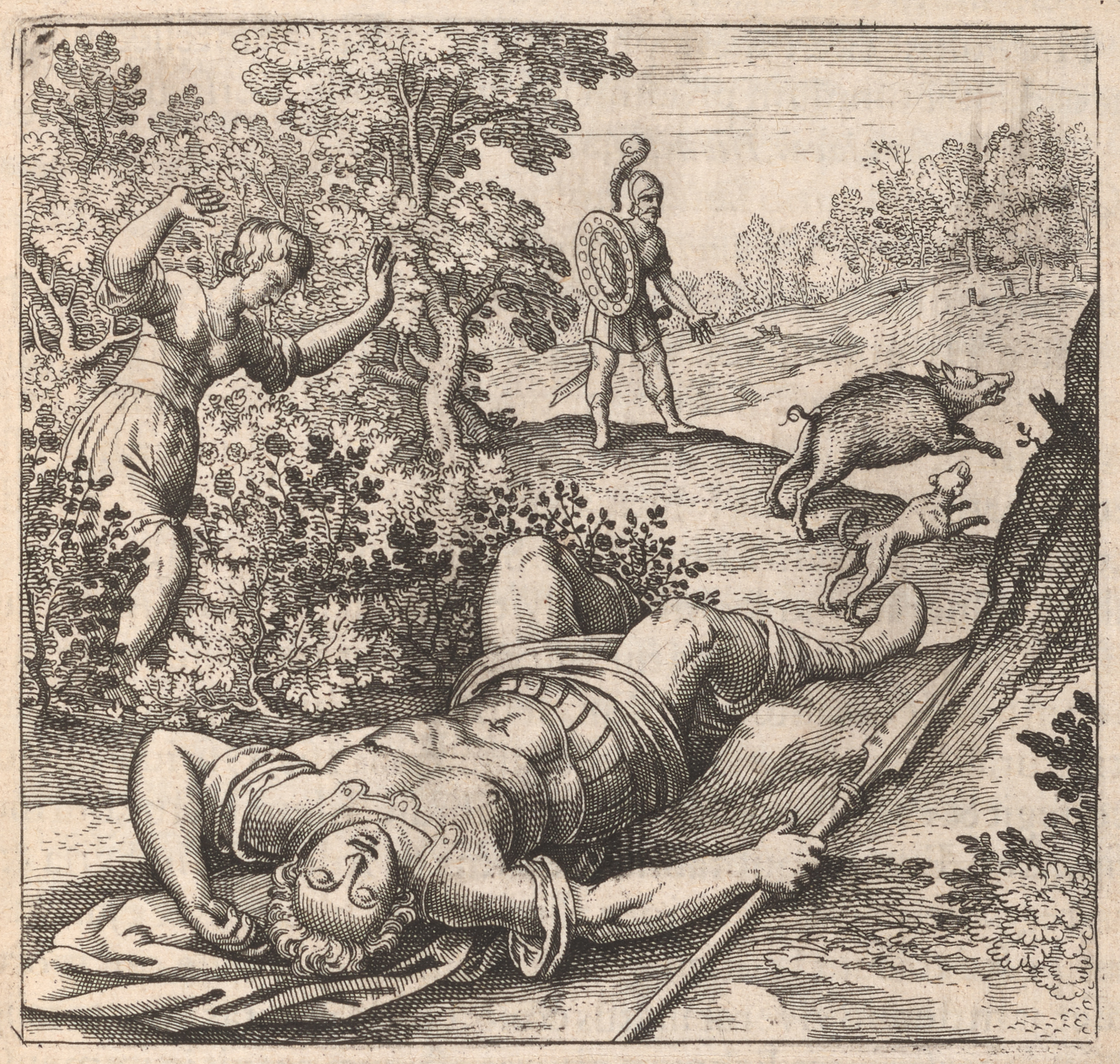
What You See
Adonis lies wounded or dead in a woodland setting, gored by a wild boar that stands nearby or flees the scene. Venus rushes toward Adonis, her robes flowing with urgency. Blood flows from Adonis's wounds onto white roses growing nearby, staining them red. The transformation of the roses from white to red is a prominent visual element, occurring at the point where divine blood meets earthly flowers.
Adonis is killed by a boar, and Venus, rushing up to him, painted the roses red with her blood.
Epigram
Adonis is killed by a boar, And Venus, rushing up to him, Painted the roses red with her blood. So the white stone must be reddened Through the sacrifice of Venus's blood, And from albedo the rubedo is born.Discourse Summary
Maier retells the death of Adonis — beloved of Venus, killed by a boar, his blood dyeing white roses red — as an allegory for the transition from albedo to rubedo. He argues that the beautiful, white philosophical substance (Adonis/the white stone) must be 'killed' — subjected to a final violent transformation — and that the resulting reddening (Venus's blood on the roses) produces the red tincture. The discourse develops the boar as a figure for the aggressive sulphurous agent that destroys the passive, beautiful white form. Maier cites Ovid's Metamorphoses as his primary source, while De Jong traces the alchemical reading of this myth through the Rosarium tradition.
Overview
Emblem XLI bears the motto: "Adonis is killed by a boar, and Venus, rushing up to him, painted the roses red with her blood."
Maier's Discourse
Maier retells the death of Adonis — beloved of Venus, killed by a boar, his blood dyeing white roses red — as an allegory for the transition from albedo to rubedo. He argues that the beautiful, white philosophical substance (Adonis/the white stone) must be 'killed' — subjected to a final violent transformation — and that the resulting reddening (Venus's blood on the roses) produces the red tincture. The discourse develops the boar as a figure for the aggressive sulphurous agent that destroys the passive, beautiful white form.
Source Texts
De Jong's source-critical analysis identifies the textual traditions Maier draws upon for this emblem.
The discourse draws on classical sources: Ovid, Metamorphoses X.560-704. The discourse draws on alchemical sources: Rosarium Philosophorum. The discourse draws on biblical sources: Solomonic / Biblical Wisdom Tradition (Proverbs).
Alchemical Significance
J.B. Craven: Craven summarizes Emblem 41: Adonis killed by wild boar, Venus colours roses with his blood — the white rose becomes red through Venus' blood, and Adonis is laid to rest under soft lettuce.
H.M.E. de Jong: Source: Ovid, Metamorpkosczs, Liber X, VII, 705-740. | In the Ovidpassage quoted, in which Adonis, thehunter, iskilledbyawild boar and inwhichheis wept for by Venus, rushingup, Venuschanges the bloodof Adonis intoananem one. In ll Iaier’s motto Venus coloured theroses red with herblood.
Scholarly Commentary
J.B. Craven MYTHOLOGICAL MEDIUM
Craven summarizes Emblem 41: Adonis killed by wild boar, Venus colours roses with his blood — the white rose becomes red through Venus' blood, and Adonis is laid to rest under soft lettuce.
Citation: p. 91
H.M.E. de Jong ALCHEMICAL HIGH
Source: Ovid, Metamorpkosczs, Liber X, VII, 705-740. | In the Ovidpassage quoted, in which Adonis, thehunter, iskilledbyawild boar and inwhichheis wept for by Venus, rushingup, Venuschanges the bloodof Adonis intoananem one. In ll Iaier’s motto Venus coloured theroses red with herblood. Icould notfind outwhere t his mottocomes from, but Isaw itmentionedin 1Belinusmetaphorin the Rosarfiuiz Plzilosoplzornm, in:Art. I-lurif. II, 41:2-413. —XLII Roschera: "aberalssich dieihrem sterbenden Liebling zu Hilfeeilende Aphrodite aneinern Domden Fusz verletzthahe, sinddurch cleren Blutdie Rosenrot gefarbtworden". Thetext of theepigram, the incestof Myrrha and her fat her Cyniras, is, just as the motto, taken from the Ovidpassage men-tioned. Theconnection between the storyof Adonis and thealchemicalpr...