Emblem L — The Dragon kills the woman NIGREDO
Original Source
What You See
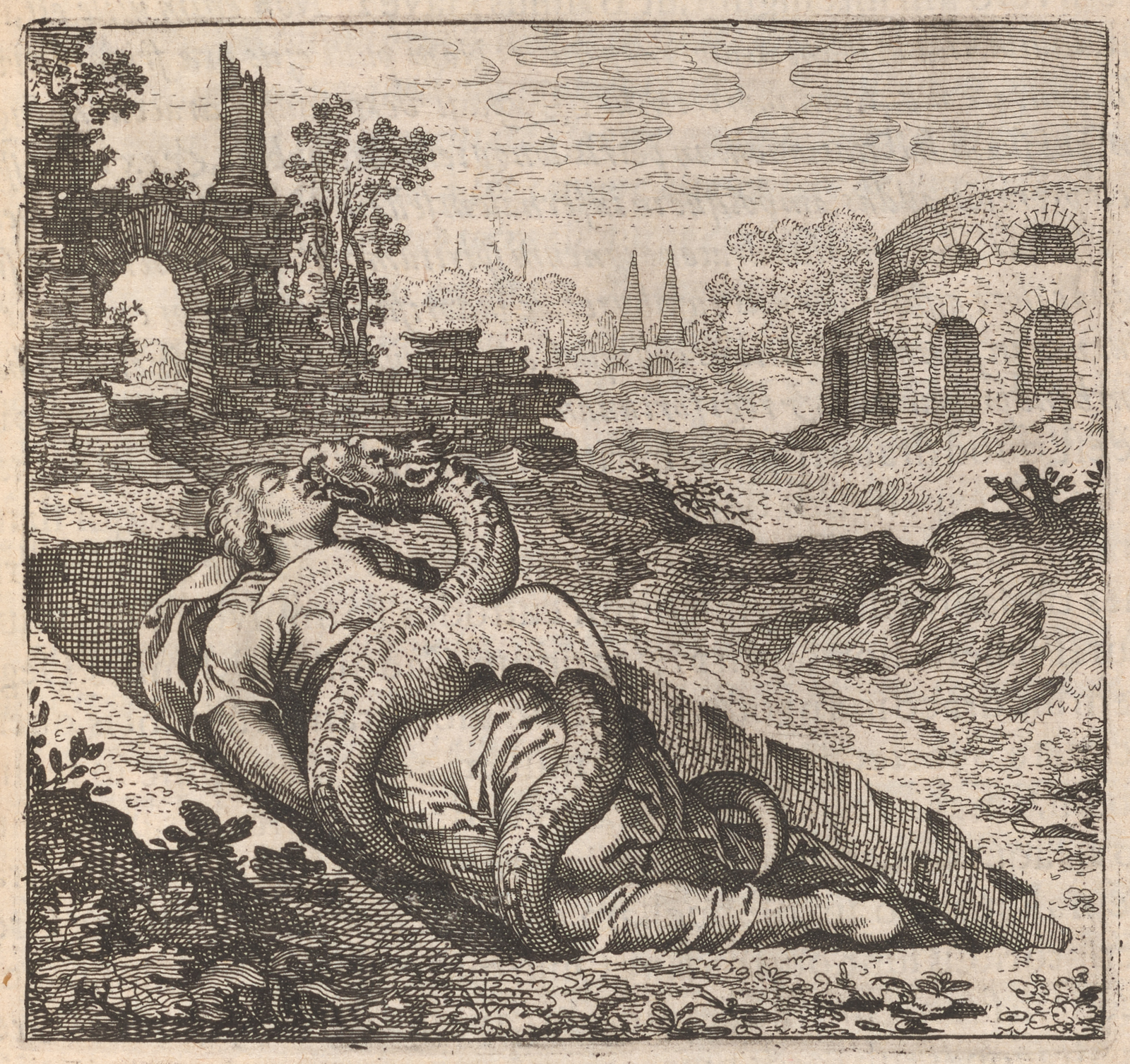
A dragon and a woman are locked in mortal combat, each killing the other simultaneously. The dragon's coils wrap around the woman's body while she strikes at its head or throat. Blood flows from both combatants. The scene takes place in a cave-like or underground setting, near a body of water or pool in which the two figures bathe in their mingled blood. The mutual destruction is also a mutual immersion.
The Dragon kills the woman, and she kills it, and together they bathe in blood.
Epigram
Have a deep grave dug for the poisonous Dragon, With which the woman should be tightly joined. They bite each other in mortal combat, And bathe together in their mingled blood. The Dragon kills the woman, she kills the Dragon; From this mutual death the Stone is born.Discourse Summary
Maier narrates the final emblem as a double death: the dragon kills the woman and she kills it, and together they bathe in the blood of their mutual destruction. He develops this as the ultimate expression of the alchemical principle that the Stone is born from the death of both its parents — the volatile (the dragon, dwelling in caves under ground) and the fixed (the woman, dwelling in the adjacent air). The discourse argues that their commingled blood — the shared substance released by reciprocal dissolution — becomes the bath of regeneration from which the philosopher's stone emerges. Maier presents this as the closing image of the entire series: the work ends where it began, in mutual consumption and transformation.
Overview
Emblem L bears the motto: "The Dragon kills the woman, and she kills it, and together they bathe in blood."
Maier's Discourse
Maier narrates the final emblem as a double death: the dragon kills the woman and she kills it, and together they bathe in the blood of their mutual destruction. He develops this as the ultimate expression of the alchemical principle that the Stone is born from the death of both its parents — the volatile (the dragon, dwelling in caves underground) and the fixed (the woman, dwelling in the adjacent air). The discourse argues that their commingled blood — the shared substance released by reciprocal dissolution — becomes the bath of regeneration from which the philosopher's stone emerges.
Source Texts
De Jong's source-critical analysis identifies the textual traditions Maier draws upon for this emblem.
The discourse draws on classical sources: Ovid, Metamorphoses X.560-704. The discourse draws on alchemical sources: Robertus Vallensis, De Veritate et Antiquitate Artis Chemicae, Turba Philosophorum.
Alchemical Significance
H.M.E. de Jong: Final emblem. Dragon = earth/fire, Woman/Eagle = air/water. Complete dissolution and transformation into primary matter. Source: Turba (Theophilus).
Key Alchemical Concepts
Process: Coniunctio (Coniunctio Oppositorum), Dissolution (Dissolutio), Mortificatio, Multiplicatio, Projectio, Solutio
Substance: Prima Materia
Figure: Atalanta, Dragon (Draco), Hippomenes
Concept: Lapis, Opus Magnum, Pelicanus, Philosopher's Stone (Lapis Philosophorum), Solve et Coagula
Source_Text: Fama Fraternitatis, Turba Philosophorum
Scholarly Commentary
H.M.E. de Jong HIGH
Final emblem. Dragon = earth/fire, Woman/Eagle = air/water. Complete dissolution and transformation into primary matter. Source: Turba (Theophilus).
Citation: Emblem L section