Emblem XXXVI — Emblem XXXVI NIGREDO
Original Source
What You See
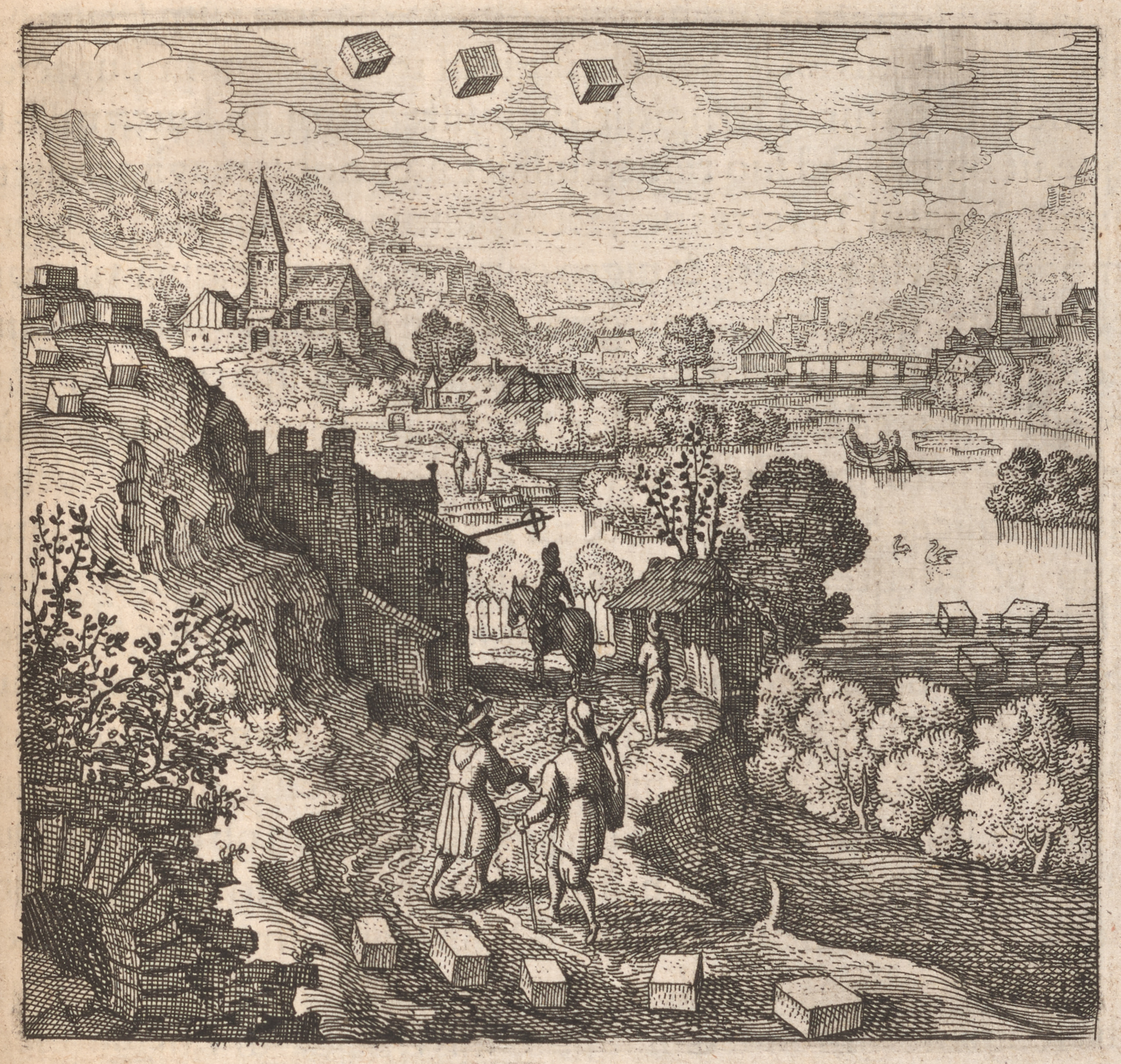
A large stone lies on the ground where it has been thrown or deposited, while in a second register the same stone is shown elevated on a mountaintop. The landscape shifts between low valley and high peak. A figure may be shown casting the stone downward or carrying it upward. The dual positioning captures the stone's journey from earth to elevation.
The Stone has been thrown on to the earth and lifted on to the mountains, and it dwells in the air and feeds in the river.
Epigram
The Stone has been thrown onto the earth, And lifted onto the mountains, and dwells in the air, And feeds in the river: It participates in all four elements, Yet belongs wholly to none. Despised by the many, it is treasure to the wise.Discourse Summary
Maier develops the paradox that the philosopher's stone has been thrown on to the earth (despised, found in humble places) yet lifted on to mountains (exalted, valued above all things). He argues that the stone dwells in the air and feeds in the river — occupying all four elements simultaneously — because it is the quintessence that participates in all elemental natures without being limited to any one. The discourse draws on the biblical metaphor of the rejected cornerstone and connects it to the alchemical tradition that the prima materia is found every where yet recognized by none. De Jong identifies a nationalistic element in Maier's treatment, connecting the earth-as-mother imagery to German territorial symbolism.
Overview
Emblem XXXVI bears the motto: "The Stone has been thrown onto the earth and lifted onto the mountains, and it dwells in the air and feeds in the river."
Maier's Discourse
Maier develops the paradox that the philosopher's stone has been thrown onto the earth (despised, found in humble places) yet lifted onto mountains (exalted, valued above all things). He argues that the stone dwells in the air and feeds in the river — occupying all four elements simultaneously — because it is the quintessence that participates in all elemental natures without being limited to any one. The discourse draws on the biblical metaphor of the rejected cornerstone and connects it to the alchemical tradition that the prima materia is found everywhere yet recognized by none.
Source Texts
De Jong's source-critical analysis identifies the textual traditions Maier draws upon for this emblem.
The discourse draws on biblical sources: Solomonic / Biblical Wisdom Tradition (Proverbs).
Alchemical Significance
Hereward Tilton: Tilton contextualizes discourse 36 within Maier's German nationalism. Following Tacitus, Maier boasts of the Cimbri who defeated Roman legions. The alchemical truth conveyed is that earth, though the last repository of putrefied things, is also most precious as the mother of all things — and German earth most of all.
H.M.E. de Jong: De Jong identifies the source in the Rosarium Philosophorum's teaching that the Stone has been cast down onto the earth yet exalted on the mountains. She connects this to the broader tradition that the prima materia is found everywhere yet recognized by none, and identifies a nationalistic element in Maier's earth-as-mother imagery.
Key Alchemical Concepts
Process: Citrinitas
Scholarly Commentary
Hereward Tilton HISTORICAL MEDIUM
Tilton contextualizes discourse 36 within Maier's German nationalism. Following Tacitus, Maier boasts of the Cimbri who defeated Roman legions. The alchemical truth conveyed is that earth, though the last repository of putrefied things, is also most precious as the mother of all things — and German earth most of all.
Citation: Ch. V, pp. 199-200
H.M.E. de Jong ALCHEMICAL HIGH
De Jong identifies the source in the Rosarium Philosophorum's teaching that the Stone has been cast down onto the earth yet exalted on the mountains. She connects this to the broader tradition that the prima materia is found everywhere yet recognized by none, and identifies a nationalistic element in Maier's earth-as-mother imagery.