Emblem XXXV — Emblem XXXV ALBEDO
Original Source
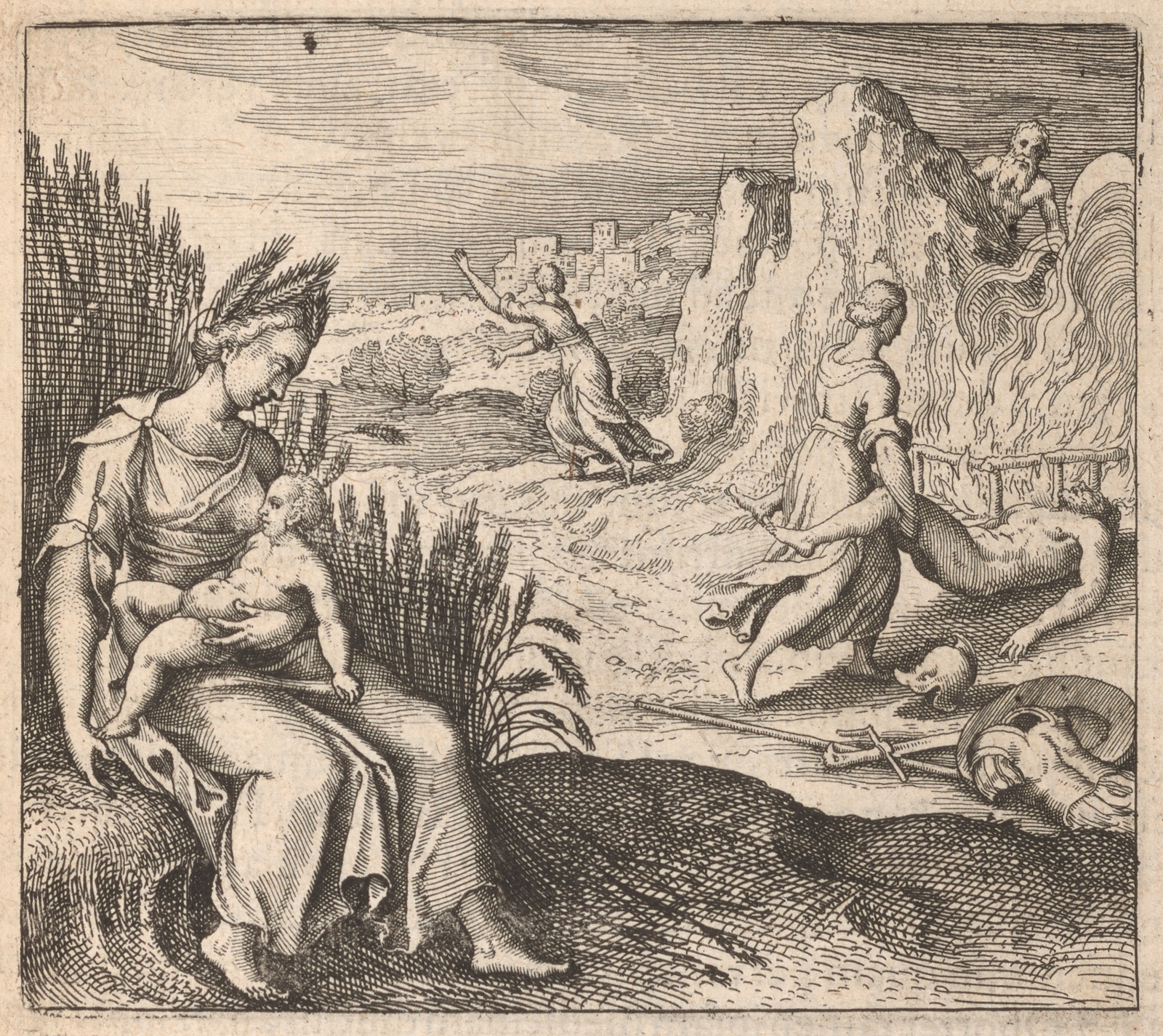
What You See
A figure identified as Ceres or Thetis holds a child — Triptolemus or Achilles — over flames, tempering the child in fire to make it immortal or invulnerable. The fire burns beneath or around the child's body while the mother-figure supports it with care. A second figure may look on with alarm at the sight of the infant in flames. The scene combines maternal nurturing with trial by fire.
As Ceres accustomed Triptolemus, and Thetis Achilles, to endure fire, so the artist does with the Stone.
Epigram
As Ceres accustomed Triptolemus to endure fire, And Thetis hardened Achilles in the flames, So the artist tempers the Stone: Gradually, patiently, with repeated applications. What does not kill the substance makes it stronger; The child of fire becomes invulnerable.Discourse Summary
Maier draws on two parallel myths — Ceres hardening Triptolemus in fire and Thetis dipping Achilles in the Styx — to argue that the philosopher's stone, like a divine child, must be tempered through exposure to fire to achieve its full power. He develops the principle that what does not kill the substance makes it stronger, drawing an explicit parallel between mythological fire-baptism and the alchemical calcination that hardens and fixes the volatile components. The discourse argues that the artist must follow these divine mothers' example, applying fire gradually and repeatedly rather than all at once, to produce a substance that endures any test.
Overview
Emblem XXXV bears the motto: "As Ceres accustomed Triptolemus, and Thetis Achilles, to endure fire, so the artist does with the Stone."
Maier's Discourse
Maier draws on two parallel myths — Ceres hardening Triptolemus in fire and Thetis dipping Achilles in the Styx — to argue that the philosopher's stone, like a divine child, must be tempered through exposure to fire to achieve its full power. He develops the principle that what does not kill the substance makes it stronger, drawing an explicit parallel between mythological fire-baptism and the alchemical calcination that hardens and fixes the volatile components.
Alchemical Significance
J.B. Craven: Craven summarizes Emblem 35: as Ceres, Triptolemus, and Thetis Achilles lingered under fire, so will the maker of the Stone — fire as the milk from the mother's breast nourishing the medicine of the wise.
H.M.E. de Jong: Source: Rosiims ad Samtantam Episcopzmz, in:Art. Am'{f., I, 332:"Item hiclapisnonlapis, proiectusest inres, et inmontibus exaltatus est, etinaere habitat, etin fluminepascitur argenturnvivurn quernvocant rnultisnorninibus, etincacumine montium quiescit".
Scholarly Commentary
J.B. Craven ALCHEMICAL MEDIUM
Craven summarizes Emblem 35: as Ceres, Triptolemus, and Thetis Achilles lingered under fire, so will the maker of the Stone — fire as the milk from the mother's breast nourishing the medicine of the wise.
Citation: p. 91
H.M.E. de Jong ALCHEMICAL HIGH
Source: Rosiims ad Samtantam Episcopzmz, in:Art. Am'{f., I, 332:"Item hiclapisnonlapis, proiectusest inres, et inmontibus exaltatus est, etinaere habitat, etin fluminepascitur argenturnvivurn quernvocant rnultisnorninibus, etincacumine montium quiescit".“In the sameway t his st one, whic his not ast one, isthrown into the things andexaltedin the mountains, andit livesin the air, and feeds intheriver, themercury, which hasmany names, anditrests onthetop of the mountains”. Morienus, De Transnmtatiozteilie | Ernbl. XXXVIrepresents thealchemicalprocess in its circularcoursethrough the elements. The value of the elements isam-bivalent; in the initialstageof theorigin of the St one the latter isfound onthedung-hill, that isto sayinthemost humble shapein whichearthandwatermanifestthemselves. Howe...