Emblem XV — Emblem XV ALBEDO
Original Source
What You See
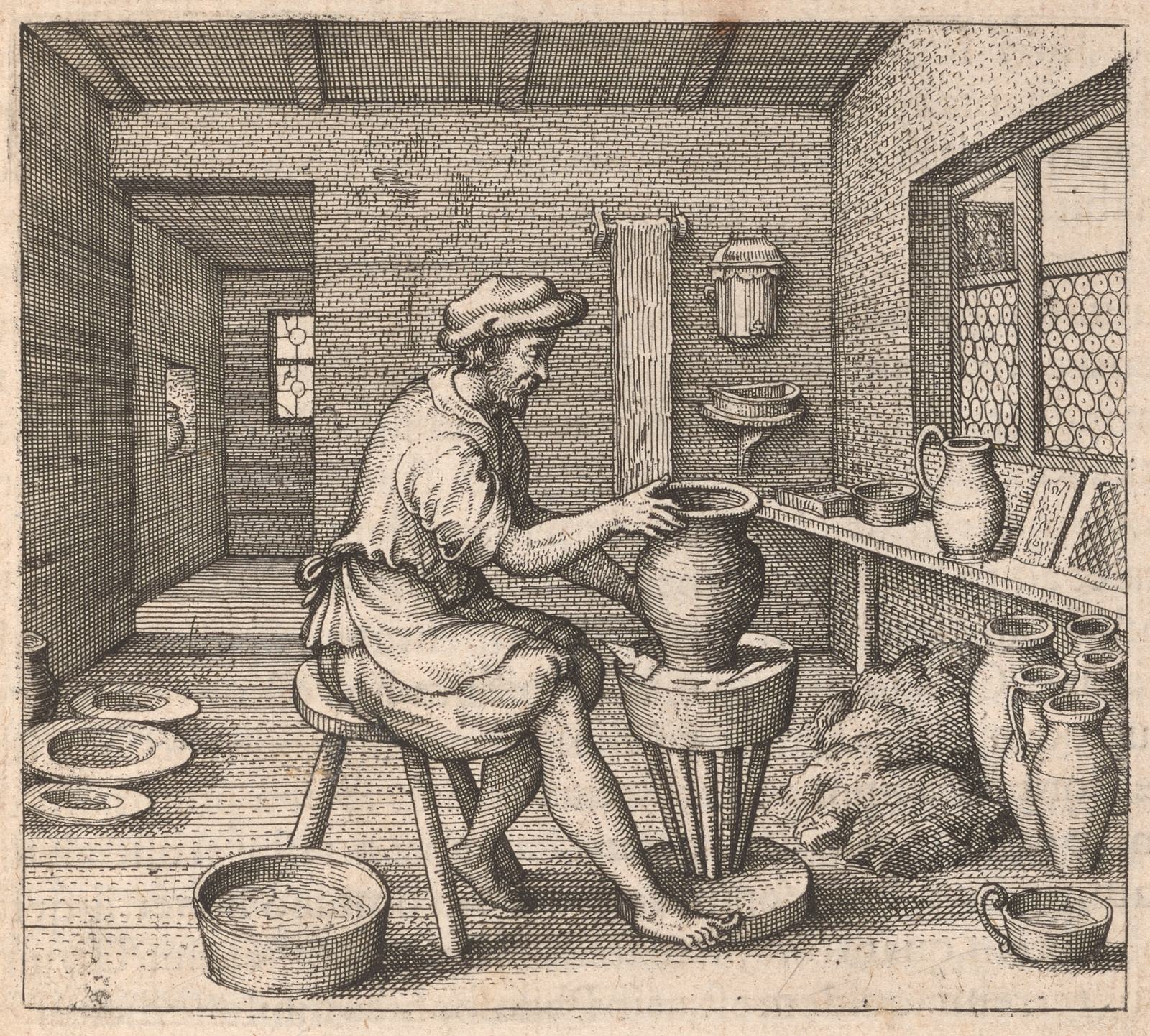
A potter sits at his wheel in a workshop, shaping a vessel from wet clay with his hands. Around him are finished pots in various stages of drying and firing — some still damp, others hardened and glazed. A kiln or furnace glows in the background. The scene emphasizes the craft of working with wet and dry materials, the potter's hands mediating between the liquid and solid states.
Let the work of the potter, consisting of dry and wet, teach you.
Epigram
Let the work of the potter, consisting of dry and wet, teach you. He moistens the clay with water, Shapes it with his hands upon the wheel, Then dries it in the sun and fires it in the kiln. So should you work with your substance: Moisten, shape, dry, and fire.Discourse Summary
Maier presents the potter's craft as a model for the alchemical work, arguing that the artisan who shapes clay from wet and dry elements teaches the principles governing the philosophical operation. He develops the analogy between the potter's sequence — moistening, forming, drying, firing — and the alchemist's manipulation of the mercurial and sulphurous components through successive stages. The discourse emphasizes that Nature provides the model, but art must apply it: the potter does not invent the properties of clay but learns to work with them. Maier cites this as evidence that alchemical skill is a techne learned through observation of natural processes.
Overview
Emblem XV bears the motto: "Let the work of the potter, consisting of dry and wet, teach you."
Maier's Discourse
Maier presents the potter's craft as a model for the alchemical work, arguing that the artisan who shapes clay from wet and dry elements teaches the principles governing the philosophical operation. He develops the analogy between the potter's sequence — moistening, forming, drying, firing — and the alchemist's manipulation of the mercurial and sulphurous components through successive stages. The discourse emphasizes that Nature provides the model, but art must apply it: the potter does not invent the properties of clay but learns to work with them.
Source Texts
De Jong's source-critical analysis identifies the textual traditions Maier draws upon for this emblem.
The discourse draws on alchemical sources: Lullius tradition (via Harmonica Chemica), Merlini Allegory, Rosarium Philosophorum.
Alchemical Significance
H.M.E. de Jong: De Jong traces this emblem's sources to the Opus Mulierum and the Pseudo-Lullian Codicillus, identifying the 'woman's work' of cooking as an allegory for the sustained, gentle heating required after the albedo stage to mature the white substance toward the rubedo.
Scholarly Commentary
H.M.E. de Jong ALCHEMICAL HIGH
De Jong traces this emblem's sources to the Opus Mulierum and the Pseudo-Lullian Codicillus, identifying the 'woman's work' of cooking as an allegory for the sustained, gentle heating required after the albedo stage to mature the white substance toward the rubedo.