Emblem XX — Emblem XX ALBEDO
Original Source
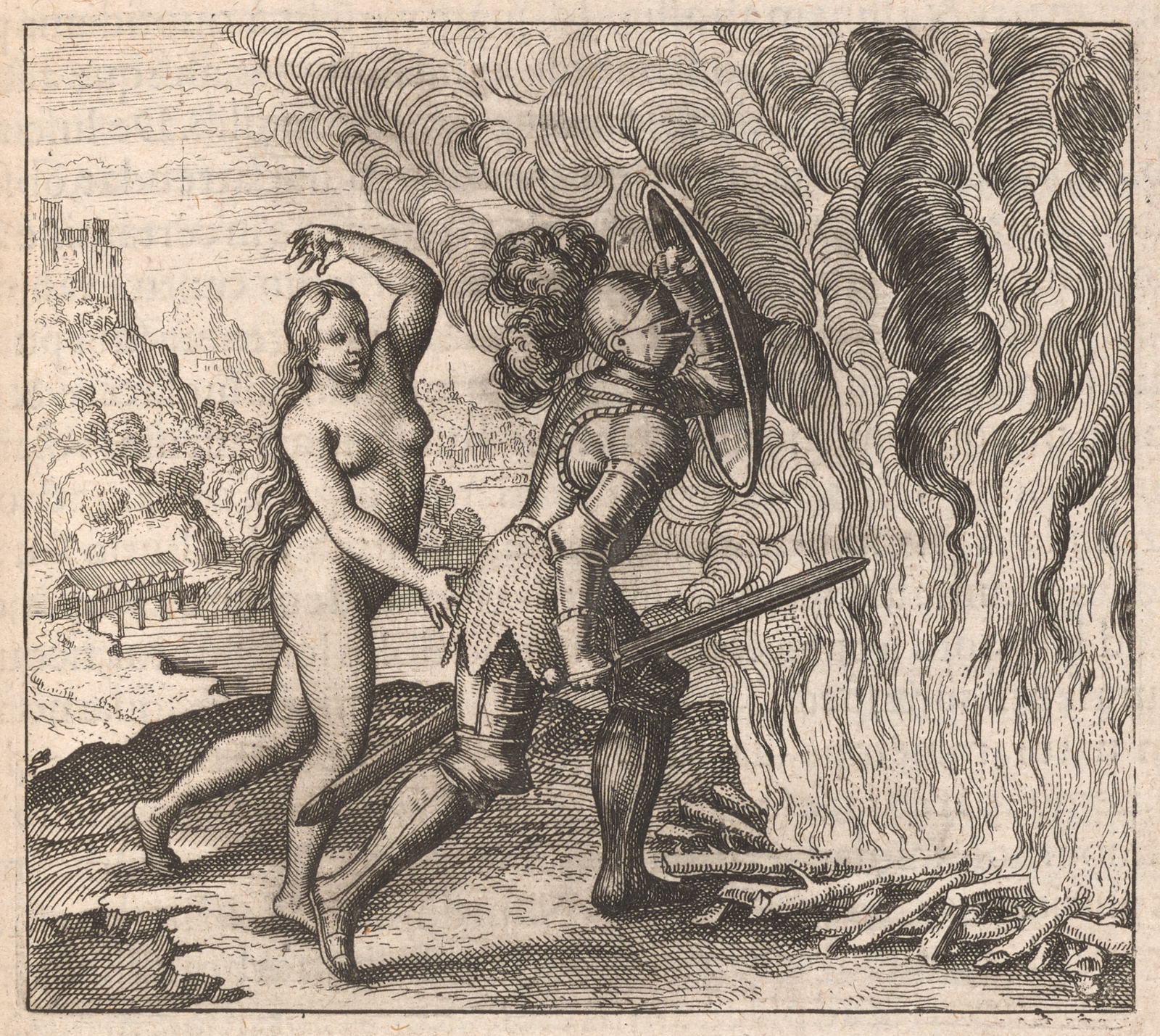
What You See
Three female figures stand in sequence, each teaching or demonstrating something to the next. The first figure may hold a natural object, the second observes or learns, and the third applies what she has learned to overcome or master the preceding figure. The arrangement suggests a pedagogical chain: nature instructs, nature learns, nature masters. The setting is outdoors with natural elements — plants, earth, water.
Nature teaches Nature, Nature conquers Nature, Nature rules Nature.
Epigram
Nature teaches Nature how to conquer fire; The teacher and the pupil are of the same kind. A woman is taught by another woman to wash clothes; The skilled one leads the unskilled. Nature teaches, Nature conquers, Nature rules: All wisdom comes from following her.Discourse Summary
Maier articulates one of alchemy's foundational maxims: Nature teaches Nature, Nature conquers Nature, Nature rules Nature. He argues that the alchemist must learn by observing natural processes, then apply those lessons to guide and finally master the transformations of matter. The discourse connects this to Democritus's principle that art imitates nature, and extends it: the alchemical art does not merely copy natural processes but accelerates and perfects them. Maier cites the washing of dirty linen (Emblem III) as an example — Nature provides rain and sun, and the was her woman learns to replicate these cleansing agents.
Overview
Emblem XX bears the motto: "Nature teaches Nature, Nature conquers Nature, Nature rules Nature."
Maier's Discourse
Maier articulates one of alchemy's foundational maxims: Nature teaches Nature, Nature conquers Nature, Nature rules Nature. He argues that the alchemist must learn by observing natural processes, then apply those lessons to guide and finally master the transformations of matter. The discourse connects this to Democritus's principle that art imitates nature, and extends it: the alchemical art does not merely copy natural processes but accelerates and perfects them.
Source Texts
De Jong's source-critical analysis identifies the textual traditions Maier draws upon for this emblem.
The discourse draws on alchemical sources: Rosarium Philosophorum. The discourse draws on Hermetic sources: Tabula Smaragdina (Emerald Tablet).
Alchemical Significance
H.M.E. de Jong: De Jong identifies the motto source in the Tabula Smaragdina and traces how Maier develops the nursing metaphor across Emblems I-II, connecting the wind (volatile mercury) as father to the earth (fixed body) as nurse. She demonstrates the systematic use of the Emerald Tablet as a structural template for the opening emblem sequence.
Scholarly Commentary
H.M.E. de Jong ALCHEMICAL HIGH
De Jong identifies the motto source in the Tabula Smaragdina and traces how Maier develops the nursing metaphor across Emblems I-II, connecting the wind (volatile mercury) as father to the earth (fixed body) as nurse. She demonstrates the systematic use of the Emerald Tablet as a structural template for the opening emblem sequence.