Emblem XXI — Circle-square-triangle-circle formula RUBEDO
Original Source
What You See
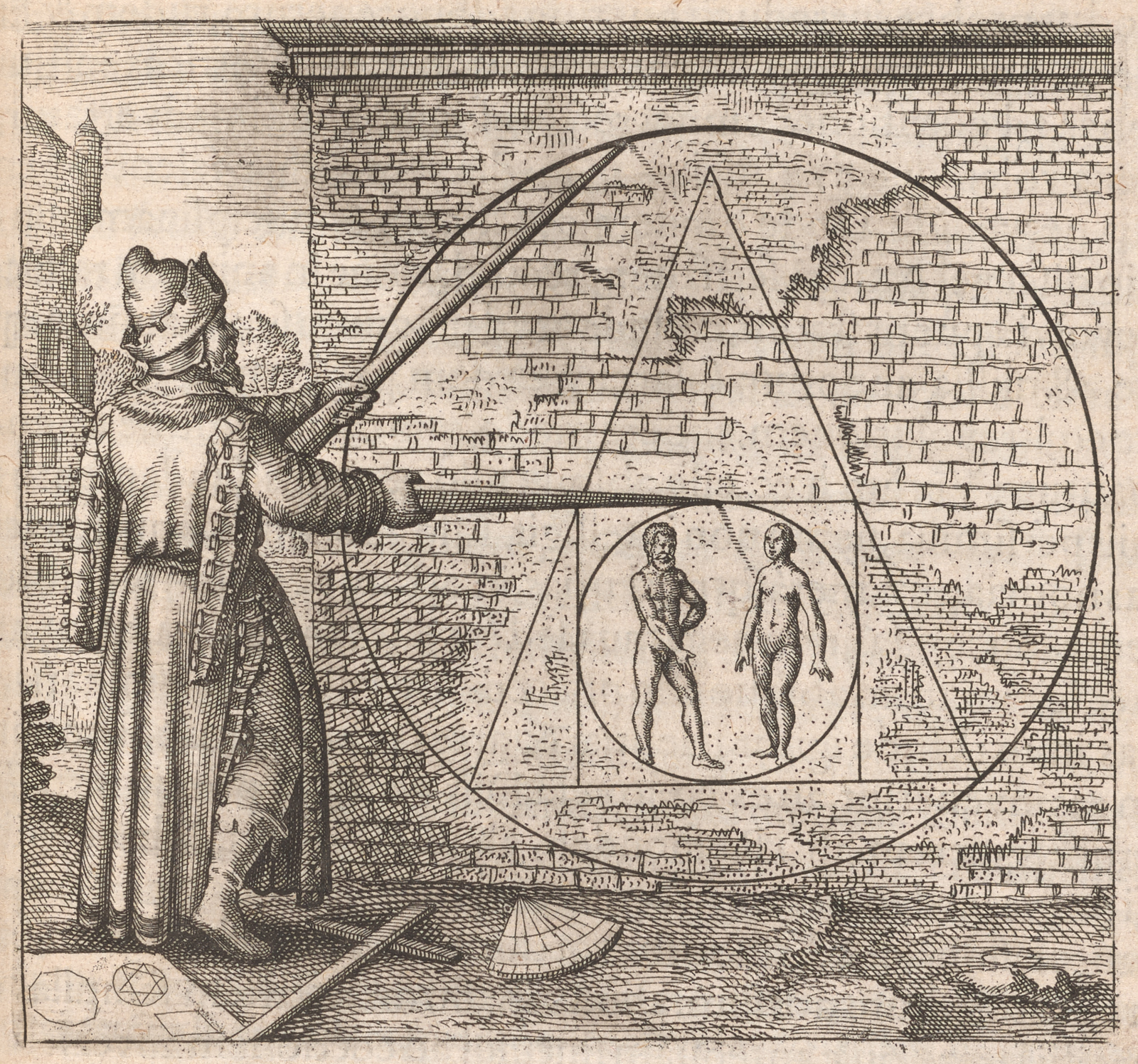
A geometric diagram at center shows the nested transformation of shapes: a man and woman form a circle, which is inscribed in a square, which contains a triangle, which encloses a final inner circle. The figures may be rendered as human bodies contorted into these geometric forms, or as abstract diagrams with human figures at the periphery. The composition is schematic and diagrammatic rather than narrative, emphasizing the mathematical-philosophical dimension of the alchemical work.
Make a circle out of a man and a woman, out of this a square, out of this a triangle, make a circle, and you will have the Philosopher's Stone.
Epigram
Make a circle out of a man and a woman, From which a quadrangular body arises with equal sides. Derive from it a triangle, which is in contact on all sides with a round sphere: Then the Stone will have come into existence. If this great thing does not immediately present itself to your mind, Learn all the doctrine of Geometry, and you will know everything.Discourse Summary
Maier develops the famous geometric formula attributed to the Rosarium Philosophorum: make a circle from a man and woman (the coniunctio of opposites), transform this into a square (the four elements), reduce the square to a triangle (the tria prima of salt, sulphur, and mercury), and finally resolve the triangle back into a circle (the unified philosopher's stone). He argues that this sequence encodes the entire alchemical opus in geometric form, drawing on Platonic philosophy to connect ideal mathematical forms to material transformations. The discourse cites the principle of squaring the circle — an impossibility in mathematics but achievable in alchemy — as evidence that the philosophical art transcends ordinary reason.
Overview
Emblem XXI bears the motto: "Make a circle out of a man and a woman, out of this a square, out of this a triangle, make a circle, and you will have the Philosopher's Stone."
Maier's Discourse
Maier develops the famous geometric formula attributed to the Rosarium Philosophorum: make a circle from a man and woman (the coniunctio of opposites), transform this into a square (the four elements), reduce the square to a triangle (the tria prima of salt, sulphur, and mercury), and finally resolve the triangle back into a circle (the unified philosopher's stone). He argues that this sequence encodes the entire alchemical opus in geometric form, drawing on Platonic philosophy to connect ideal mathematical forms to material transformations.
Source Texts
De Jong's source-critical analysis identifies the textual traditions Maier draws upon for this emblem.
De Jong identifies the motto source as Rosarium Philosophorum. The discourse draws on alchemical sources: Pseudo-Aristotle, Tractatulus de Practica Lapidis, Rosarium Philosophorum.
Alchemical Significance
Hereward Tilton: Interprets through Aristotelian elemental transmutation: black Saturn/lead = body/earth, white phase = spirit/water, yellowness = soul/air, final redness = perfected unity of the stone. Not simply Paracelsian tria prima.
Hereward Tilton: Tilton interprets the squaring of the circle through Aristotelian elemental transmutation rather than the Paracelsian tria prima. The circle-square-triangle-circle sequence represents the cosmic work from monad through elements to perfected unity, the return to the Monad.
J.B. Craven: Craven summarizes Emblem 21: squaring the circle — make of man and woman a circle, then quadrangle, then triangle, then circle again to obtain the Stone of the Wise.
H.M.E. de Jong: Rosarium formula: make circle from man and woman, derive square and triangle, return to circle. Four elements within unity. Body/spirit/soul triad.
Key Alchemical Concepts
Process: Circulatio, Citrinitas, Coniunctio (Coniunctio Oppositorum), Rubedo
Substance: Aurum Philosophicum
Figure: Hippomenes
Concept: Cauda Pavonis, Lapis, Opus Magnum, Philosopher's Stone (Lapis Philosophorum), Tria Prima
Source_Text: Rosarium Philosophorum
Scholarly Commentary
Hereward Tilton HIGH
Interprets through Aristotelian elemental transmutation: black Saturn/lead = body/earth, white phase = spirit/water, yellowness = soul/air, final redness = perfected unity of the stone. Not simply Paracelsian tria prima.
Citation: Discussion of Emblem XXI
Hereward Tilton ALCHEMICAL MEDIUM
Tilton interprets the squaring of the circle through Aristotelian elemental transmutation rather than the Paracelsian tria prima. The circle-square-triangle-circle sequence represents the cosmic work from monad through elements to perfected unity, the return to the Monad.
Citation: Ch. V, pp. 186-188
J.B. Craven ALCHEMICAL MEDIUM
Craven summarizes Emblem 21: squaring the circle — make of man and woman a circle, then quadrangle, then triangle, then circle again to obtain the Stone of the Wise.
Citation: p. 90
H.M.E. de Jong HIGH
Rosarium formula: make circle from man and woman, derive square and triangle, return to circle. Four elements within unity. Body/spirit/soul triad.
Citation: Emblem XXI section