Emblem X — Emblem X CITRINITAS
Original Source
What You See
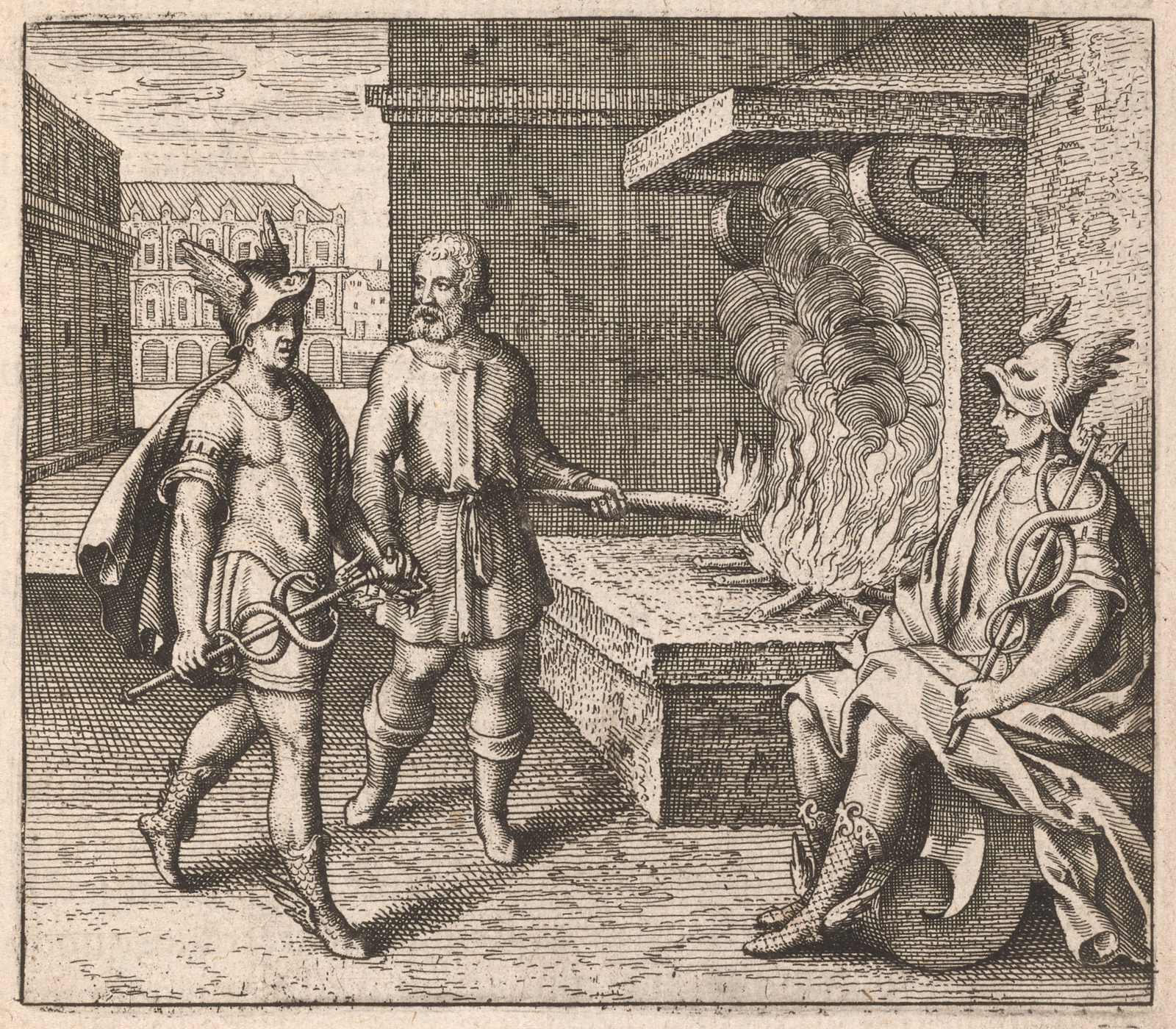
Two fires burn in separate vessels or furnaces, with a figure tending them or directing material between them. Mercury — possibly depicted as a caduceus-bearing figure or as liquid quicksilver — appears in duplicate, being passed from one vessel to another. The composition emphasizes doubling and correspondence: fire feeds fire, mercury feeds mercury, in a self-reinforcing cycle.
Give fire to fire, Mercury to Mercury, and that is enough for you.
Epigram
You want to know the reason why so many poets sing of Helicon, And say that everybody must try to reach the top of it? At its summit a Stone has been placed as a souvenir, The Stone that was devoured and spat out by Saturn. Give fire to fire, Mercury to Mercury, And that is enough for you.Discourse Summary
Maier develops the principle that like produces like: fire must be added to fire, and mercury to mercury, for the philosophical work to succeed. He argues against the common error of mixing incompatible substances, insisting that the alchemist must recognize the common nature hidden beneath different appearances. The discourse draws on the allegory of Saturn devouring his children, which Maier interprets as the dissolution of metals back into their mercurial prima materia. He cites the Turba Philosophorum's dictum that the Stone is nourished only by its own kind, establishing the principle of philosophical homogeneity that governs the entire citrinitas stage.
Overview
Emblem X bears the motto: "Give fire to fire, Mercury to Mercury, and that is enough for you."
Maier's Discourse
Maier develops the principle that like produces like: fire must be added to fire, and mercury to mercury, for the philosophical work to succeed. He argues against the common error of mixing incompatible substances, insisting that the alchemist must recognize the common nature hidden beneath different appearances. The discourse draws on the allegory of Saturn devouring his children, which Maier interprets as the dissolution of metals back into their mercurial prima materia.
Source Texts
De Jong's source-critical analysis identifies the textual traditions Maier draws upon for this emblem.
The discourse draws on alchemical sources: Aurora Consurgens, Turba Philosophorum.
Alchemical Significance
Hereward Tilton: Tilton discusses discourse 10's reference to the aqua foetida — the powerful spirit with the smell of sulphur and the grave — identified as the quintessence from Parnassus's fountain struck by Pegasus. This connects to Maier's Rosicrucian allegorical reading of the Fama Fraternitatis.
Walter Pagel: Pagel discusses Maier's Empedoclean cosmology in the discourse to Emblem X: air and earth as secondary elements arising from the conjunction of primary elements water (mercury) and fire (sulphur), the union of opposites.
H.M.E. de Jong: De Jong traces the sources for this emblem to Hesiod's Theogony and to the Turba Philosophorum, identifying the underlying chemistry as the addition of fire to fire and mercury to mercury — the principle of philosophical homogeneity. She connects the allegory of Saturn devouring his children to the dissolution of metals back into their mercurial prima materia.
Key Alchemical Concepts
Figure: Kronos / Saturn (Saturnus)
Scholarly Commentary
Hereward Tilton ALCHEMICAL MEDIUM
Tilton discusses discourse 10's reference to the aqua foetida — the powerful spirit with the smell of sulphur and the grave — identified as the quintessence from Parnassus's fountain struck by Pegasus. This connects to Maier's Rosicrucian allegorical reading of the Fama Fraternitatis.
Citation: Ch. IV, pp. 170-171
Walter Pagel ALCHEMICAL MEDIUM
Pagel discusses Maier's Empedoclean cosmology in the discourse to Emblem X: air and earth as secondary elements arising from the conjunction of primary elements water (mercury) and fire (sulphur), the union of opposites.
Citation: p. 102
H.M.E. de Jong ALCHEMICAL HIGH
De Jong traces the sources for this emblem to Hesiod's Theogony and to the Turba Philosophorum, identifying the underlying chemistry as the addition of fire to fire and mercury to mercury — the principle of philosophical homogeneity. She connects the allegory of Saturn devouring his children to the dissolution of metals back into their mercurial prima materia.