Emblem XXIX — Emblem XXIX CITRINITAS
Original Source
What You See
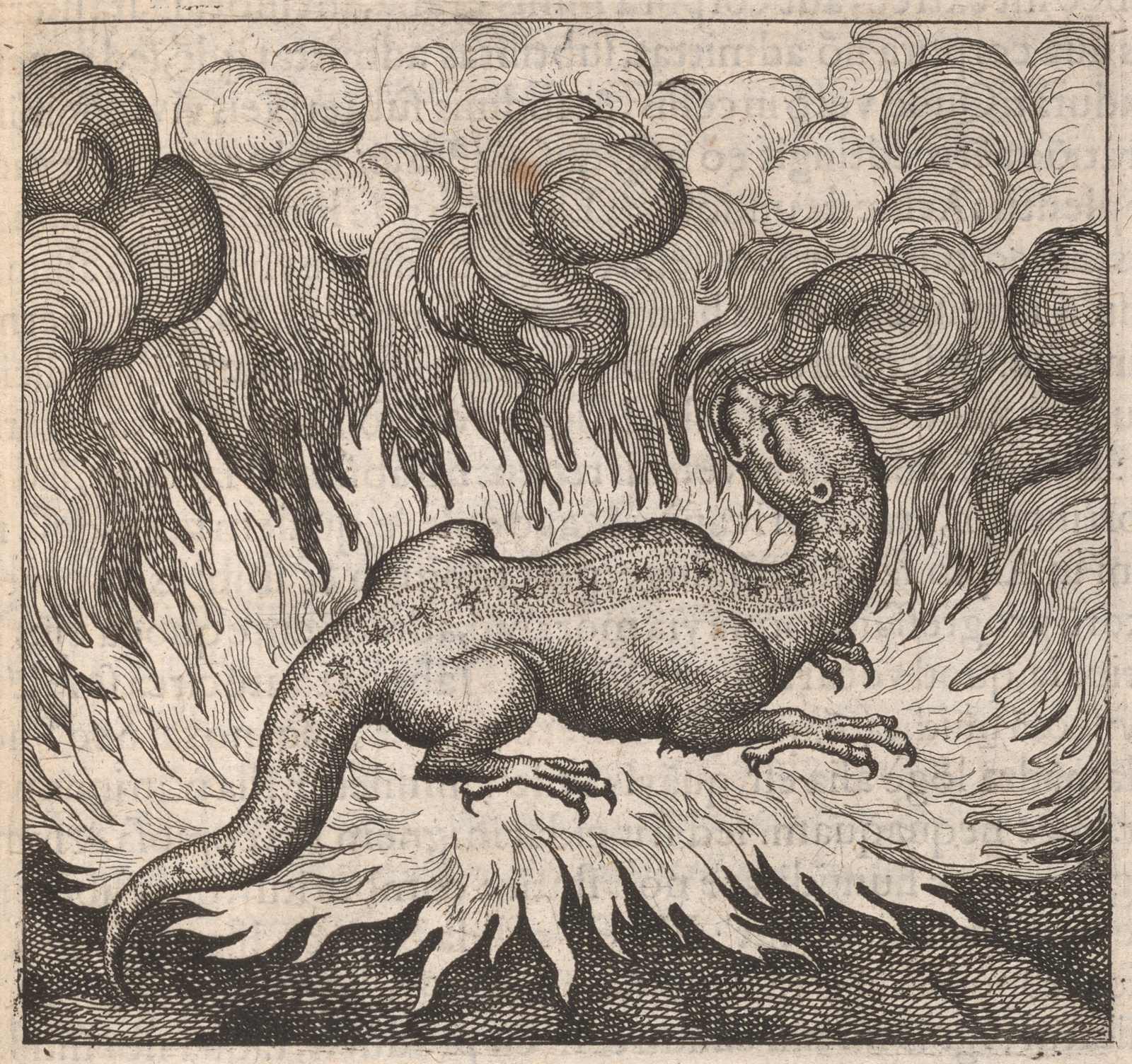
A salamander sits calmly within flames, unharmed by the fire that surrounds it. The fire burns vigorously — depicted with detailed, curling flames — but the creature rests at ease in the center. The scene may include a furnace or hearth as the fire's source. The salamander's composure within the destructive element is the focal point of the composition.
Just as the Salamander lives in the fire, so also the Stone.
Epigram
Just as the Salamander lives in the fire And is not consumed by the flames, So also the Stone endures the test of fire, Growing stronger where other things perish. What fire cannot destroy is truly fixed; This is the mark of the perfected substance.Discourse Summary
Maier develops the ancient belief that the salamander lives in fire without being consumed, applying it as an allegory for the philosopher's stone, which endures the test of fire and emerges unchanged or improved. He argues that just as the salamander is nourished rather than destroyed by flames, the perfected stone with stands any degree of heat — a key test of its authenticity. The discourse connects this to the broader principle of fixation: a substance is 'fixed' when it can endure fire without volatilizing. Maier cites classical natural historians including Pliny on the salamander's fire-resistance, while noting that the philosophical salamander transcends the merely natural creature.
Overview
Emblem XXIX bears the motto: "Just as the Salamander lives in the fire, so also the Stone."
Maier's Discourse
Maier develops the ancient belief that the salamander lives in fire without being consumed, applying it as an allegory for the philosopher's stone, which endures the test of fire and emerges unchanged or improved. He argues that just as the salamander is nourished rather than destroyed by flames, the perfected stone withstands any degree of heat — a key test of its authenticity. The discourse connects this to the broader principle of fixation: a substance is 'fixed' when it can endure fire without volatilizing.
Source Texts
De Jong's source-critical analysis identifies the textual traditions Maier draws upon for this emblem.
The discourse draws on alchemical sources: Lambsprinck, De Lapide Philosophico, Pseudo-Aristotle, Tractatulus de Practica Lapidis, Senior Zadith (Muhammad ibn Umail), Tabula Chimica.
Alchemical Significance
J.B. Craven: Craven summarizes Emblem 29: as the Salamander lives in fire, so does the Stone — the Philosopher's Stone is born in perpetual fire and stands in equal heat with the Salamander.
H.M.E. de Jong: De Jong traces the salamander-in-fire motif to Avicenna's Tractatulus de Alchimia, identifying the philosophical stone's fire-resistance as the key test of successful fixation. She connects the coral analogy (growing soft underwater, hardening in air) to the same principle of state-change from fluid process to solid product.
Scholarly Commentary
J.B. Craven ALCHEMICAL MEDIUM
Craven summarizes Emblem 29: as the Salamander lives in fire, so does the Stone — the Philosopher's Stone is born in perpetual fire and stands in equal heat with the Salamander.
Citation: p. 91
H.M.E. de Jong ALCHEMICAL HIGH
De Jong traces the salamander-in-fire motif to Avicenna's Tractatulus de Alchimia, identifying the philosophical stone's fire-resistance as the key test of successful fixation. She connects the coral analogy (growing soft underwater, hardening in air) to the same principle of state-change from fluid process to solid product.