Emblem XLVI — Emblem XLVI CITRINITAS
Original Source
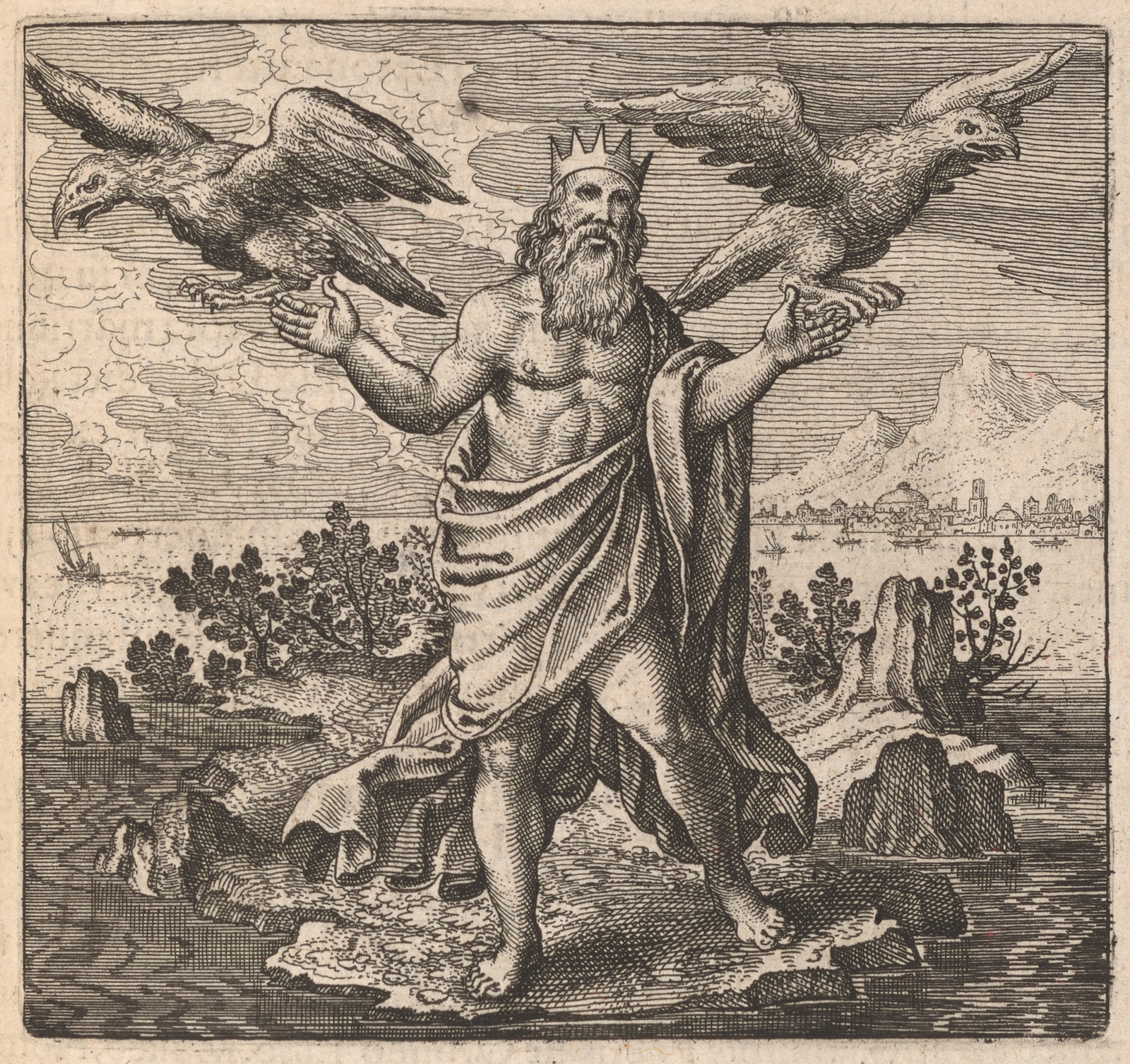
What You See
Two eagles fly toward each other from opposite directions — one from the East (the right), the other from the West (the left). They meet in mid-air, their talons or beaks engaging at the point of collision. The landscape below stretches between two horizons, emphasizing the vast distance the eagles have traveled. The meeting point at center is the focal climax of the composition.
Two eagles meet, the one from the East, the other from the West.
Epigram
Two eagles meet, one from the East, The other from the West. One is winged and swift, the other steady; They converge at the center of the sky. From their meeting, the volatile and fixed unite In the aerial conjunction of the great work.Discourse Summary
Maier develops the meeting of two eagles — one from the East, the other from the West — as an allegory for the conjunction of the two philosophical principles that originate from opposite ends of the alchemical process. He identifies the Eastern eagle with sulphur (the hot, solar principle born from fire) and the Western eagle with mercury (the cool, lunar principle born from water). Their meeting in mid-air represents the volatile conjunction where both principles abandon their fixed natures and unite in the aerial, spiritual realm. The discourse connects the circumnavigation imagery — east to west, west to east — to the Hermetic principle of universal circulation, where all things return to their origin.
Overview
Emblem XLVI bears the motto: "Two eagles meet, the one from the East, the other from the West."
Maier's Discourse
Maier develops the meeting of two eagles — one from the East, the other from the West — as an allegory for the conjunction of the two philosophical principles that originate from opposite ends of the alchemical process. He identifies the Eastern eagle with sulphur (the hot, solar principle born from fire) and the Western eagle with mercury (the cool, lunar principle born from water). Their meeting in mid-air represents the volatile conjunction where both principles abandon their fixed natures and unite in the aerial, spiritual realm.
Source Texts
De Jong's source-critical analysis identifies the textual traditions Maier draws upon for this emblem.
The discourse draws on alchemical sources: Pseudo-Aristotle, Tractatulus de Practica Lapidis.
Alchemical Significance
Hereward Tilton: Tilton reads emblem 46 in the context of the Allegoria Bella: two eagles circumnavigating the globe from east and west signify masculine Sulphur and feminine Mercury. The eagle restores itself to youth by plunging three times into a fountain, linking to the cyclical processes in the vessel and Maier's own circumnavigation-pilgrimage.
H.M.E. de Jong: De Jong identifies the two eagles from East and West in the Consilium Conjugii and traces the philosophical conjunction of Sulphur (Eastern, solar) and Mercury (Western, lunar) through the Aristotelian tradition transmitted via Petrus Bonus's Margarita Pretiosa.
Scholarly Commentary
Hereward Tilton ALCHEMICAL MEDIUM
Tilton reads emblem 46 in the context of the Allegoria Bella: two eagles circumnavigating the globe from east and west signify masculine Sulphur and feminine Mercury. The eagle restores itself to youth by plunging three times into a fountain, linking to the cyclical processes in the vessel and Maier's own circumnavigation-pilgrimage.
Citation: Ch. V, pp. 221-222
H.M.E. de Jong ALCHEMICAL HIGH
De Jong identifies the two eagles from East and West in the Consilium Conjugii and traces the philosophical conjunction of Sulphur (Eastern, solar) and Mercury (Western, lunar) through the Aristotelian tradition transmitted via Petrus Bonus's Margarita Pretiosa.