← All Folios
Signature b6v
Folio 14v, Quire b
British Library, London — C.60.o.12
HIGH
Alchemical Analysis
Elephant and Obelisk: Ideograms in Syntax
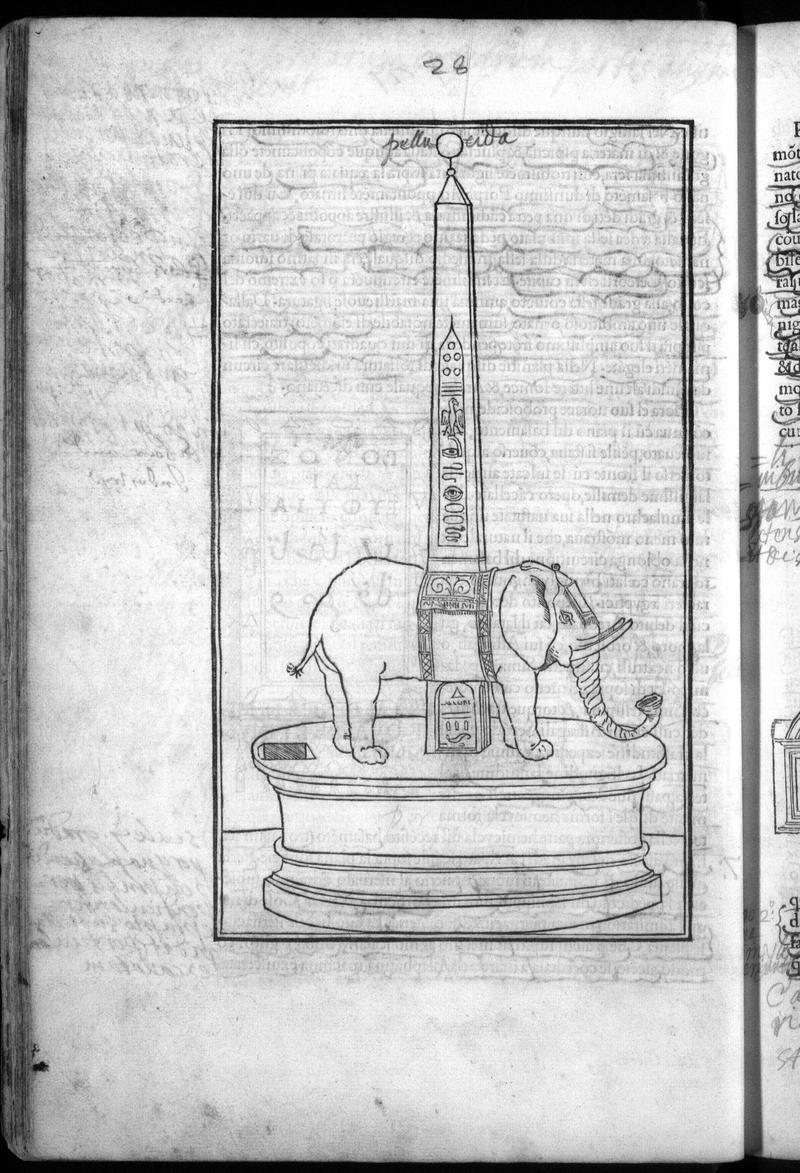
The famous woodcut of the elephant bearing an obelisk -- later realized by Bernini in the Piazza della Minerva for Pope Alexander VII -- is densely annotated by Hand B with alchemical ideograms embedded directly in the syntax of Latin sentences. The sun symbol with the suffix '-ra' reads 'scintillata aurata' (shimmering gold). These are not marginal glosses but a complete symbolic language: compact symbols for gold, silver, mercury, Venus, and Jupiter carry Latin case endings, allowing them to function as nouns and adjectives within grammatical sentences. Russell notes the consistency with Newton's Keynes MSS vocabulary, suggesting a possible connection to the Royal Society or Cambridge alchemical circle.
Element: Multiple metals: Gold, Silver, Mercury, Venus, Jupiter
Process: Ideographic decipherment of the printed text
Framework: d'Espagnet: standardized ideographic vocabulary
Russell, pp. 156-158
LLM-assisted synthesis from Russell
Alchemical Symbols Present
| Symbol |
Metal |
Planet |
Gender |
Hand |
Conf. |
| Jupiter |
Tin (Stannum) |
Jupiter |
masculine |
Hand B |
HIGH |
| Luna |
Silver (Argentum) |
Moon |
feminine |
Hand B |
HIGH |
| Mercury |
Quicksilver (Hydrargyrum) |
Mercury |
hermaphroditic |
Hand B |
HIGH |
| Sol |
Gold (Aurum) |
Sun |
masculine |
Hand B |
HIGH |
| Venus |
Copper (Cuprum) |
Venus |
feminine |
Hand B |
HIGH |
Vision Reading (Phase 3 deep analysis)
Primary hand: Hand B (alchemist) · Hands: 2 · Type: woodcut_page · Sig: b6v
Woodcut: Elephant bearing an obelisk on a circular pedestal
The famous elephant-and-obelisk woodcut. A large elephant stands on a round stepped base, carrying an obelisk topped with a sphere on its back. The obelisk bears hieroglyphic-style decorative panels. This is the image that would later inspire Bernini's 1667 elephant and obelisk in Piazza della Minerva, Rome.
Condition: Good. Clean impression. Some foxing on surrounding page
Transcription Attempts
above_woodcut · Latin · HIGH
bellua
KEY ANNOTATION: 'bellua' (= beast/monster) written above the elephant woodcut. This is one of Hand B's most important annotations — Russell identifies this as an alchemical keyword connecting the elephant to bestiary/alchemical symbolism
right_margin · Latin · LOW
[...] nat[...] [...] m[...] [...]
Very faint marginal text in right margin, mostly cropped by photograph edge. At least 4-5 lines visible but largely illegible at this resolution
left_margin_bottom · uncertain · LOW
[...] J[...] [...]
Faint marks in lower left margin
Scholarly Significance
This is one of the key alchemical sites in the volume. Hand B's annotation 'bellua' above the elephant connects to a tradition of reading the HP's bestiary imagery through an alchemical lens. The elephant-and-obelisk is one of the most reproduced and influential images in the HP, and the fact that an early reader glossed it with alchemical terminology is significant for reception history. Russell discusses this annotation extensively.
Cross-references: Russell thesis Ch. 5 (Hand B annotations), Photo 3 (Master Mercury declaration), Photo 55 (alchemical symbols p.42), Bernini elephant (1667)
Vision reading (Claude Code, Phase 3)
Annotations
SYMBOL (2)
Hand B: Anonymous (possibly Royal Society circle) (Jean d'Espagnet (Enchiridion Physicae Restitutae)) Alchemist
Symbol
are
remnants from what was at one time an extensive ideographic vocabulary.37 A number of
these ideograms are of significant antiquity.38 Others may be of more recent coinage, or even
signs distinct to a particular practitioner. Thus, by following the procession of operations
signified in each of these symbols, one can correlate passages of the HP with the alchemical
processes presumed to be encoded therein. For example, the following annotation on the
image of the Elephant and Obelisk ...
Russell, PhD Thesis, p. 156 (Ch. 6)
Hand B: Anonymous (possibly Royal Society circle) (Jean d'Espagnet (Enchiridion Physicae Restitutae)) Alchemist
Symbol
146
Detail, (b6v)
The annotator consistently uses in-text ideograms throughout his annotation. The hand is
heavy throughout the book, although notes decline in frequency and alchemical significance
in Book II. Nevertheless, even on (E8v) the symbol of Venus is still used as a replacement
for the goddess’ name.
Detail, (E8v)
The Latin inflexions suffixed to the symbols serve to disambiguate each sign by
identifying its gender and case, as well as allowing the ideogram to fun...
Russell, PhD Thesis, p. 157 (Ch. 6)
Hand B: Anonymous (possibly Royal Society circle) (Jean d'Espagnet (Enchiridion Physicae Restitutae)) Alchemist
Symbol
are
remnants from what was at one time an extensive ideographic vocabulary.37 A number of
these ideograms are of significant antiquity.38 Others may be of more recent coinage, or even
signs distinct to a particular practitioner. Thus, by following the procession of operations
signified in each of these symbols, one can correlate passages of the HP with the alchemical
processes presumed to be encoded therein. For example, the following annotation on the
image of the Elephant and Obelisk ...
Russell, PhD Thesis, p. 156 (Ch. 6)
Hand B: Anonymous (possibly Royal Society circle) (Jean d'Espagnet (Enchiridion Physicae Restitutae)) Alchemist
Symbol
146
Detail, (b6v)
The annotator consistently uses in-text ideograms throughout his annotation. The hand is
heavy throughout the book, although notes decline in frequency and alchemical significance
in Book II. Nevertheless, even on (E8v) the symbol of Venus is still used as a replacement
for the goddess’ name.
Detail, (E8v)
The Latin inflexions suffixed to the symbols serve to disambiguate each sign by
identifying its gender and case, as well as allowing the ideogram to fun...
Russell, PhD Thesis, p. 157 (Ch. 6)