Signature b3r
Folio 11r, Quire b
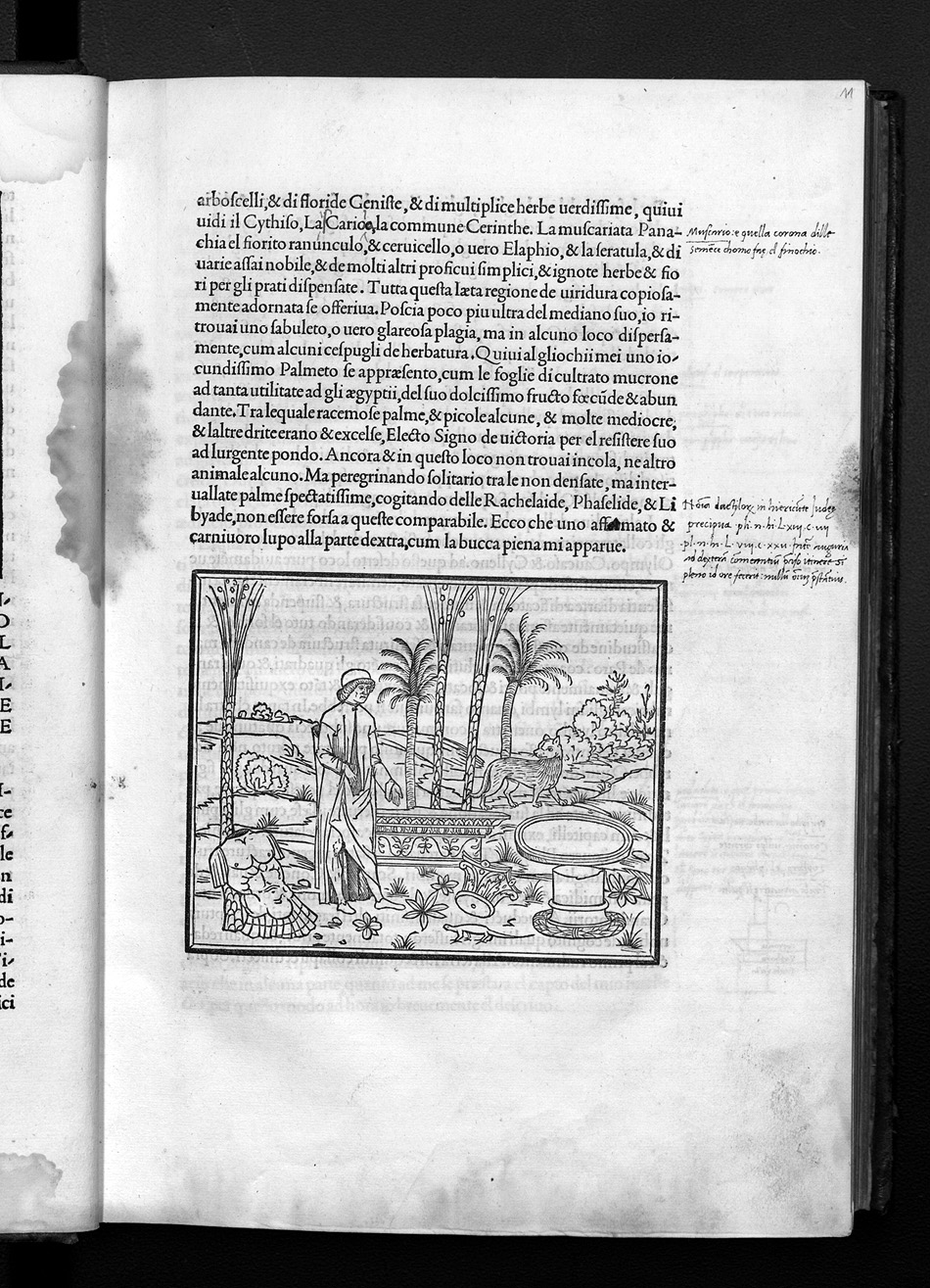
Biblioteca degli Intronati, Siena — O.III.38
HIGH
Vision Reading (Phase 3 deep analysis)
Primary hand: Multiple · Hands: 3 · Type: text_page · Sig: b5r
Transcription Attempts
top_right · Latin · LOW
principia [...] stabile [...] calores [...]
'principia' (principles/beginnings), 'calores' (heats). Both words can function in alchemical or architectural contexts
right_margin_upper · Latin/Italian · LOW
lapidem [...] Petra [...] Basilicum [...] bruni [...] molta [...]
'lapidem' (stone), 'Petra' (rock), 'Basilicum' (basilica/royal). These could be architectural or alchemical — 'lapidem' is the accusative of 'lapis', which in alchemical discourse refers to the philosopher's stone
right_margin_lower · Latin/Italian · LOW
gloria [...] Roma [...] sublimis [...] Vagabonda [...] imperatore [...]
'Roma', 'sublimis' (sublime/elevated), 'imperatore' (emperor). Reader connecting the HP's monumental architecture to Roman imperial precedent
bottom · Latin · MEDIUM
[...] columnarum [...] plano [...] stylobata [...] columnaro [...]
'columnarum' (of columns), 'stylobata' (stylobate — column base). Precise Vitruvian architectural terminology. This reader knows classical architectural vocabulary
Scholarly Significance
Page 21 continues the monumental architecture description. The annotations show two distinct reading interests competing on the same page: (1) an architectural reader using Vitruvian terms ('columnarum', 'stylobata') to analyze Colonna's buildings, and (2) a reader connecting the architecture to imperial Roman grandeur ('Roma', 'imperatore', 'sublimis'). The word 'lapidem' creates an alchemical ambiguity — the same word means 'stone' architecturally and 'philosopher's stone' alchemically.
Cross-references: Photo 27 (p.14), Photo 25 (p.12), Russell thesis Ch. 4 (architectural vocabulary)
Vision reading (Claude Code, Phase 3)
Annotations
INDEX_ENTRY (2)
Hand Primary: Anonymous
Index Entry
“reverse engineering”
226
possibly through ‘reverse engineering’ Poliphilesque terms of Greek origin by use of
Torriani. Other examples include:
a2v: Agrypnia > vigilia
a8r: panglypho > tutoreliono
b3r: lithogliphi > Saxisculptura
d3r: micropsycho > .l. pusilanimo
The latiniser also translates the Greek motto on the cloth hanging over the elephant’s brow on
the ‘Elephant and Obelisk’ statue, as ‘labor et industria.’ (b7r, G 37).
The Sydney hand takes a particular interest in latinizing the symbolic n...
Russell, PhD Thesis, p. 237 (Ch. 9)
Hand Primary: Anonymous
Index Entry
“licet”
. She was the Arsacis of my senses, the Murana of my love, the
patron and revered empress of my whole being. (G 369)21
The annotators of the linked copies also take a different approach to the architectural
content of the text. While Siena contains elegant architectural diagrams, Sydney contains no
illustrations of any kind. Yet even if the Sydney annotator’s interest is not expressed in
drawings, he takes note of architectural vocabulary, again making use of ‘licet’. For example:
...
Russell, PhD Thesis, p. 238 (Ch. 9)
Hand Primary: Anonymous
Index Entry
“reverse engineering”
226
possibly through ‘reverse engineering’ Poliphilesque terms of Greek origin by use of
Torriani. Other examples include:
a2v: Agrypnia > vigilia
a8r: panglypho > tutoreliono
b3r: lithogliphi > Saxisculptura
d3r: micropsycho > .l. pusilanimo
The latiniser also translates the Greek motto on the cloth hanging over the elephant’s brow on
the ‘Elephant and Obelisk’ statue, as ‘labor et industria.’ (b7r, G 37).
The Sydney hand takes a particular interest in latinizing the symbolic n...
Russell, PhD Thesis, p. 237 (Ch. 9)
Hand Primary: Anonymous
Index Entry
“licet”
. She was the Arsacis of my senses, the Murana of my love, the
patron and revered empress of my whole being. (G 369)21
The annotators of the linked copies also take a different approach to the architectural
content of the text. While Siena contains elegant architectural diagrams, Sydney contains no
illustrations of any kind. Yet even if the Sydney annotator’s interest is not expressed in
drawings, he takes note of architectural vocabulary, again making use of ‘licet’. For example:
...
Russell, PhD Thesis, p. 238 (Ch. 9)