Signature a7v
Folio 7v, Quire a
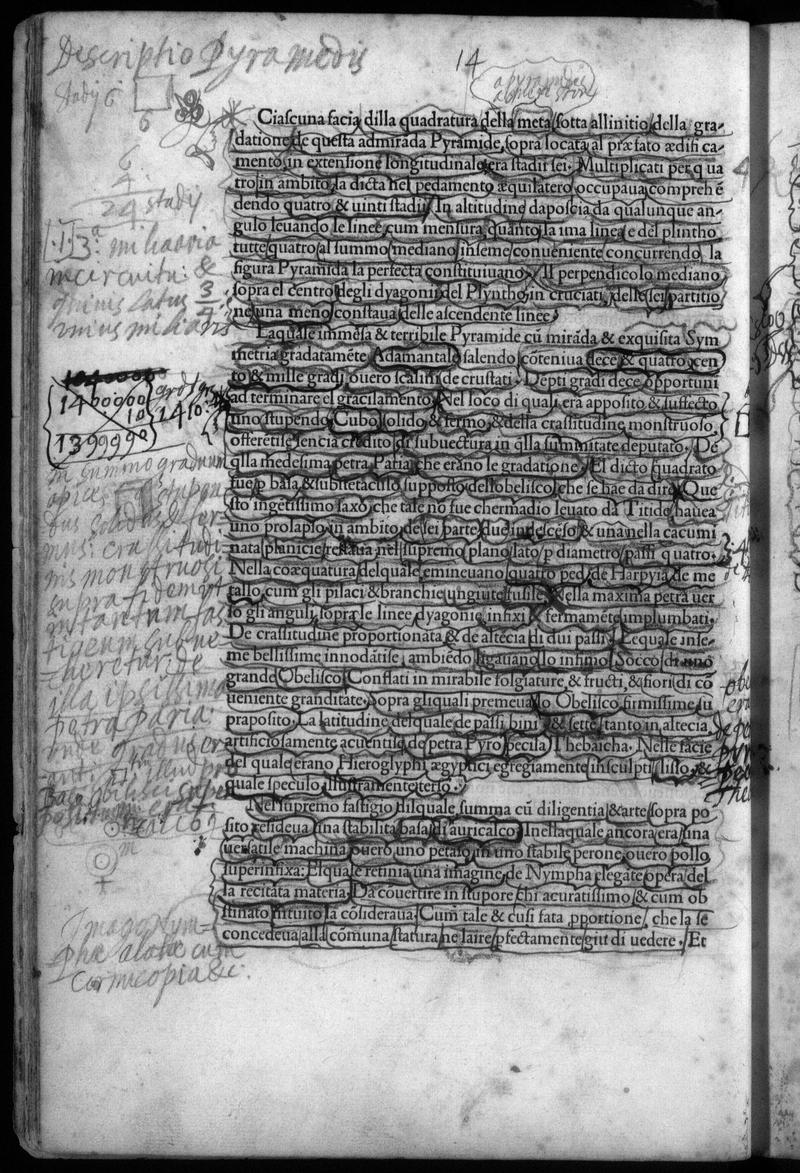
British Library, London — C.60.o.12
HIGH
Vision Reading (Phase 3 deep analysis)
Primary hand: Multiple (at least 3) · Hands: 3 · Type: text_page · Sig: b2v
Transcription Attempts
top_left · Latin · HIGH
Descriptio Pyramidis
Clear heading in manuscript hand. Reader has added a section title summarizing the printed text's content: description of the pyramid
top_right · n/a · HIGH
14
Page number confirmed
left_margin_top · Latin · MEDIUM
latitudo [...] 24 stadia [...] B3 [...] milliaria [...] milliaria [...] & [...] altitudo [...] domini [...] millitura
Mathematical/metrological annotations. Reader is calculating dimensions of the pyramid described in the text. 'stadia' is an ancient unit of measurement. Multiple numerical calculations visible
left_margin_bottom · numerical · MEDIUM
1400000 [...] 1399994 [...] 600 [...] 466[...]
Extended arithmetic calculations. Reader is working out the dimensions/proportions described in the printed text. Numbers in the millions suggest calculating volumes or surface areas
bottom_left · English · LOW
the above [...] in our [...] phrase
English-language annotation at bottom left, possibly by a later hand (17th c.?)
right_margin · Latin · LOW
proportio [...] altitudinis [...] latit[...] [...] cubiti [...] propast[...]
Dense commentary on proportional relationships. Continues the mathematical analysis
Symbols Detected
mathematical · left_margin
Division and multiplication marks alongside the numerical calculations
Scholarly Significance
This page demonstrates serious engagement with the HP's architectural ekphrasis. The reader (possibly Hand A — the learned humanist) is not merely glossing the text but performing independent calculations to verify Colonna's dimensional claims for the pyramid. The mathematical annotations show someone treating the HP as a source of real architectural/metrological data, not just literary fantasy. The English note at bottom suggests a later reader also engaged with this passage.
Cross-references: Russell thesis Ch. 4 (architectural sections), Photos 29 (pyramid woodcut p.16), HP text: Poliphilo's pyramid description
Vision reading (Claude Code, Phase 3)
Annotations
INDEX_ENTRY (1)MARGINAL_NOTE (1)
Marginal Note
ht and tall: the
chosen signs of victory because of their resistance to heavy weight. (G 20-21).
Beginning with the frightening event on (a6r), a content-specific subsection begins on
plants, which are themselves divided into subsections which consist of rather prosaic lists of
greenery. Once the discourse has calmed to the level of a simple list, Poliphilo is jolted out
of his reverie – and this section of description is ended – by the appearance of a wolf, another
intense mirabilium ...
Russell, PhD Thesis, p. 127 (Ch. 6)
Index Entry
“glaceosa”
hich consist of rather prosaic lists of
greenery. Once the discourse has calmed to the level of a simple list, Poliphilo is jolted out
of his reverie – and this section of description is ended – by the appearance of a wolf, another
intense mirabilium (a7v). Immediately after encountering the wolf, Poliphilo comes upon the
description of the Great Pyramid, a new kind of mirabilium, and discussion abruptly shifts
from botany to architecture, with architectural descriptions continuing from (...
Russell, PhD Thesis, p. 127 (Ch. 6)
Marginal Note
ht and tall: the
chosen signs of victory because of their resistance to heavy weight. (G 20-21).
Beginning with the frightening event on (a6r), a content-specific subsection begins on
plants, which are themselves divided into subsections which consist of rather prosaic lists of
greenery. Once the discourse has calmed to the level of a simple list, Poliphilo is jolted out
of his reverie – and this section of description is ended – by the appearance of a wolf, another
intense mirabilium ...
Russell, PhD Thesis, p. 127 (Ch. 6)
Index Entry
“glaceosa”
hich consist of rather prosaic lists of
greenery. Once the discourse has calmed to the level of a simple list, Poliphilo is jolted out
of his reverie – and this section of description is ended – by the appearance of a wolf, another
intense mirabilium (a7v). Immediately after encountering the wolf, Poliphilo comes upon the
description of the Great Pyramid, a new kind of mirabilium, and discussion abruptly shifts
from botany to architecture, with architectural descriptions continuing from (...
Russell, PhD Thesis, p. 127 (Ch. 6)